

Volume 16, Issue 1 (Jan & Feb 2026)
J Research Health 2026, 16(1): 1-4 |
Back to browse issues page



Download citation:
BibTeX | RIS | EndNote | Medlars | ProCite | Reference Manager | RefWorks
Send citation to:


BibTeX | RIS | EndNote | Medlars | ProCite | Reference Manager | RefWorks
Send citation to:
Romadhan K, Susanto T, Wijaya D. Framework for Peer Group Support Intervention in the Management of Hypertension for the Elderly in the Community. J Research Health 2026; 16 (1) :1-4
URL: http://jrh.gmu.ac.ir/article-1-2841-en.html
URL: http://jrh.gmu.ac.ir/article-1-2841-en.html


1- Department of Nursing Program, Faculty of Nursing, Universitas Jember, Jember, Indonesia.
2- Department of Community, Family, and Geriatric Nursing, Faculty of Nursing, Universitas Jember, Jember, Indonesia. ,tantut_s.psik@unej.ac.id
3- Department of Fundamental Nursing, Faculty of Nursing, Universitas Jember, Jember, Indonesia.
2- Department of Community, Family, and Geriatric Nursing, Faculty of Nursing, Universitas Jember, Jember, Indonesia. ,
3- Department of Fundamental Nursing, Faculty of Nursing, Universitas Jember, Jember, Indonesia.
Keywords: None
Full-Text [PDF 374 kb]
(326 Downloads)
| Abstract (HTML) (2741 Views)
Full-Text: (165 Views)
Introduction
Hypertension is a serious health problem and one of the most common diseases experienced by the elderly [1]. This condition is often triggered by physiological changes associated with aging. Poor management of hypertension in the elderly can lead to serious complications and even fatality [2]. Research has shown that hypertension can be significantly controlled with a proper management approach [3]. Crucial factors in managing hypertension include knowledge of the condition, physical activity, a low-salt diet, adherence to medication, and stress management [3–5]. Given these factors, there is a clear need for effective interventions to improve hypertension management in this population. The third sustainable development goal, a healthy and prosperous life, is directly concerned with reducing the prevalence of hypertension among the elderly, as outlined in the 2030 Agenda for Sustainable Development.
Concerns about the rising prevalence of hypertension in Indonesia have prompted a global strategy with three main pillars: Surveillance, strengthening the health service system, and primary prevention. This global strategy is supported by the primary service integration (integrasi layanan primer [ILP]) program of Public Health Centers (Pusat Kesehatan Masyarakat/Puskesmas) [6]. The ILP aims to provide comprehensive services—promotive, preventive, curative, rehabilitative, and palliative—to adults and the elderly. Primary prevention, in particular, focuses on improving health and promoting awareness so individuals have the knowledge and ability to manage their disease [7]. One such preventive strategy can be implemented within the community [8]. A powerful intervention is the formation of social support networks, such as peer group support (PGS) for the elderly [9].
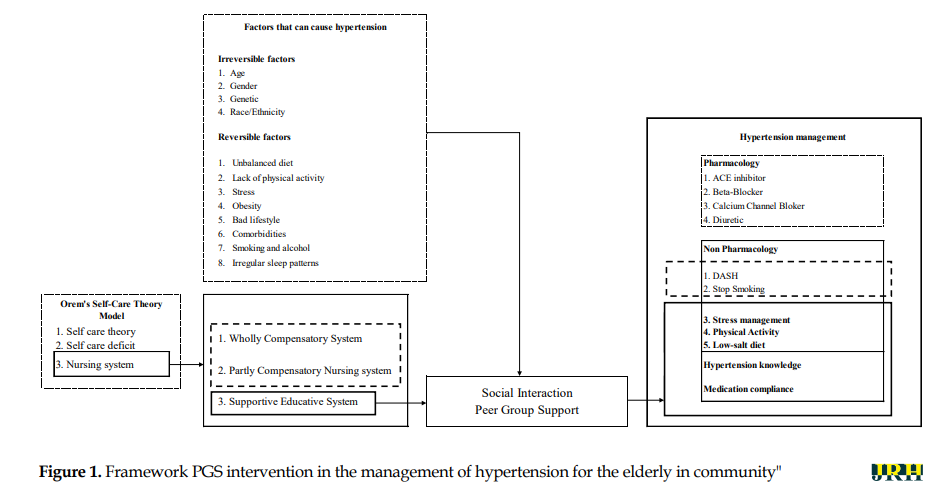
While various studies have confirmed the effectiveness of PGS in hypertension management, its application as a structured framework in community settings remains an area requiring further exploration to enhance self-care capabilities among the elderly [10]. This viewpoint article proposes a novel framework for implementing PGS to manage hypertension in the elderly in the community of Jember Regency, Indonesia. This framework is based on Orem’s self-care theory, which posits that nursing intervention is needed when individuals experience limitations in meeting their self-care needs independently (Figure 1).
The prevalence of hypertension in Indonesia is projected to be 57.1% in 2024 [11], with the condition being the top priority for non-communicable diseases (NCDs) screening [6]. Specifically, East Java Province has a prevalence of 35.0% [12], and Jember Regency ranks second in the province with a prevalence of 6.5% [13]. Data from the UPTD Puskesmas Ajung in Jember Regency in 2023 showed that out of 1 456 elderly with hypertension, 537(36.8%) did not routinely take their medication. This highlights the urgent need for effective interventions in this community.
Orem’s theory, also known as the self-care deficit nursing theory, provides a framework for understanding how PGS can aid elderly individuals with hypertension in self-care. The theory is built on the idea that individuals are capable of self-care, which includes activities they perform to maintain, restore, and promote their health. A “self-care deficit” arises when a person’s ability to perform these activities is less than what their health condition demands. In the context of elderly individuals with hypertension, this deficit may manifest as a lack of knowledge about their condition, difficulty with medication adherence, or challenges in maintaining a healthy lifestyle. Therefore, PGS serves as a supportive-educative nursing system within Orem’s framework. Instead of a nurse taking full responsibility for the patient’s care, the peer group, facilitated by a nurse or other healthcare professional, provides guidance, education, motivation, and a supportive environment [14]. This empowers the elderly individuals to develop their own self-care skills and agency, enabling them to actively manage their hypertension and reduce their self-care deficit. This approach emphasizes patient autonomy and responsibility, with the ultimate goal of improving their health outcomes and quality of life. This framework uses Orem’s self-care theory as a basis for intervention, which is particularly relevant when elderly individuals have a decreased self-care capacity or become dependent. PGS has been proven to be effective practical approach in hypertension management, especially among the elderly [14]. This support can improve the psychological well-being of the elderly by reducing loneliness and feelings of isolation, which positively impacts hypertension management.
Practical strategies are recommended to increase the effectiveness of peer support. Peer groups should be structured with clear goals, such as monitoring blood pressure, adhering to medication schedules, and engaging in light physical activity. Additionally, group members should share their feelings and concerns related to their health, as emotional support can help reduce depression and improve commitment to positive lifestyle changes. Turan et al. [15] found that participants in a support group reported greater treatment adherence and improved hypertension control. When individuals feel supported and accountable to their group, they are more likely to remain committed to their treatment plans.
Conclusion
This framework provides a practical strategy to leverage a peer group’s social dynamics to create a supportive environment that promotes motivation and adherence to treatment. Further studies are recommended to examine the effectiveness of this PGS framework in the management of other NCDs, such as diabetes mellitus.
Ethical Considerations
Compliance with ethical guidelines
There were no ethical considerations to be considered in this research.
Funding
This research was financially supported by the Directorate of Research and Community Service, Ministry of Higher Education, Science, and Technology (Code: PPS-PTM) and extracted fron master thesis of Khoirul Romadhan, approved by Universitas Jember, Jember, Indonesia (No.: 072/C3/DT.05.00/PL/2025).
Authors' contributions
Data extraction: Khoirul Romadhan; Review and editing: Tantut Susanto; Conceptualization, supervision, and writing the original draft: All authors;
Conflict of interest
The authors declared no conflicts of interest.
Acknowledgments
The authors extend their appreciation to the Research and Community Service Institution of the Universitas Jember for facilitating PPS-PTM scheme research.
References
Hypertension is a serious health problem and one of the most common diseases experienced by the elderly [1]. This condition is often triggered by physiological changes associated with aging. Poor management of hypertension in the elderly can lead to serious complications and even fatality [2]. Research has shown that hypertension can be significantly controlled with a proper management approach [3]. Crucial factors in managing hypertension include knowledge of the condition, physical activity, a low-salt diet, adherence to medication, and stress management [3–5]. Given these factors, there is a clear need for effective interventions to improve hypertension management in this population. The third sustainable development goal, a healthy and prosperous life, is directly concerned with reducing the prevalence of hypertension among the elderly, as outlined in the 2030 Agenda for Sustainable Development.
Concerns about the rising prevalence of hypertension in Indonesia have prompted a global strategy with three main pillars: Surveillance, strengthening the health service system, and primary prevention. This global strategy is supported by the primary service integration (integrasi layanan primer [ILP]) program of Public Health Centers (Pusat Kesehatan Masyarakat/Puskesmas) [6]. The ILP aims to provide comprehensive services—promotive, preventive, curative, rehabilitative, and palliative—to adults and the elderly. Primary prevention, in particular, focuses on improving health and promoting awareness so individuals have the knowledge and ability to manage their disease [7]. One such preventive strategy can be implemented within the community [8]. A powerful intervention is the formation of social support networks, such as peer group support (PGS) for the elderly [9].
While various studies have confirmed the effectiveness of PGS in hypertension management, its application as a structured framework in community settings remains an area requiring further exploration to enhance self-care capabilities among the elderly [10]. This viewpoint article proposes a novel framework for implementing PGS to manage hypertension in the elderly in the community of Jember Regency, Indonesia. This framework is based on Orem’s self-care theory, which posits that nursing intervention is needed when individuals experience limitations in meeting their self-care needs independently (Figure 1).
The prevalence of hypertension in Indonesia is projected to be 57.1% in 2024 [11], with the condition being the top priority for non-communicable diseases (NCDs) screening [6]. Specifically, East Java Province has a prevalence of 35.0% [12], and Jember Regency ranks second in the province with a prevalence of 6.5% [13]. Data from the UPTD Puskesmas Ajung in Jember Regency in 2023 showed that out of 1 456 elderly with hypertension, 537(36.8%) did not routinely take their medication. This highlights the urgent need for effective interventions in this community.
Orem’s theory, also known as the self-care deficit nursing theory, provides a framework for understanding how PGS can aid elderly individuals with hypertension in self-care. The theory is built on the idea that individuals are capable of self-care, which includes activities they perform to maintain, restore, and promote their health. A “self-care deficit” arises when a person’s ability to perform these activities is less than what their health condition demands. In the context of elderly individuals with hypertension, this deficit may manifest as a lack of knowledge about their condition, difficulty with medication adherence, or challenges in maintaining a healthy lifestyle. Therefore, PGS serves as a supportive-educative nursing system within Orem’s framework. Instead of a nurse taking full responsibility for the patient’s care, the peer group, facilitated by a nurse or other healthcare professional, provides guidance, education, motivation, and a supportive environment [14]. This empowers the elderly individuals to develop their own self-care skills and agency, enabling them to actively manage their hypertension and reduce their self-care deficit. This approach emphasizes patient autonomy and responsibility, with the ultimate goal of improving their health outcomes and quality of life. This framework uses Orem’s self-care theory as a basis for intervention, which is particularly relevant when elderly individuals have a decreased self-care capacity or become dependent. PGS has been proven to be effective practical approach in hypertension management, especially among the elderly [14]. This support can improve the psychological well-being of the elderly by reducing loneliness and feelings of isolation, which positively impacts hypertension management.
Practical strategies are recommended to increase the effectiveness of peer support. Peer groups should be structured with clear goals, such as monitoring blood pressure, adhering to medication schedules, and engaging in light physical activity. Additionally, group members should share their feelings and concerns related to their health, as emotional support can help reduce depression and improve commitment to positive lifestyle changes. Turan et al. [15] found that participants in a support group reported greater treatment adherence and improved hypertension control. When individuals feel supported and accountable to their group, they are more likely to remain committed to their treatment plans.
Conclusion
This framework provides a practical strategy to leverage a peer group’s social dynamics to create a supportive environment that promotes motivation and adherence to treatment. Further studies are recommended to examine the effectiveness of this PGS framework in the management of other NCDs, such as diabetes mellitus.
Ethical Considerations
Compliance with ethical guidelines
There were no ethical considerations to be considered in this research.
Funding
This research was financially supported by the Directorate of Research and Community Service, Ministry of Higher Education, Science, and Technology (Code: PPS-PTM) and extracted fron master thesis of Khoirul Romadhan, approved by Universitas Jember, Jember, Indonesia (No.: 072/C3/DT.05.00/PL/2025).
Authors' contributions
Data extraction: Khoirul Romadhan; Review and editing: Tantut Susanto; Conceptualization, supervision, and writing the original draft: All authors;
Conflict of interest
The authors declared no conflicts of interest.
Acknowledgments
The authors extend their appreciation to the Research and Community Service Institution of the Universitas Jember for facilitating PPS-PTM scheme research.
References
- World Health Organization (WHO). World hypertension day 2024: Measure your blood pressure accurately, control it, live longer [Internet]. 2024 [Updated 2024 May 17]. Available from: [Link]
- Pratiwi RD, Rahmawati I, Intiyaskanti RO, Saadah NU, Sholeh B, Susanto T. Hypertension health education and hypertension exercise training in the elderly at Wisma Cempaka UPT PSTW Jember. Journal of Health Community Service. 2023; 3(1):9-15. [Link]
- Susanto T, Rasny H, Kurdi F, Yunanto RA, Rahmawati I. Management of hypertension using a plant-based diet among farmers: Protocol for a mixed methods study. JMIr Research Protocols. 2023; 12:e41146. [DOI:10.2196/41146] [PMID]
- Afandi Y, Cristina D, Alfionita N, Sholikah S, Susanto T. Implementation of the hypertension preventetion program through hypertension exercise for the elderly at wisma cempaka upt pstw puger jember regency. Journal of Health Community Service. 2022; 2(3):76-87. [DOI:10.33086/jhcs.v2i3.3142]
- Mustapa GW, Susanto T, Asmaningrum N. Risk factors of hypertension in the elderly within the family: A literature review. Care: Jurnal Ilmiah Ilmu Kesehatan. 2025; 13(2):242-54. [Link]
- Badan Pusat Statistik. Statistik Penduduk Lanjut Usia 2024 [Internet]. 2024 [Updated 2025 December 20]. Available from: [Link]
- Kementrian Kesehatan RI, Keputusan Menteri Kesehatan Republik Indonesia Nomor HK.01.07/MENKES/2015/2023. Jakarta: Kenenterian Kesehatan Republic of Andonesia; 2023. [Link]
- Kementerian Kesehatan RI. Asma [Interenet]. 2024 [Updated 2024 October 10]. Available from: [Link]
- Ikafah I. Profil kesehatan provinsi jawa timur tahun 2023,” BMC Public Health. 2023; 2(1):1-8. [Link]
- United Nations. Transforming our world: The 2030 agenda for sustainable development [Internet]. 2024 [Updated 2024 December 29]. Available from: [Link]
- Fajriyah NN, Abdullah A, Amrullah AJ. Dukungan sosial keluarga pada pasien hipertensi. Jurnal Ilmiah Kesehatan. 2016; 9(2):97000. [Link]
- Khoirunisak N, Susanto T, Miftahurroziqin MA, Kurdi F, Putra AJ, Agustina DN. [Education and increasing community knowledge about the benefits of vegetables and fruits for hypertension response community groups in sumbersalak, jember regency (Indonesian)]. Jurnal Pengabdian Masyarakat: Svasta Harena. 2023; 3(1):29-38. [DOI:10.33860/jpmsh.v3i1.2562]
- Haidari A, Moeini M, Khosravi A. Effect of the peer supportive program on blood pressure changes in patients affected with hypertension: A randomized controlled trial. International Journal of Medical Research & Health Sciences. 2016; 5(7):98-102. [Link]
- Cahayati E, Lestari N. Pengaruh peer group education terhadap kualitas hidup dengan hipertensi di posyandu lansia desa sumberbendo kecamatan pare kabupaten kediri. Jurnal Ilkes. 2018; 9(1):75-84. [Link]
- Turan GB, Aksoy M, Çiftçi B. Effect of social support on the treatment adherence of hypertension patients. Journal of Vascular Nursing. 2019; 37(1):46-51. [DOI:10.1016/j.jvn.2018.10.005.] [PMID]
Type of Study: Viewpoint |
Subject:
● Health Education
Received: 2025/07/9 | Accepted: 2025/08/26 | Published: 2026/01/1
Received: 2025/07/9 | Accepted: 2025/08/26 | Published: 2026/01/1
| Rights and permissions | |
 |
This work is licensed under a Creative Commons Attribution-NonCommercial 4.0 International License. |


This is an open access article distributed under the terms of the Creative Commons Attribution License (CC-By-NC), which permits use, distribution, and reproduction in any medium, provided the original work is properly cited and is not used for commercial purposes.
Contact Information
