

Volume 16, Issue 4 (Jul & Aug 2026)
J Research Health 2026, 16(4): 417-422 |
Back to browse issues page



Ethics code: IR.IAU.ZAH.REC.1403.031


Download citation:
BibTeX | RIS | EndNote | Medlars | ProCite | Reference Manager | RefWorks
Send citation to:


BibTeX | RIS | EndNote | Medlars | ProCite | Reference Manager | RefWorks
Send citation to:
Sarparastrazmju P. Breastfeeding Self-efficacy and Its Associated Factors in Iranian Postpartum Women: A Cross-sectional Study. J Research Health 2026; 16 (4) :417-422
URL: http://jrh.gmu.ac.ir/article-1-2855-en.html
URL: http://jrh.gmu.ac.ir/article-1-2855-en.html


Department of Midwifery, ZAH.C., Islamic Azad University, Zahedan, Iran. , p.sarparastrazmju@iau.ac.ir
Full-Text [PDF 529 kb]
(75 Downloads)
| Abstract (HTML) (603 Views)
References
Full-Text: (8 Views)
Introduction
Breastfeeding is the normative standard for infant feeding and is beneficial to the health of both mothers and infants. Numerous studies in developed and developing countries have provided strong evidence that breastfeeding decreases the incidence and/or severity of a wide range of diseases in infants and mothers [1]. Thus, international and national organizations have promoted exclusive breastfeeding (EBF) for the first 6 months of life [2, 3]. The World Health Organization (WHO) recommends that all babies receive EBF during the first 6 months of life and continue breastfeeding, along with complementary foods, until at least age 2 [4]. However, the rates of EBF remain low worldwide, with only 36% of babies under 6 months receiving it [5]. Breastfeeding immediately after birth also helps the uterus contract, reducing the mother’s postpartum blood loss [6]. Similar to many countries worldwide, in Japan, many mothers prematurely discontinue EBF against their prenatal intention to breastfeed. Although a nationwide survey reported that 96% of Japanese women intend to breastfeed prenatally [1], many start supplementation with infant formula after delivery. In a study conducted in Europe, in Spain, the EBF rate was 25.4% at 6 months and 7.7% at 2 years [7]. It has been reported that the EBF rate in Iran at the national level is 56.8% at four months and 27.7% at six months. This amount is 56% in four months and 27% in six months in urban areas and 58% in four months and 29% in six months in rural areas [8]. Recently, maternal breastfeeding self-efficacy has been highlighted as an important psychometric factor for improving breastfeeding outcomes [9]. Breastfeeding self-efficacy is defined as a mother’s confidence in her ability to breastfeed her new infant [10] and has been positively associated with breastfeeding duration and exclusivity in various cultures and age groups [11]. Theoretically, breastfeeding self-efficacy is influenced by the following four main sources of information: Performance accomplishments (e.g. past breastfeeding experiences), vicarious experiences (e.g. watching other women breastfeed, peer counseling), verbal persuasion (e.g. encouragement from influential others such as friends, family, and lactation consultants), and influence of one’s physiological and/or affective states (e.g. pain, fatigue, anxiety, and stress) [12-15]. International studies have shown a connection between the following factors and the mother’s intention to exclusively breastfeed: Positive attitudes toward EBF, perceived social support and monitoring of behaviour, previous experience with EBF, the mother being breastfed as a baby, older maternal age, and a high level of education and knowledge of the benefits of EBF [16-19]. Little is known about breastfeeding self-efficacy and sociocultural factors in the early postpartum period among Iranian women. However, evidence in this field is lacking, especially regarding the population residing in Zahedan City, Iran. This study was conducted to identify mothers at risk of stopping breastfeeding due to low breastfeeding self-efficacy. This study aimed to evaluate breastfeeding self-efficacy and associated socio-demographic and obstetric factors among women in the early postpartum period in Zahedan City.
Methods
Study design
This cross-sectional study was conducted among 228 postpartum mothers within the last 24 hours and examined breastfeeding self-efficacy of mothers and associated factors at Zahedan Social Security Hospital. The study population consisted of all mothers who had given birth either vaginally or by cesarean section. The inclusion criteria included women who had given birth in the hospital within the past 24 h to a healthy, live, full-term infant, with no known abnormalities, an intention to breastfeed, no readmission of the mother or baby to the hospital, no history of infertility, and no history of any physical or mental illness, as well as no self-reported addiction to smoking, alcohol, or drugs.
Study sample
In this study, the sample size was estimated based on findings from similar studies, considering 95% confidencee interval, a standard deviation of 7.65, and an acceptable margin of error of 1. The required sample size in this study was estimated to be 230 postpartum mothers (occurring within at least 24 hours after delivery) [8]. The respondents of this study were 228 postpartum mothers. Sampling was performed continuously for three months.
Study instrument
The questionnaire was composed of two parts: the sociodemographic and obstetric characteristics section and the breastfeeding self-efficacy scale. The sociodemographic and obstetric characteristics section included age, mother’s education, spouse’s education, mother’s occupation, spouse’s occupation, income level, place of residence, gravidity, type of delivery, gender of the baby, skin-to-skin contact, skin-to-skin contact time, time of the first breastfeeding, and number of breastfeeding times in 24 hours. Exploratory factor analysis demonstrated appropriate construct validity. The second part of the questionnaire was the breastfeeding self-efficacy scale short form (BSES-SF). The BSES-SF consists of 13 items rated on a 5-point Likert scale ranging from always confident (score 5) to not at all confident (score 1). The total score for each item reflects the breastfeeding self-efficacy score, with minimum and maximum scores of 13 and 65, respectively. Higher scores indicate greater breastfeeding self-efficacy [10]. According to the psychometric analysis of the Persian version of the BSES-SF by Araban et al. exploratory factor analysis demonstrated its appropriate construct validity, and its desirable reliability was confirmed by a Cronbach’s α of 91% [12]. In this study, Cronbach’s α was used to assess the scale’s internal reliability, yielding 92.7%.
Data collection
Eligible mothers were selected using convenience sampling from April to June 2024. Data were collected through a survey interview using a questionnaire. Postpartum mothers were interviewed in the postnatal care section of the Social Security Hospital. Informed consent was obtained from the mothers prior to the interviews.
Data analysis
Frequencies and percentages were computed to describe the sociodemographic and obstetric characteristics of the mothers. The Kolmogorov-Smirnov test was used to assess data normality, but the data were not normal; therefore, non-parametric tests were used for statistical analysis. SPSS software, version 22 was used for descriptive and analytical statistics. A significance level of <0.05 was considered. Finally, Mann-Whitney, Kruskal-Wallis, and Spearman correlation analyses were performed to determine the relationship between breastfeeding self-efficacy and sociodemographic and obstetric characteristics.
Results
The average age of mothers was 28.14±6.7 years, and the average self-efficacy score among the participants was 47.02±11.92. The data presented in Table 1 show a statistically significant difference in breastfeeding self-efficacy according to sociodemographic variables.
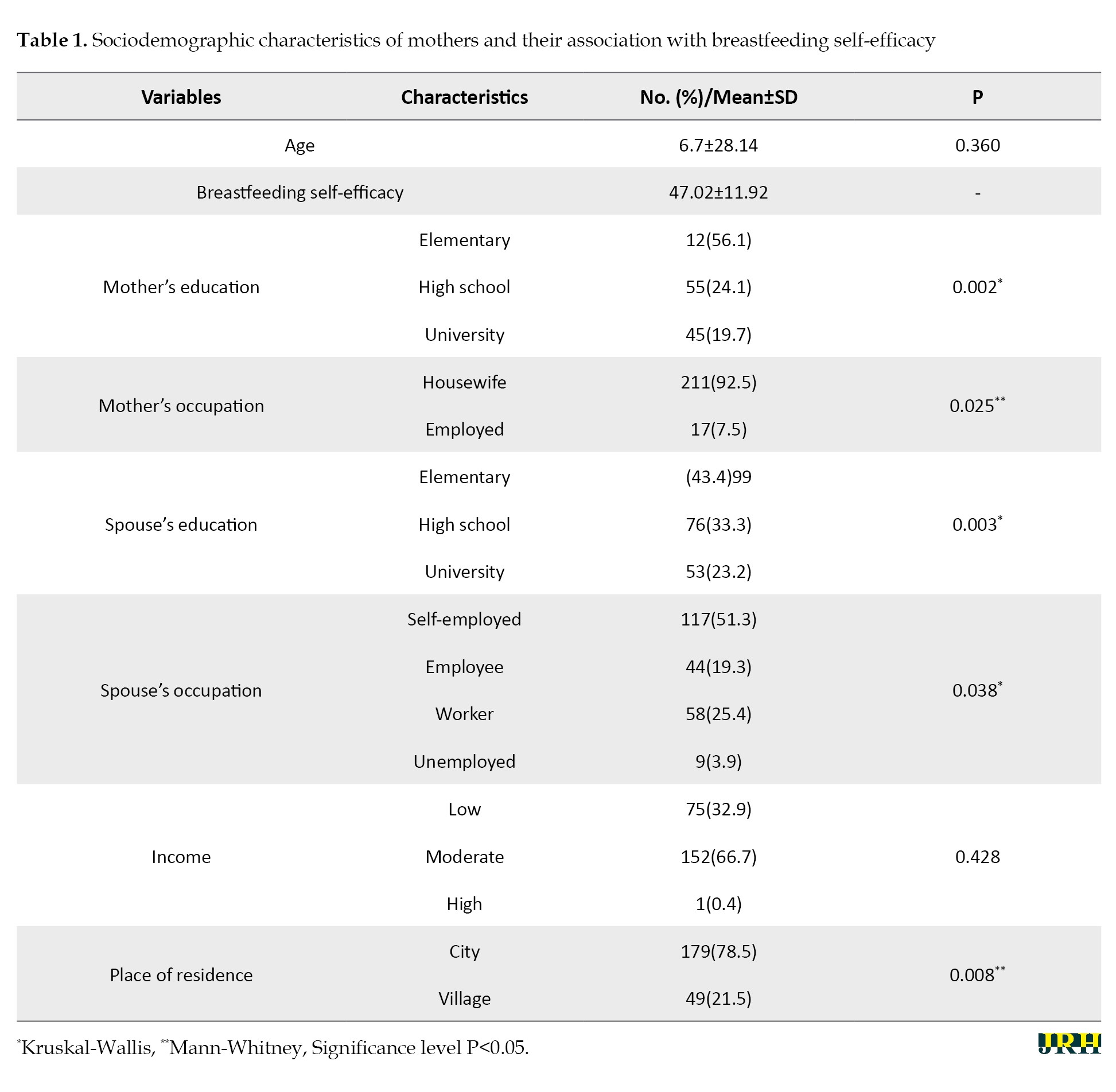
Among socio-demographic factors, a statistically significant difference was observed between breastfeeding self-efficacy and mother’s education (P=0.002), mother’s occupation (P=0.025), spouse’s education (P=0.003), spouse’s occupation (P=0.038), and place of residence (P=0.008). Table 2 presents the statistically significant differences between obstetric variables and breastfeeding self-efficacy.
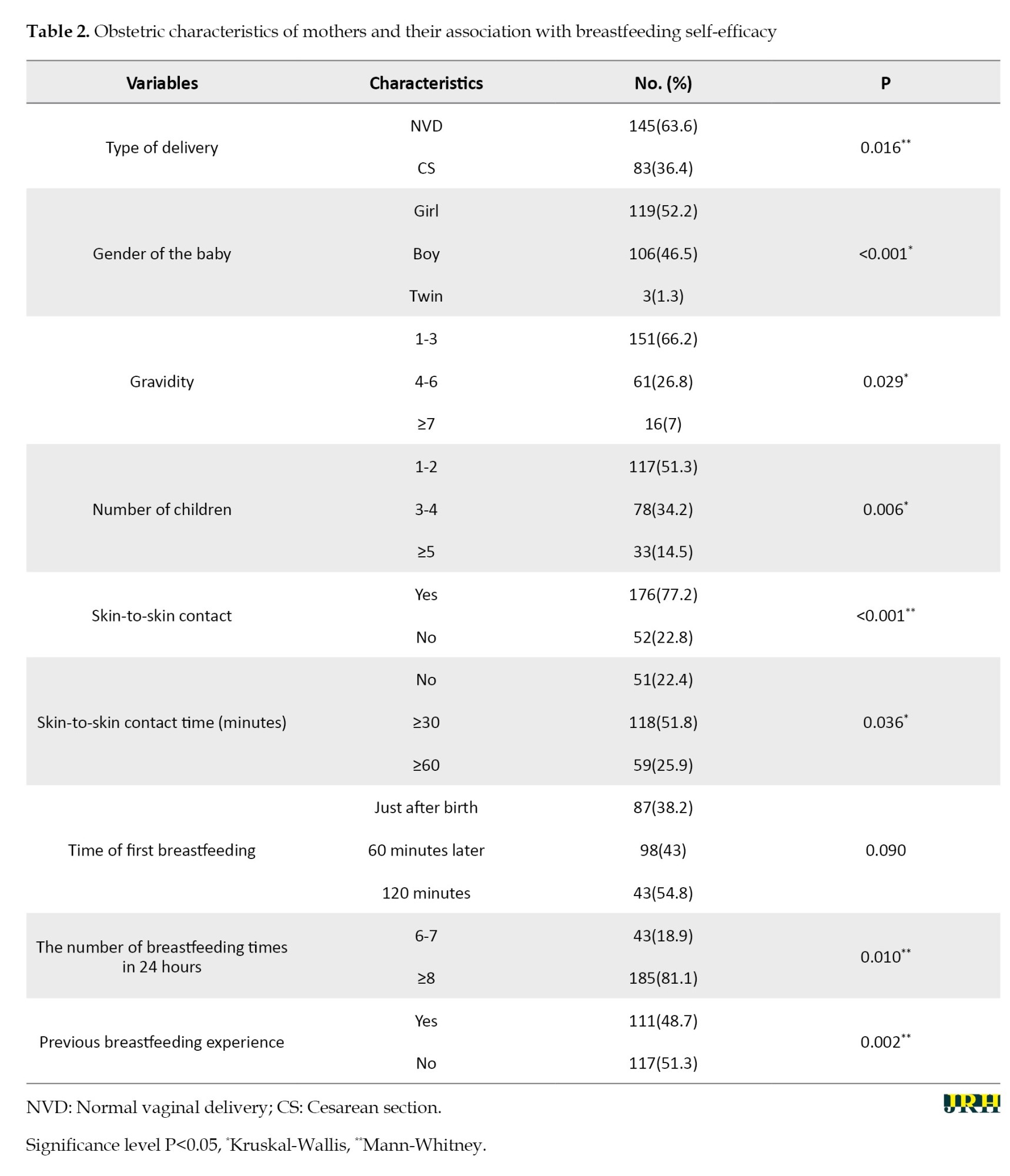
Among obstetric factors, a statistically significant difference was observed between breastfeeding self-efficacy and gravidity (P=0.029), number of children (P=0.006), type of delivery (P=0.016), gender of the baby (P<0.001), skin-to-skin contact (P<0.001), skin-to-skin contact time (P=0.036), number of breastfeeding times in 24 hours (P=0.010), and previous breastfeeding experience (P=0.002).
Discussion
The results showed a significant relationship between self-efficacy and baby gender, which was inconsistent with the study by Moafi et al. [8]. In our study, a significant relationship was observed between self-efficacy and the number of pregnancies and children, consistent with previous studies [8, 20]. A significant and positive relationship was observed among breastfeeding self-efficacy, previous breastfeeding experience, and the timing of first breastfeeding, consistent with Bandura’s theory. Bandura believed that having breastfeeding experience is a contributing factor to breastfeeding self-efficacy [21]. Moreover, Brandao reported that breastfeeding self-efficacy can help identify pregnant women at higher risk of prematurely discontinuing breastfeeding and who may require additional intervention from health providers to ensure breastfeeding success [22]. Adequate nutrition during infancy and early childhood is essential to ensure that children reach their full potential in terms of growth, health, and development [4]. Early nutritional deficiencies have been linked to long-term growth and health problems [5]. The demonstrated benefits of breastfeeding and its superiority over formula feeding are now undisputed, as reflected in the WHO and UNICEF recommendations for optimal infant feeding. It is set out in the Global Strategy to include EBF for the first 6 months of life and the introduction of adequate and safe complementary foods from six months, with continued breastfeeding up to two years or beyond [4 ,5, 19]. This study revealed no significant relationship between breastfeeding self-efficacy and maternal age. This finding is consistent with the study by Gonzales [6]. In this study, a significant relationship was observed between the level of the mother’s education, the spouse’s education, the mother’s occupation, the spouse’s occupation and self-efficacy. These data contradict those obtained in other studies [6, 16]. A significant relationship was observed between breastfeeding self-efficacy and place of residence, inconsistent with the results of the study by Moafi et al. [8]. The results of the study showed a significant relationship between breastfeeding self-efficacy and delivery type, which is in contrast to Dilk’s study in Turkey [20].
The limitation of this study was that the sample consisted of postpartum women who presented to the Social Security Hospital in Zahedan City. This research does not claim that the findings are representative of all women in Zahedan City. It is difficult to state that the sample used fully represented the sociocultural groups living in the province. It is important to conduct further studies to assess the scale’s psychometric properties across different groups. Another limitation of this study was its cross-sectional design, which means that the relationships between breastfeeding self-efficacy and sociodemographic variables do not necessarily imply causation. Therefore, interventions to enhance breastfeeding self-efficacy are promising to improve EBF.
Conclusion
In conclusion, 13 factors were identified related to breastfeeding self-efficacy: Maternal education, spouse’s education, maternal occupation, spouse’s job, place of residence, previous experience of breastfeeding, number of pregnancies, having two or more children, type of delivery, gender of the baby, skin-to-skin contact, skin-to-skin contact time, and number of breastfeeding times in 24 hours. Considering the effects of demographic and obstetric factors, it is suggested that more training and counseling be provided to at-risk groups to improve breastfeeding self-efficacy.
Ethical Considerations
Compliance with ethical guidelines
This study was approved by the Ethics Committee of Islamic Azad University, Zahedan Branch, Zahedan, Iran (Code: IR.IAU.ZAH.REC.1403.031).
Funding
The Islamic Azad University, Zahedan Branch Iran funded this study.
Acknowledgments
The author acknowledge the contributions of the mothers who participated in this research and the university research institute.
Breastfeeding is the normative standard for infant feeding and is beneficial to the health of both mothers and infants. Numerous studies in developed and developing countries have provided strong evidence that breastfeeding decreases the incidence and/or severity of a wide range of diseases in infants and mothers [1]. Thus, international and national organizations have promoted exclusive breastfeeding (EBF) for the first 6 months of life [2, 3]. The World Health Organization (WHO) recommends that all babies receive EBF during the first 6 months of life and continue breastfeeding, along with complementary foods, until at least age 2 [4]. However, the rates of EBF remain low worldwide, with only 36% of babies under 6 months receiving it [5]. Breastfeeding immediately after birth also helps the uterus contract, reducing the mother’s postpartum blood loss [6]. Similar to many countries worldwide, in Japan, many mothers prematurely discontinue EBF against their prenatal intention to breastfeed. Although a nationwide survey reported that 96% of Japanese women intend to breastfeed prenatally [1], many start supplementation with infant formula after delivery. In a study conducted in Europe, in Spain, the EBF rate was 25.4% at 6 months and 7.7% at 2 years [7]. It has been reported that the EBF rate in Iran at the national level is 56.8% at four months and 27.7% at six months. This amount is 56% in four months and 27% in six months in urban areas and 58% in four months and 29% in six months in rural areas [8]. Recently, maternal breastfeeding self-efficacy has been highlighted as an important psychometric factor for improving breastfeeding outcomes [9]. Breastfeeding self-efficacy is defined as a mother’s confidence in her ability to breastfeed her new infant [10] and has been positively associated with breastfeeding duration and exclusivity in various cultures and age groups [11]. Theoretically, breastfeeding self-efficacy is influenced by the following four main sources of information: Performance accomplishments (e.g. past breastfeeding experiences), vicarious experiences (e.g. watching other women breastfeed, peer counseling), verbal persuasion (e.g. encouragement from influential others such as friends, family, and lactation consultants), and influence of one’s physiological and/or affective states (e.g. pain, fatigue, anxiety, and stress) [12-15]. International studies have shown a connection between the following factors and the mother’s intention to exclusively breastfeed: Positive attitudes toward EBF, perceived social support and monitoring of behaviour, previous experience with EBF, the mother being breastfed as a baby, older maternal age, and a high level of education and knowledge of the benefits of EBF [16-19]. Little is known about breastfeeding self-efficacy and sociocultural factors in the early postpartum period among Iranian women. However, evidence in this field is lacking, especially regarding the population residing in Zahedan City, Iran. This study was conducted to identify mothers at risk of stopping breastfeeding due to low breastfeeding self-efficacy. This study aimed to evaluate breastfeeding self-efficacy and associated socio-demographic and obstetric factors among women in the early postpartum period in Zahedan City.
Methods
Study design
This cross-sectional study was conducted among 228 postpartum mothers within the last 24 hours and examined breastfeeding self-efficacy of mothers and associated factors at Zahedan Social Security Hospital. The study population consisted of all mothers who had given birth either vaginally or by cesarean section. The inclusion criteria included women who had given birth in the hospital within the past 24 h to a healthy, live, full-term infant, with no known abnormalities, an intention to breastfeed, no readmission of the mother or baby to the hospital, no history of infertility, and no history of any physical or mental illness, as well as no self-reported addiction to smoking, alcohol, or drugs.
Study sample
In this study, the sample size was estimated based on findings from similar studies, considering 95% confidencee interval, a standard deviation of 7.65, and an acceptable margin of error of 1. The required sample size in this study was estimated to be 230 postpartum mothers (occurring within at least 24 hours after delivery) [8]. The respondents of this study were 228 postpartum mothers. Sampling was performed continuously for three months.
Study instrument
The questionnaire was composed of two parts: the sociodemographic and obstetric characteristics section and the breastfeeding self-efficacy scale. The sociodemographic and obstetric characteristics section included age, mother’s education, spouse’s education, mother’s occupation, spouse’s occupation, income level, place of residence, gravidity, type of delivery, gender of the baby, skin-to-skin contact, skin-to-skin contact time, time of the first breastfeeding, and number of breastfeeding times in 24 hours. Exploratory factor analysis demonstrated appropriate construct validity. The second part of the questionnaire was the breastfeeding self-efficacy scale short form (BSES-SF). The BSES-SF consists of 13 items rated on a 5-point Likert scale ranging from always confident (score 5) to not at all confident (score 1). The total score for each item reflects the breastfeeding self-efficacy score, with minimum and maximum scores of 13 and 65, respectively. Higher scores indicate greater breastfeeding self-efficacy [10]. According to the psychometric analysis of the Persian version of the BSES-SF by Araban et al. exploratory factor analysis demonstrated its appropriate construct validity, and its desirable reliability was confirmed by a Cronbach’s α of 91% [12]. In this study, Cronbach’s α was used to assess the scale’s internal reliability, yielding 92.7%.
Data collection
Eligible mothers were selected using convenience sampling from April to June 2024. Data were collected through a survey interview using a questionnaire. Postpartum mothers were interviewed in the postnatal care section of the Social Security Hospital. Informed consent was obtained from the mothers prior to the interviews.
Data analysis
Frequencies and percentages were computed to describe the sociodemographic and obstetric characteristics of the mothers. The Kolmogorov-Smirnov test was used to assess data normality, but the data were not normal; therefore, non-parametric tests were used for statistical analysis. SPSS software, version 22 was used for descriptive and analytical statistics. A significance level of <0.05 was considered. Finally, Mann-Whitney, Kruskal-Wallis, and Spearman correlation analyses were performed to determine the relationship between breastfeeding self-efficacy and sociodemographic and obstetric characteristics.
Results
The average age of mothers was 28.14±6.7 years, and the average self-efficacy score among the participants was 47.02±11.92. The data presented in Table 1 show a statistically significant difference in breastfeeding self-efficacy according to sociodemographic variables.
Among socio-demographic factors, a statistically significant difference was observed between breastfeeding self-efficacy and mother’s education (P=0.002), mother’s occupation (P=0.025), spouse’s education (P=0.003), spouse’s occupation (P=0.038), and place of residence (P=0.008). Table 2 presents the statistically significant differences between obstetric variables and breastfeeding self-efficacy.
Among obstetric factors, a statistically significant difference was observed between breastfeeding self-efficacy and gravidity (P=0.029), number of children (P=0.006), type of delivery (P=0.016), gender of the baby (P<0.001), skin-to-skin contact (P<0.001), skin-to-skin contact time (P=0.036), number of breastfeeding times in 24 hours (P=0.010), and previous breastfeeding experience (P=0.002).
Discussion
The results showed a significant relationship between self-efficacy and baby gender, which was inconsistent with the study by Moafi et al. [8]. In our study, a significant relationship was observed between self-efficacy and the number of pregnancies and children, consistent with previous studies [8, 20]. A significant and positive relationship was observed among breastfeeding self-efficacy, previous breastfeeding experience, and the timing of first breastfeeding, consistent with Bandura’s theory. Bandura believed that having breastfeeding experience is a contributing factor to breastfeeding self-efficacy [21]. Moreover, Brandao reported that breastfeeding self-efficacy can help identify pregnant women at higher risk of prematurely discontinuing breastfeeding and who may require additional intervention from health providers to ensure breastfeeding success [22]. Adequate nutrition during infancy and early childhood is essential to ensure that children reach their full potential in terms of growth, health, and development [4]. Early nutritional deficiencies have been linked to long-term growth and health problems [5]. The demonstrated benefits of breastfeeding and its superiority over formula feeding are now undisputed, as reflected in the WHO and UNICEF recommendations for optimal infant feeding. It is set out in the Global Strategy to include EBF for the first 6 months of life and the introduction of adequate and safe complementary foods from six months, with continued breastfeeding up to two years or beyond [4 ,5, 19]. This study revealed no significant relationship between breastfeeding self-efficacy and maternal age. This finding is consistent with the study by Gonzales [6]. In this study, a significant relationship was observed between the level of the mother’s education, the spouse’s education, the mother’s occupation, the spouse’s occupation and self-efficacy. These data contradict those obtained in other studies [6, 16]. A significant relationship was observed between breastfeeding self-efficacy and place of residence, inconsistent with the results of the study by Moafi et al. [8]. The results of the study showed a significant relationship between breastfeeding self-efficacy and delivery type, which is in contrast to Dilk’s study in Turkey [20].
The limitation of this study was that the sample consisted of postpartum women who presented to the Social Security Hospital in Zahedan City. This research does not claim that the findings are representative of all women in Zahedan City. It is difficult to state that the sample used fully represented the sociocultural groups living in the province. It is important to conduct further studies to assess the scale’s psychometric properties across different groups. Another limitation of this study was its cross-sectional design, which means that the relationships between breastfeeding self-efficacy and sociodemographic variables do not necessarily imply causation. Therefore, interventions to enhance breastfeeding self-efficacy are promising to improve EBF.
Conclusion
In conclusion, 13 factors were identified related to breastfeeding self-efficacy: Maternal education, spouse’s education, maternal occupation, spouse’s job, place of residence, previous experience of breastfeeding, number of pregnancies, having two or more children, type of delivery, gender of the baby, skin-to-skin contact, skin-to-skin contact time, and number of breastfeeding times in 24 hours. Considering the effects of demographic and obstetric factors, it is suggested that more training and counseling be provided to at-risk groups to improve breastfeeding self-efficacy.
Ethical Considerations
Compliance with ethical guidelines
This study was approved by the Ethics Committee of Islamic Azad University, Zahedan Branch, Zahedan, Iran (Code: IR.IAU.ZAH.REC.1403.031).
Funding
The Islamic Azad University, Zahedan Branch Iran funded this study.
Acknowledgments
The author acknowledge the contributions of the mothers who participated in this research and the university research institute.
References
- Pirzadeh A, Naghdi A. [Evaluation of mothers’ knowledge, self-efficacy, and performance in the field of exclusive breastfeeding and its related factors in infants less than 6 months of age in Ashkzar city of Yazd province (Persian)]. Tolooe Behdasht. 2022; 20(6):73-84. [Link]
- Section on Breastfeeding. Breastfeeding and the use of human milk. Pediatrics. 2012; 129(3):e827-41. [DOI:10.1542/peds.2011-3552] [PMID]
- WHO, UNICEF. Increasing commitment to breastfeeding through funding and improved policies and programmers’: Global breastfeeding scorecard. Geneva: World Health Organization; 2019. [Link]
- WHO. Infant and young child feeding. Geneva: World Health Organization; 2023. [Link]
- Ballesta-Castillejos A, Gómez-Salgado J, Rodríguez-Almagro J, Ortiz-Esquinas I, Hernández-Martínez A. Factors that influence mothers’ prenatal decision to breastfeed in Spain. International Breastfeeding Journal. 2020; 15(1):97. [DOI:10.1186/s13006-020-00341-5] [PMID] [PMCID]
- Gonzales Jr AM. Breastfeeding self-efficacy of early postpartum mothers in an urban municipality in the Philippines. Asian/Pacific Island Nursing Journal. 2020; 4(4):135-43. [DOI:10.31372/20190404.1023] [PMID] [PMCID]
- Ramiro González MD, Ortiz Marrón H, Arana Cañedo-Argüelles C, Esparza Olcina MJ, Cortés Rico O, Terol Claramonte M, et al. [Prevalence of breastfeeding and factors associated with the start and duration of exclusive breastfeeding in the Community of Madrid among participants in the ELOIN (Spanish)]. Anales de pediatria. 2018; 89(1):32-43. [DOI:10.1016/j.anpedi.2017.09.002] [PMID]
- Moafi F, Asgari S, Yekefalah Z, Momeni M, Hajnasiri H. [Assessment of breastfeeding self-efficacy and patterns and its predictors in mothers living in Qazvin provinc (Persian)]. Nursing and Midwifery Journal. 2018; 15(10):777-87. [Link]
- Hadjiona V, Middleton N, Kouta C, Hadjigeorgiou E, Lambrinou E, Kolokotroni O. Cyprus mothers׳ breast feeding self-efficacy and their perceptions about the implementation of the '10 steps' in the first 48hours after birth. Midwifery. 2016; 36:43-52. [DOI:10.1016/j.midw.2016.02.021] [PMID]
- Dennis CL. The breastfeeding self-efficacy scale: psychometric assessment of the short form. Journal of Obstetric, Gynecologic, & Neonatal Nursing. 2003; 32(6):734-44. [DOI:10.1177/0884217503258459] [PMID] [PMCID]
- Asadi Noghabi F, Yousefi M, Golalipour E, Zarei A, Yousefi H, Amini E. [The effect of educational intervention based on bandura’s social cognitive theory on breastfeeding behaviors of mothers with premature infants: A quasi-experimental study (Persian)]. Journal of Preventive Medicine. 2022; 9(3):256-67. [Link]
- Araban M, Falahiyan Mehrjardi F, Shahry P, Montazeri A. [The Persian version of Breastfeeding Self-Efficacy Scale-Short Form (BSES-SF): translation and psychometric assessment (Persian)]. Payesh. 2016; 15(1:87-93. [Link]
- Sharifirad G, Shahnazi H, Sedighi E, Mahaki B. [The effect of supporter presence in education sessions of breastfeeding on knowledge, attitude and behavior of nulliparous women (Persian)]. Journal of Health. 2018; 9(1):45-61. [Link]
- Callaghan S, Moore RL, Geraghty AA, Yelverton C, McAuliffe F. Examination of weight status, parity and maternal education factors on intentions to breastfeed and breastfeeding duration in an Irish cohort. Proceedings of the Nutrition Society. 2020; 79(OCE2):E158. [DOI:10.1017/S0029665120001068]
- Aghababaei S, Khodakarami B, Farhadian M, Kamali M. [Effectiveness of counseling on mother’s breastfeeding self-efficacy (Persian)]. Avicenna Journal of Nursing and Midwifery Care. 2020; 28(4):83-90. [DOI:10.30699/ajnmc.28.4.84]
- Khorshidifard MS, Sadat Z, Shabanian M, Nasiri S. [The relationship between childbirth satisfaction and breastfeeding self-efficacy in women referring to comprehensive health centers in Kashan (Persian)]. Armaghane-danesh. 2022; 27(1):84-96. [DOI:10.52547/armaghanj.27.1.84]
- Gordani N. [Relationship between breastfeeding self-efficacy and quality of life, self-esteem and general health in breastfeeding mothers referring to Falavarjan health centers (Persian)] [MA thesis]. Tabriz: Tabriz University of Medical Sciences and Health Services; 2017. [Link]
- Satari F, Alami A, Matlabi M, Dogonchi M. [Comparison of the effect of mothers' education by two routine and standardized methods in the enhancement of the self-efficacy of exclusive breastfeeding: An experimental study in the field (Persian)]. Iranian Journal of Health Education and Health Promotion. 2025; 13(3):18-30. [DOI:10.22034/13.3.1]
- International Child Development Centre. Celebrating the innocenti declaration on the protection, promotion and support of breastfeeding: Past achievements, present challenges and priority actions for infant and young child feeding. Florencia: UNICEF; 2006. [Link]
- Konukbay D, Öksüz E, Guvenc G. Breastfeeding self-efficacy in terms of sleep quality, perceived social support, depression and certain variables: A cross-sectional study of postpartum women in Turkey. BMC Pregnancy and Childbirth. 2024; 24(1):231. [DOI:10.1186/s12884-024-06456-5] [PMID] [PMCID]
- Bandura A. Self-efficacy: Toward a unifying theory of behavioral change. Psychological Review. 1977; 84(2):191-215.[DOI:10.1037//0033-295x.84.2.191.] [PMID] [PMCID]
- Brandao S, Mendonca D, Dias CC, Pinto TM, Dennis CL, Figueiredo B. Breastfeeding self-efficacy in Portuguese pregnant women: Bárbara Figueiredo. The European Journal of Public Health. 2017; 27(S 3):ckx186-088. [DOI:10.1093/eurpub/ckx186.088]
Type of Study: Short Communication |
Subject:
● International Health
Received: 2025/07/22 | Accepted: 2025/11/22 | Published: 2026/07/1
Received: 2025/07/22 | Accepted: 2025/11/22 | Published: 2026/07/1
| Rights and permissions | |
 |
This work is licensed under a Creative Commons Attribution-NonCommercial 4.0 International License. |


This is an open access article distributed under the terms of the Creative Commons Attribution License (CC-By-NC), which permits use, distribution, and reproduction in any medium, provided the original work is properly cited and is not used for commercial purposes.
Contact Information
