

Volume 16, Issue 5 (Sep & Oct 2026)
J Research Health 2026, 16(5): 479-486 |
Back to browse issues page



Ethics code: IR.MUMS.FHMPM.REC.1401.058


Download citation:
BibTeX | RIS | EndNote | Medlars | ProCite | Reference Manager | RefWorks
Send citation to:


BibTeX | RIS | EndNote | Medlars | ProCite | Reference Manager | RefWorks
Send citation to:
Mousaei I, Moradi A, Mosa Farkhani E, Satarzadeh L, Asif Kabir M, Vafaee Najar A. Enhancing Hospital Service Quality in Afghanistan: A Patient-centered SERVQUAL Evaluation. J Research Health 2026; 16 (5) :479-486
URL: http://jrh.gmu.ac.ir/article-1-2802-en.html
URL: http://jrh.gmu.ac.ir/article-1-2802-en.html
Iman Mousaei1 

 , Amin Moradi1 , Ehsan Mosa Farkhani1 , Laleh Satarzadeh2 , Mohammad Asif Kabir2 , Ali Vafaee Najar *3
1- Department of Epidemiology, School of Health, Mashhad University of Medical Sciences, Mashhad, Iran.
2- Department of Health Economic and Management Sciences, School of Health, Mashhad University of Medical Sciences, Mashhad, Iran.
3- Department of Health Economic and Management Sciences, School of Health, Mashhad University of Medical Sciences, Mashhad, Iran. ,vafaeea@mums.ac.ir
2- Department of Health Economic and Management Sciences, School of Health, Mashhad University of Medical Sciences, Mashhad, Iran.
3- Department of Health Economic and Management Sciences, School of Health, Mashhad University of Medical Sciences, Mashhad, Iran. ,
Full-Text [PDF 615 kb]
(22 Downloads)
| Abstract (HTML) (785 Views)
Full-Text: (23 Views)
Introduction
Delivering high-quality healthcare is a global priority, and hospitals serve as critical institutions tasked with providing effective, patient-centered care [1]. Quality of care encompasses multiple dimensions, including patient satisfaction, a key indicator of healthcare service success that reflects the alignment between patients’ expectations and their actual experiences [2]. Patient satisfaction influences trust, loyalty, and healthcare utilization; hospitals that meet patient expectations through seamless, coordinated, and humanistic care foster confidence and promote positive health outcomes [1, 2]. Conversely, suboptimal service quality erodes trust and diminishes patient satisfaction, particularly in resource-constrained settings [3].
In low- and middle-income countries (LMICs), healthcare systems face significant challenges due to limited resources, inadequate infrastructure, and socioeconomic instability [4, 5]. Recent studies have shown that patient-reported quality of care in LMICs is strongly influenced by person-centered care factors, including communication, respect, and emotional support [4]. Additionally, differences in the conceptualization and measurement of healthcare quality across LMICs highlight the need for validated instruments that capture local contexts [5].
Afghanistan presents a particularly challenging environment for healthcare delivery. Following decades of conflict and the political transition in August 2021, the country’s health system has experienced critical underfunding and severe resource constraints [6, 7]. The World Health Organization (WHO) reported in 2023 that Afghanistan’s healthcare infrastructure is severely under-resourced, especially in underserved areas where access remains vulnerable due to the ongoing humanitarian crisis [6]. Healthcare collapse has been attributed to political turmoil, natural catastrophes, and insufficient international aid, leading to shortages of medical equipment, trained staff, and basic hospital amenities [8]. These constraints create substantial gaps between patient expectations and the quality of care received, particularly in urban centers, such as Herat City, Afghanistan, where public and private hospitals serve large populations but struggle to meet demand [9, 10].
Understanding service quality gaps is essential for improving healthcare delivery in such contexts [3]. Service quality is a strategic differentiator that enhances hospital competitiveness and patient retention [1, 2]. The SERVQUAL model, developed by Parasuraman et al. (1988), remains a widely used framework for assessing healthcare service quality by measuring the gap between patient expectations and perceptions across five dimensions: Tangibles, reliability, responsiveness, assurance, and empathy [11]. This model has been successfully applied in various Asian countries and remains an effective tool for identifying quality factors and measuring patient satisfaction [12, 13]. Recent systematic reviews have confirmed that SERVQUAL is particularly valuable in LMICs, where patient perspectives are often underutilized in quality assessments [3, 13, 14]. Research across multiple countries has demonstrated that service quality directly impacts patient satisfaction and behavioral intentions, such as hospital choice and return visits [1, 15].
Despite global efforts to improve healthcare quality, significant shortcomings persist in meeting patient expectations, particularly in developing nations [3]. Health service quality in LMICs is often characterized by management challenges, workforce constraints, and community engagement issues [16]. Regular evaluation of patient perspectives is critical to identify priority areas for improvement and ensure equitable, patient-centered care [2, 5]. However, such evaluations remain scarce in Afghanistan, where systemic barriers and limited research on patient experiences compound healthcare challenges [9, 10].
This study aimed to apply the SERVQUAL model to assess gaps between patient expectations and perceptions of healthcare services in public and private hospitals in Herat City, Afghanistan. Given the unique context of Afghanistan’s healthcare system—marked by recent political upheaval and ongoing resource limitations [6-8]—this research provides timely insights into service quality from the patient perspective. The findings will offer actionable evidence to guide strategies to enhance hospital service quality and improve patient experiences in one of the world’s most challenging healthcare environments [9, 10].
Methods
Study design and setting
This cross-sectional study was conducted from July to December 2022 in eight hospitals in Herat City, including public, private, and NGO facilities. The hospitals varied in size and capacity, with bed counts ranging from 20 to 65 and staff ranging from approximately 70 to 250. The only governmental hospital (Herat Regional Hospital) had the highest capacity (65 beds, 150–200 staff), while private hospitals such as Ghalib, Mofid, Loghman Hakim, Kimia, and Afghan Turkman operated with 20–50 beds and similar staffing levels. Two NGO hospitals (Iran Clinic and Red Crescent) provided outpatient and limited inpatient services with smaller capacities.
The study population included Dari-speaking Afghan inpatients aged ≥18 years who could provide informed consent. Patients with critical illness, cognitive impairment, or unwillingness to participate were excluded.
Sample size and sampling
The sample size was calculated as 337 using Cochran’s formula (Equation 1):

With Z=1.96 (95% CI), P=0.676 (prior satisfaction rate [17]), and d=0.05 (margin of error).
To ensure simple random sampling, patient lists were first obtained from each public and private hospital in Herat City. The number of participants from each hospital was determined proportionally based on inpatient volume. Within each hospital, department-level lists (e.g. internal medicine, surgery) were used, and participants were selected using computer-generated random numbers. If a selected patient was ineligible or declined, the next randomly selected number was used. A total of 400 patients were approached, and 337 completed the survey.
Data collection
Instruments
The validated Dari version of the 22-item SERVQUAL questionnaire assessed expectations and perceptions across five dimensions: Tangibles (4 items), reliability (5 items), responsiveness (4 items), assurance (4 items), and empathy (5 items), using a 5-point Likert scale (1=strongly disagree, 5=strongly agree). Minor linguistic adaptations ensured cultural relevance. Validity was confirmed (CVI=0.85); reliability showed Cronbach’s α of 0.89 (perceptions) and 0.91 (expectations). Demographic data included age, gender, marital status, and education. Scores for each SERVQUAL dimension were calculated by averaging item scores for expectations and perceptions separately. The service quality gap (gap = perception−expectation) was computed for each item and dimension, where negative values indicated unmet expectations. Overall gap scores were obtained by averaging dimension-level gaps, and paired t-tests or Wilcoxon tests were used to test differences between expectations and perceptions.
Data collection procedure
Trained research assistants collected data via self-administered questionnaires for literate patients and in-person interviews for illiterate ones, after obtaining verbal and written consent.
Statistical analysis
Data were analyzed using SPSS software, version 16. Descriptive statistics (Mean±SD, medians) were calculated for gaps (expectation-perception). Normality was tested via Kolmogorov-Smirnov. Non-normal data led to Wilcoxon signed-rank tests for gaps, Mann-Whitney U/Kruskal-Wallis for demographic comparisons, and paired t-tests for normal variables (P<0.05).
Results
A total of 337 inpatients participated: 53.4% male and 46.6% female; 59.3% aged <40 years and 40.7% aged ≥40 years; 70.3% married; and 65.3% with a diploma or less education. Analysis of SERVQUAL scores revealed no significant differences between patients’ expectations and perceptions across all five dimensions (P>0.05, paired t-test), indicating close alignment overall (Table 1).
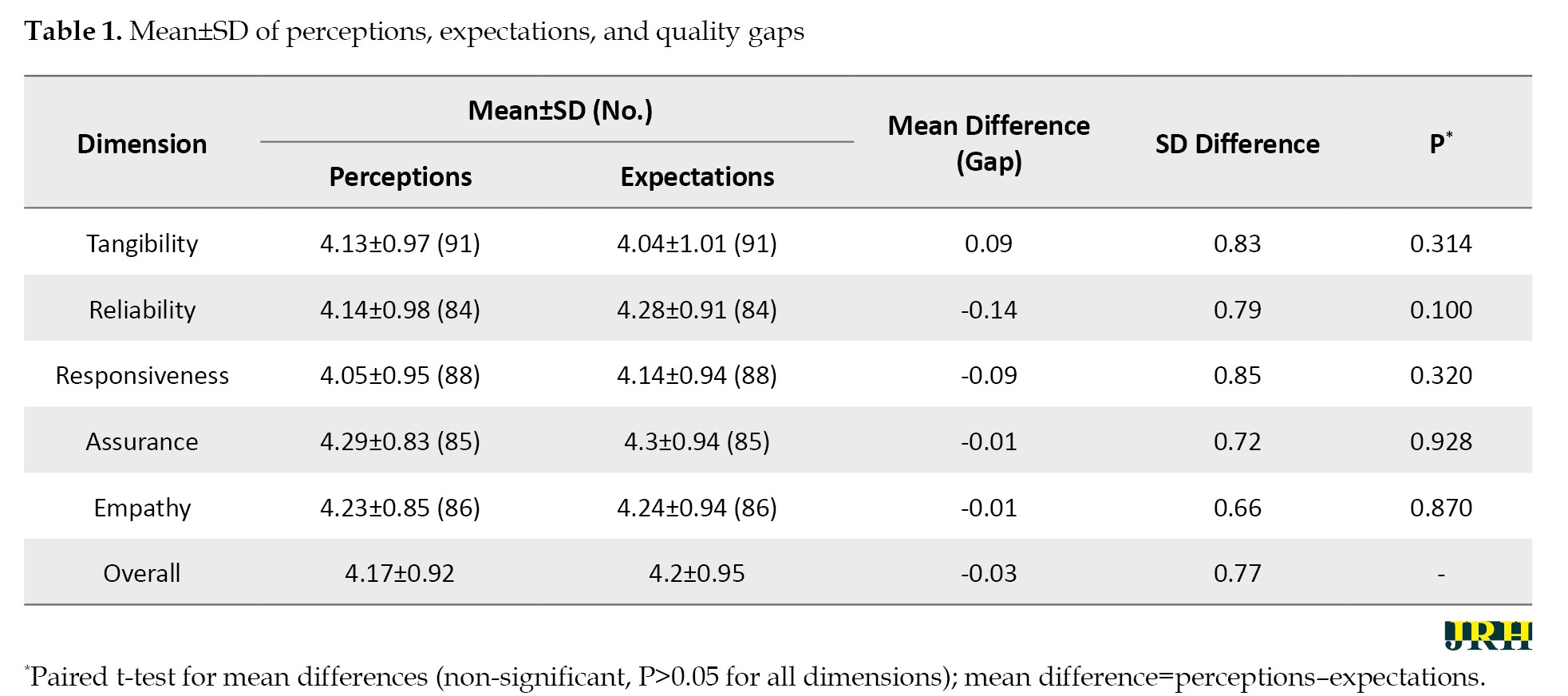
The mean differences (gaps) were minimal, with the largest in reliability (-0.14) and responsiveness (-0.09), followed by tangibility (0.09), assurance (-0.01), and empathy (-0.01). The overall SERVQUAL gap was -0.03, suggesting that expectations were generally met, though slight variations remained in tangible and reliability aspects, such as facilities and dependability (Table 1).
Patients <40 years had smaller absolute gaps in tangibility (-0.12 vs -0.01, P=0.313) and empathy (-0.07 vs 0.19, P=0.466) compared to those ≥40 years, suggesting marginally better alignment with expectations among younger patients, though differences were non-significant (P>0.05) across all dimensions (Table 2).
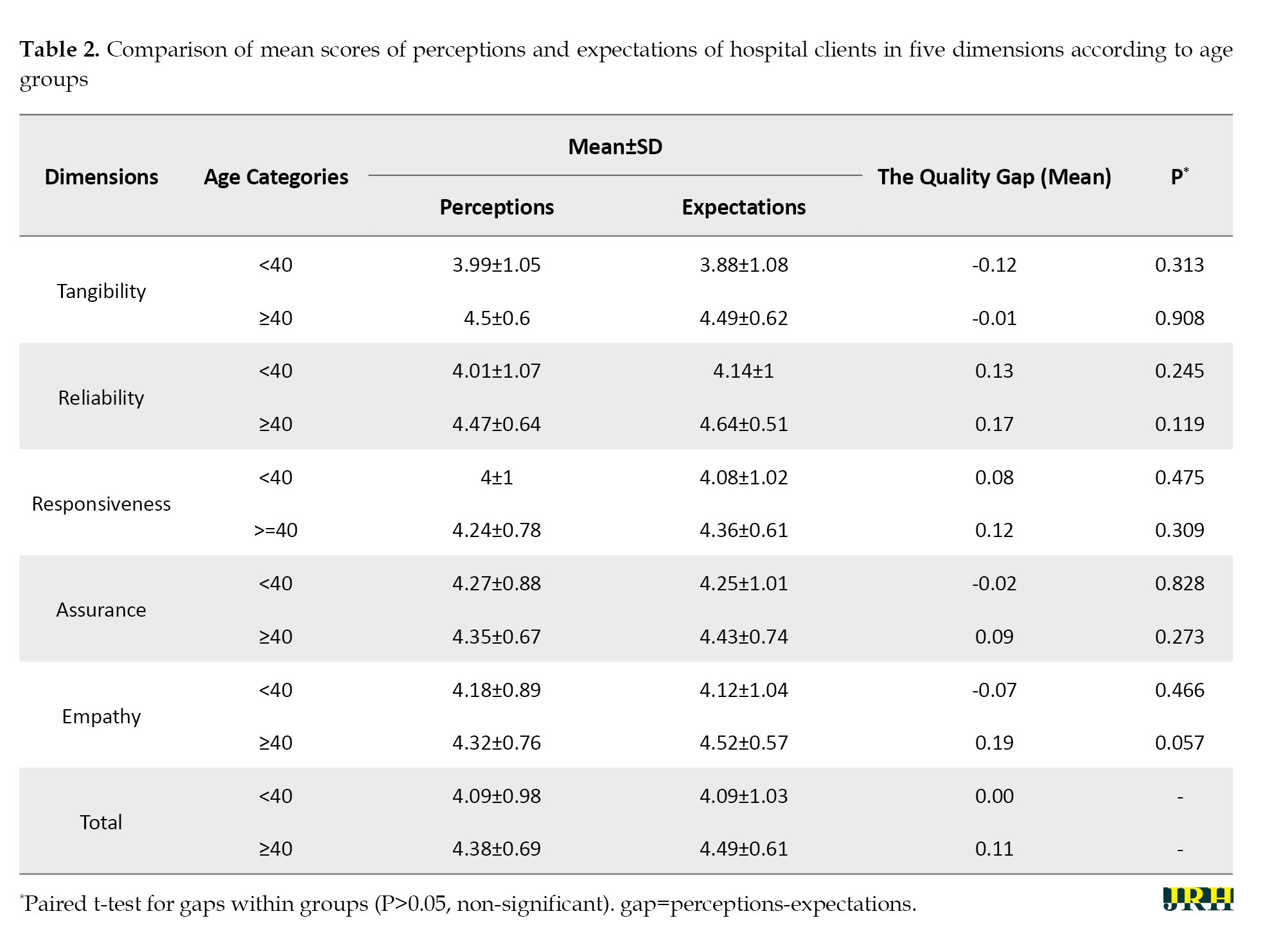
The total gap was near zero for <40 years (0.00) and slightly positive for ≥40 years (0.11).
Analysis by gender showed that females had slightly more negative gaps than males in reliability (-0.29 vs 0.06, P=0.024) and assurance (-0.17 vs 0.18, P=0.085), indicating marginally greater unmet needs in these areas, while other dimensions showed no significant differences (P>0.05) (Table 3).
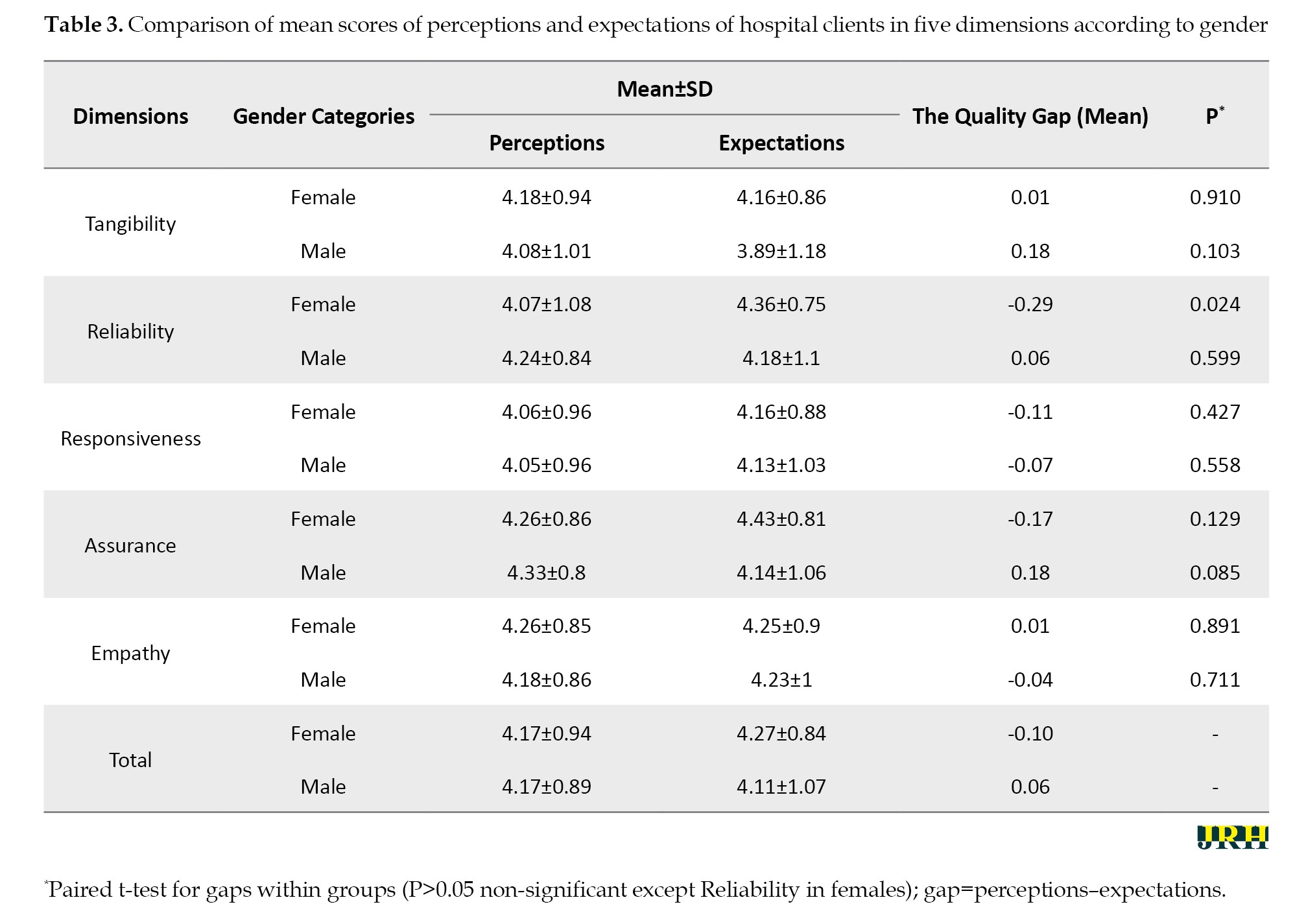
The total gap was comparable between groups (-0.10 for females vs 0.06 for males).
Patients by marital status of married reported slightly larger absolute gaps in reliability (-0.14 vs -0.10, P>0.05) and responsiveness (-0.09 vs -0.08, P>0.05) compared to single patients, indicating minor unmet needs related to family responsibilities; however, no significant differences were observed (Table not shown; P>0.05 for all).
Patients with diploma or less had slightly larger absolute gaps in tangibility (-0.10 vs -0.02, P=0.280) and responsiveness (0.15 vs -0.18, P=0.129) compared to those with higher education, reflecting marginally greater dissatisfaction possibly due to communication barriers, though all differences were non-significant (P>0.05) (Table 4).
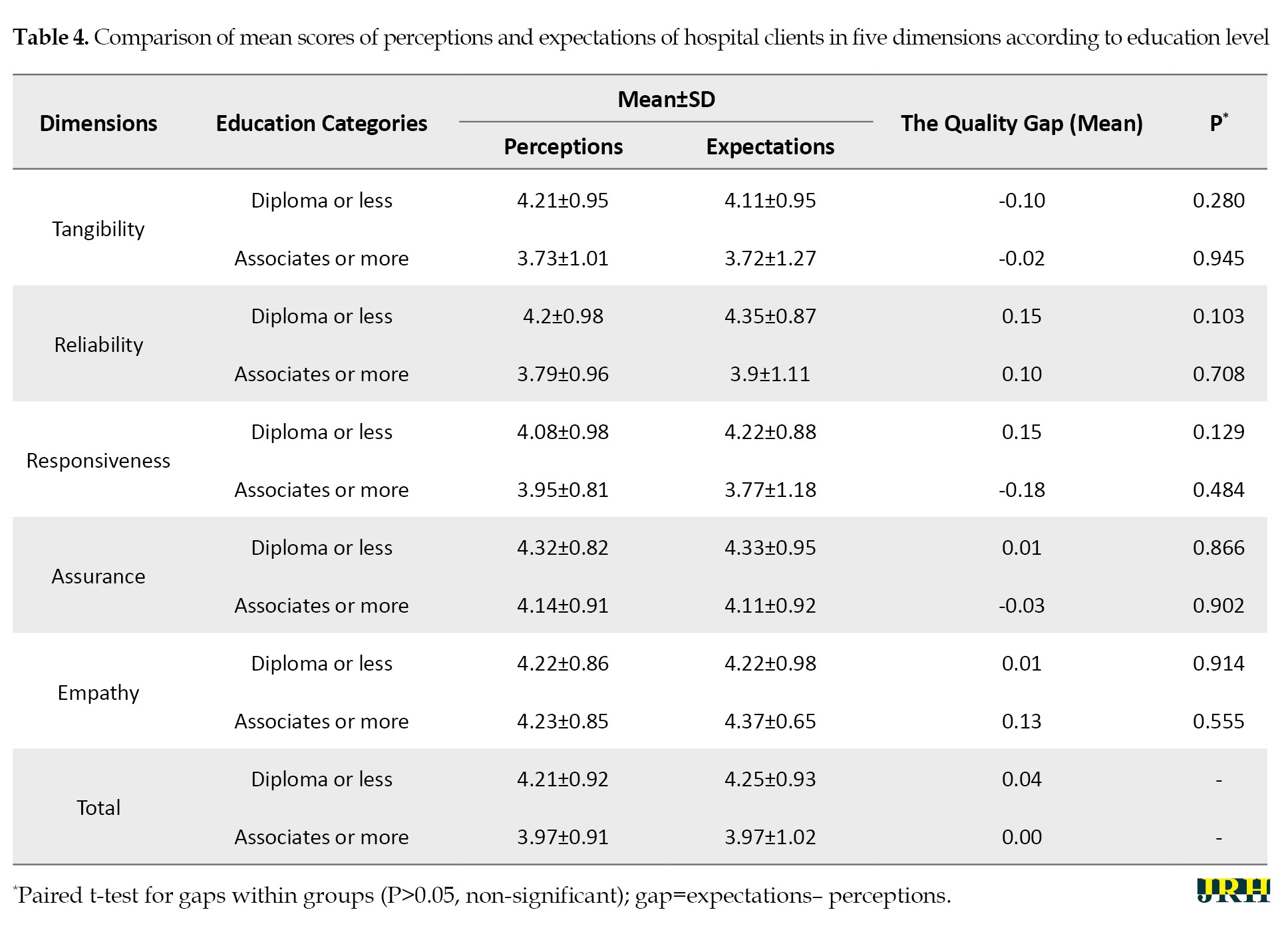
The total gap was minimal in both groups (0.04 for diploma or less vs 0.00 for associates or more).
These results highlight overall alignment between expectations and perceptions in Herat hospitals, with subtle demographic variations that warrant targeted monitoring rather than major interventions.
Discussion
This study assessed patient expectations and perceptions of hospital service quality in Herat City, Afghanistan, using the SERVQUAL model. Overall, no significant differences were found between expectations and perceptions across all five dimensions (P>0.05), with a minimal overall gap of -0.03, indicating generally met expectations and strong alignment in service delivery [18]. This finding is noteworthy given Afghanistan’s challenging healthcare context and contrasts with prior studies in other developing countries that reported larger negative gaps [3, 19, 20].
Studies in various LMICs have documented substantial service quality gaps. For example, research in Iran using the SERVQUAL questionnaire found an overall quality gap of -1.7 between expectations and perceptions [19, 20]. Similarly, systematic reviews of patient satisfaction tools in LMICs have revealed that differences in conceptualization and measurement of healthcare quality often reflect local resource constraints and infrastructure limitations [5]. Health service quality research across 2,929 facilities in six LMICs identified that best-performing health facilities are characterized by good management and engaged leadership, suggesting that quality improvement is achievable even in resource-limited settings [16]. The relatively small gaps observed in Herat hospitals suggest effective service delivery despite Afghanistan’s recent healthcare challenges, including critical underfunding and workforce shortages documented by the WHO in 2023 [6, 7].
The small gaps observed in this study, particularly in reliability and assurance dimensions, suggest that Herat hospitals are maintaining core service standards despite systemic challenges. However, subtle deficiencies in tangibles (e.g. physical facilities and equipment) and responsiveness warrant attention, as these dimensions often deteriorate first in resource-constrained environments [3, 20]. Recent literature has acknowledged the resilience of Afghanistan’s health system despite recent political turmoil and economic crises [8, 9], though ongoing challenges related to funding, infrastructure, and workforce capacity remain critical concerns [6, 9, 10].
Demographic analyses revealed non-significant variations (P>0.05); however, observable trends provided important insights for targeted quality improvement. Females showed slightly more negative gaps in reliability (-0.29 vs 0.06 for males, P=0.024) and assurance (-0.17 vs 0.18), possibly reflecting sociocultural barriers that limit women’s access and quality of care [9, 10]. Qualitative research on healthcare access in Afghanistan following the 2021 political changes has documented substantial barriers faced by women, including restricted mobility and reduced access to female healthcare providers [9, 10]. These findings align with broader evidence from LMICs showing that gender disparities significantly affect patient-reported quality of care and satisfaction levels [4].
Younger patients (<40 years) demonstrated smaller absolute gaps in tangibility (-0.12 vs -0.01 for ≥40 years) and empathy (-0.07 vs 0.19), suggesting better service alignment for this group, while older patients had marginally higher expectations. This pattern may reflect differences in health literacy, communication preferences, or expectations shaped by previous healthcare experiences [2]. Married patients showed larger absolute gaps in reliability (-0.14 vs -0.10 for single patients) and responsiveness (-0.09 vs -0.08), likely influenced by family-related healthcare needs and caregiving responsibilities [1]. Less educated patients (diploma or less) displayed slightly larger gaps in tangibility (-0.10 vs -0.02) and responsiveness (0.15 vs -0.18), potentially reflecting communication challenges and difficulties navigating the healthcare system [4, 20]. These demographic patterns are consistent with international evidence demonstrating that socioeconomic characteristics and educational background influence patient satisfaction across diverse healthcare settings [1, 2].
The SERVQUAL model remains valuable for baseline assessments in conflict-affected and resource-limited settings [12, 13]. Recent applications across Asian countries have demonstrated its utility in identifying service gaps and guiding quality improvement initiatives [12, 14]. When properly validated and culturally adapted, Tools for measuring client experiences in LMICs can facilitate meaningful improvements in service delivery [5]. The current study confirms that even in Afghanistan’s challenging environment, systematically assessing patient perspectives can reveal nuanced patterns that inform targeted interventions [9, 10].
To sustain and enhance the relatively positive service alignment observed in Herat hospitals, several strategies warrant consideration. Continuous monitoring through patient surveys should be implemented to track quality trends over time and identify emerging issues [2, 5]. Staff training programs focused on enhancing responsiveness and communication skills are particularly important for addressing the needs of diverse patient populations [1, 16]. Infrastructure investments targeting tangible improvements—including facility maintenance, equipment upgrades, and environmental enhancements—remain critical priorities, especially given Afghanistan’s recent healthcare infrastructure challenges [6, 8]. Targeted interventions for vulnerable subgroups, including women, elderly patients, married individuals with family responsibilities, and those with lower educational attainment, could enhance equity in service delivery and patient experiences [4, 9, 10].
The resilience demonstrated by Herat hospitals in maintaining service quality alignment despite Afghanistan’s recent political transition, economic crisis, and healthcare system pressures is encouraging [8, 9]. However, this resilience should not diminish attention to ongoing vulnerabilities. The WHO’s 2023 alert regarding critical underfunding in Afghanistan underscores the precarious nature of current achievements and the need for sustained domestic and international support to maintain and improve healthcare quality [6].
Overall, this study provides evidence that Herat hospitals are reasonably aligned with patient expectations and perceptions of service quality. The minimal gaps observed suggest effective service delivery despite systemic challenges [18], though proactive strategies targeting specific dimensions and vulnerable populations will be essential to sustain patient satisfaction and advance healthcare quality in Afghanistan’s evolving context [9, 10].
Limitations
This study has several limitations. First, the sample was limited to public and private hospitals in Herat City, which may limit generalizability to other regions or facility types [15]. Second, self-reported questionnaire data from hospitalized patients could introduce response bias due to factors such as illness, anxiety, or cultural unfamiliarity with surveys [16]. The voluntary participation may also skew toward more literate or less severely ill individuals, potentially underrepresenting perspectives of non-respondents. Future studies should use multi-regional sampling and mixed methods to capture broader insights.
Conclusion
This study revealed close alignment between patient expectations and perceptions of hospital services in Herat City, with minimal overall SERVQUAL gaps (-0.03, P>0.05), indicating effective service delivery across all dimensions. Subtle variations—such as slightly larger gaps in reliability for females and older patients—suggest opportunities for targeted enhancements to sustain this performance.
To further improve quality, the following policy recommendations are proposed: upgrade tangible infrastructure, focusing on facilities and equipment; train staff on reliability and responsiveness for diverse needs; enhance social accountability through outreach and feedback for vulnerable groups; and implement routine SERVQUAL monitoring for ongoing refinement. These patient-centered strategies will promote equitable care and strengthen Afghanistan’s healthcare system.
Ethical Considerations
Compliance with ethical guidelines
This study was approved by the Research Ethics Committee of Mashhad University of Medical Sciences, Mashhad, Iran (Code: IR.MUMS.FHMPM.REC.1401.058). Participants provided written and verbal consent after the study objectives were explained. Participants in the study were in a condition to provide informed consent and fully understood the study purposes. All methods were performed in accordance with relevant guidelines and regulations.
Funding
This research did not receive any grant from funding agencies in the public, commercial, or non-profit sectors.
Authors' contributions
Conceptualization, study design, validation, data analysis, and supervision: Iman Mousaei and Ali Vafaee Najar; Methodology: Iman Mousaei, Ali Vafaee Najar, Amin Moradi, and Ehsan Mosafarkhani; Data collection and formal analysis: Amin Moradi and Ehsan Mosafarkhani; Resources, project administration, review and editing: Laleh Satarzadeh and Mohammad Asif Kabir; Writing the original draft and final approval: All authors.
Conflict of interest
The authors declared no conflict of interest.
Acknowledgments
The authors thank the patients who participated in the study interviews. They appreciate the cooperation of hospital administration and staff for facilitating data collection. The authors thank the research assistants from Mashhad University of Medical Sciences for helping with patient recruitment and questionnaires. They are grateful to native Dari speakers for their expert input on adapting the survey tool.
Delivering high-quality healthcare is a global priority, and hospitals serve as critical institutions tasked with providing effective, patient-centered care [1]. Quality of care encompasses multiple dimensions, including patient satisfaction, a key indicator of healthcare service success that reflects the alignment between patients’ expectations and their actual experiences [2]. Patient satisfaction influences trust, loyalty, and healthcare utilization; hospitals that meet patient expectations through seamless, coordinated, and humanistic care foster confidence and promote positive health outcomes [1, 2]. Conversely, suboptimal service quality erodes trust and diminishes patient satisfaction, particularly in resource-constrained settings [3].
In low- and middle-income countries (LMICs), healthcare systems face significant challenges due to limited resources, inadequate infrastructure, and socioeconomic instability [4, 5]. Recent studies have shown that patient-reported quality of care in LMICs is strongly influenced by person-centered care factors, including communication, respect, and emotional support [4]. Additionally, differences in the conceptualization and measurement of healthcare quality across LMICs highlight the need for validated instruments that capture local contexts [5].
Afghanistan presents a particularly challenging environment for healthcare delivery. Following decades of conflict and the political transition in August 2021, the country’s health system has experienced critical underfunding and severe resource constraints [6, 7]. The World Health Organization (WHO) reported in 2023 that Afghanistan’s healthcare infrastructure is severely under-resourced, especially in underserved areas where access remains vulnerable due to the ongoing humanitarian crisis [6]. Healthcare collapse has been attributed to political turmoil, natural catastrophes, and insufficient international aid, leading to shortages of medical equipment, trained staff, and basic hospital amenities [8]. These constraints create substantial gaps between patient expectations and the quality of care received, particularly in urban centers, such as Herat City, Afghanistan, where public and private hospitals serve large populations but struggle to meet demand [9, 10].
Understanding service quality gaps is essential for improving healthcare delivery in such contexts [3]. Service quality is a strategic differentiator that enhances hospital competitiveness and patient retention [1, 2]. The SERVQUAL model, developed by Parasuraman et al. (1988), remains a widely used framework for assessing healthcare service quality by measuring the gap between patient expectations and perceptions across five dimensions: Tangibles, reliability, responsiveness, assurance, and empathy [11]. This model has been successfully applied in various Asian countries and remains an effective tool for identifying quality factors and measuring patient satisfaction [12, 13]. Recent systematic reviews have confirmed that SERVQUAL is particularly valuable in LMICs, where patient perspectives are often underutilized in quality assessments [3, 13, 14]. Research across multiple countries has demonstrated that service quality directly impacts patient satisfaction and behavioral intentions, such as hospital choice and return visits [1, 15].
Despite global efforts to improve healthcare quality, significant shortcomings persist in meeting patient expectations, particularly in developing nations [3]. Health service quality in LMICs is often characterized by management challenges, workforce constraints, and community engagement issues [16]. Regular evaluation of patient perspectives is critical to identify priority areas for improvement and ensure equitable, patient-centered care [2, 5]. However, such evaluations remain scarce in Afghanistan, where systemic barriers and limited research on patient experiences compound healthcare challenges [9, 10].
This study aimed to apply the SERVQUAL model to assess gaps between patient expectations and perceptions of healthcare services in public and private hospitals in Herat City, Afghanistan. Given the unique context of Afghanistan’s healthcare system—marked by recent political upheaval and ongoing resource limitations [6-8]—this research provides timely insights into service quality from the patient perspective. The findings will offer actionable evidence to guide strategies to enhance hospital service quality and improve patient experiences in one of the world’s most challenging healthcare environments [9, 10].
Methods
Study design and setting
This cross-sectional study was conducted from July to December 2022 in eight hospitals in Herat City, including public, private, and NGO facilities. The hospitals varied in size and capacity, with bed counts ranging from 20 to 65 and staff ranging from approximately 70 to 250. The only governmental hospital (Herat Regional Hospital) had the highest capacity (65 beds, 150–200 staff), while private hospitals such as Ghalib, Mofid, Loghman Hakim, Kimia, and Afghan Turkman operated with 20–50 beds and similar staffing levels. Two NGO hospitals (Iran Clinic and Red Crescent) provided outpatient and limited inpatient services with smaller capacities.
The study population included Dari-speaking Afghan inpatients aged ≥18 years who could provide informed consent. Patients with critical illness, cognitive impairment, or unwillingness to participate were excluded.
Sample size and sampling
The sample size was calculated as 337 using Cochran’s formula (Equation 1):
With Z=1.96 (95% CI), P=0.676 (prior satisfaction rate [17]), and d=0.05 (margin of error).
To ensure simple random sampling, patient lists were first obtained from each public and private hospital in Herat City. The number of participants from each hospital was determined proportionally based on inpatient volume. Within each hospital, department-level lists (e.g. internal medicine, surgery) were used, and participants were selected using computer-generated random numbers. If a selected patient was ineligible or declined, the next randomly selected number was used. A total of 400 patients were approached, and 337 completed the survey.
Data collection
Instruments
The validated Dari version of the 22-item SERVQUAL questionnaire assessed expectations and perceptions across five dimensions: Tangibles (4 items), reliability (5 items), responsiveness (4 items), assurance (4 items), and empathy (5 items), using a 5-point Likert scale (1=strongly disagree, 5=strongly agree). Minor linguistic adaptations ensured cultural relevance. Validity was confirmed (CVI=0.85); reliability showed Cronbach’s α of 0.89 (perceptions) and 0.91 (expectations). Demographic data included age, gender, marital status, and education. Scores for each SERVQUAL dimension were calculated by averaging item scores for expectations and perceptions separately. The service quality gap (gap = perception−expectation) was computed for each item and dimension, where negative values indicated unmet expectations. Overall gap scores were obtained by averaging dimension-level gaps, and paired t-tests or Wilcoxon tests were used to test differences between expectations and perceptions.
Data collection procedure
Trained research assistants collected data via self-administered questionnaires for literate patients and in-person interviews for illiterate ones, after obtaining verbal and written consent.
Statistical analysis
Data were analyzed using SPSS software, version 16. Descriptive statistics (Mean±SD, medians) were calculated for gaps (expectation-perception). Normality was tested via Kolmogorov-Smirnov. Non-normal data led to Wilcoxon signed-rank tests for gaps, Mann-Whitney U/Kruskal-Wallis for demographic comparisons, and paired t-tests for normal variables (P<0.05).
Results
A total of 337 inpatients participated: 53.4% male and 46.6% female; 59.3% aged <40 years and 40.7% aged ≥40 years; 70.3% married; and 65.3% with a diploma or less education. Analysis of SERVQUAL scores revealed no significant differences between patients’ expectations and perceptions across all five dimensions (P>0.05, paired t-test), indicating close alignment overall (Table 1).
The mean differences (gaps) were minimal, with the largest in reliability (-0.14) and responsiveness (-0.09), followed by tangibility (0.09), assurance (-0.01), and empathy (-0.01). The overall SERVQUAL gap was -0.03, suggesting that expectations were generally met, though slight variations remained in tangible and reliability aspects, such as facilities and dependability (Table 1).
Patients <40 years had smaller absolute gaps in tangibility (-0.12 vs -0.01, P=0.313) and empathy (-0.07 vs 0.19, P=0.466) compared to those ≥40 years, suggesting marginally better alignment with expectations among younger patients, though differences were non-significant (P>0.05) across all dimensions (Table 2).
The total gap was near zero for <40 years (0.00) and slightly positive for ≥40 years (0.11).
Analysis by gender showed that females had slightly more negative gaps than males in reliability (-0.29 vs 0.06, P=0.024) and assurance (-0.17 vs 0.18, P=0.085), indicating marginally greater unmet needs in these areas, while other dimensions showed no significant differences (P>0.05) (Table 3).
The total gap was comparable between groups (-0.10 for females vs 0.06 for males).
Patients by marital status of married reported slightly larger absolute gaps in reliability (-0.14 vs -0.10, P>0.05) and responsiveness (-0.09 vs -0.08, P>0.05) compared to single patients, indicating minor unmet needs related to family responsibilities; however, no significant differences were observed (Table not shown; P>0.05 for all).
Patients with diploma or less had slightly larger absolute gaps in tangibility (-0.10 vs -0.02, P=0.280) and responsiveness (0.15 vs -0.18, P=0.129) compared to those with higher education, reflecting marginally greater dissatisfaction possibly due to communication barriers, though all differences were non-significant (P>0.05) (Table 4).
The total gap was minimal in both groups (0.04 for diploma or less vs 0.00 for associates or more).
These results highlight overall alignment between expectations and perceptions in Herat hospitals, with subtle demographic variations that warrant targeted monitoring rather than major interventions.
Discussion
This study assessed patient expectations and perceptions of hospital service quality in Herat City, Afghanistan, using the SERVQUAL model. Overall, no significant differences were found between expectations and perceptions across all five dimensions (P>0.05), with a minimal overall gap of -0.03, indicating generally met expectations and strong alignment in service delivery [18]. This finding is noteworthy given Afghanistan’s challenging healthcare context and contrasts with prior studies in other developing countries that reported larger negative gaps [3, 19, 20].
Studies in various LMICs have documented substantial service quality gaps. For example, research in Iran using the SERVQUAL questionnaire found an overall quality gap of -1.7 between expectations and perceptions [19, 20]. Similarly, systematic reviews of patient satisfaction tools in LMICs have revealed that differences in conceptualization and measurement of healthcare quality often reflect local resource constraints and infrastructure limitations [5]. Health service quality research across 2,929 facilities in six LMICs identified that best-performing health facilities are characterized by good management and engaged leadership, suggesting that quality improvement is achievable even in resource-limited settings [16]. The relatively small gaps observed in Herat hospitals suggest effective service delivery despite Afghanistan’s recent healthcare challenges, including critical underfunding and workforce shortages documented by the WHO in 2023 [6, 7].
The small gaps observed in this study, particularly in reliability and assurance dimensions, suggest that Herat hospitals are maintaining core service standards despite systemic challenges. However, subtle deficiencies in tangibles (e.g. physical facilities and equipment) and responsiveness warrant attention, as these dimensions often deteriorate first in resource-constrained environments [3, 20]. Recent literature has acknowledged the resilience of Afghanistan’s health system despite recent political turmoil and economic crises [8, 9], though ongoing challenges related to funding, infrastructure, and workforce capacity remain critical concerns [6, 9, 10].
Demographic analyses revealed non-significant variations (P>0.05); however, observable trends provided important insights for targeted quality improvement. Females showed slightly more negative gaps in reliability (-0.29 vs 0.06 for males, P=0.024) and assurance (-0.17 vs 0.18), possibly reflecting sociocultural barriers that limit women’s access and quality of care [9, 10]. Qualitative research on healthcare access in Afghanistan following the 2021 political changes has documented substantial barriers faced by women, including restricted mobility and reduced access to female healthcare providers [9, 10]. These findings align with broader evidence from LMICs showing that gender disparities significantly affect patient-reported quality of care and satisfaction levels [4].
Younger patients (<40 years) demonstrated smaller absolute gaps in tangibility (-0.12 vs -0.01 for ≥40 years) and empathy (-0.07 vs 0.19), suggesting better service alignment for this group, while older patients had marginally higher expectations. This pattern may reflect differences in health literacy, communication preferences, or expectations shaped by previous healthcare experiences [2]. Married patients showed larger absolute gaps in reliability (-0.14 vs -0.10 for single patients) and responsiveness (-0.09 vs -0.08), likely influenced by family-related healthcare needs and caregiving responsibilities [1]. Less educated patients (diploma or less) displayed slightly larger gaps in tangibility (-0.10 vs -0.02) and responsiveness (0.15 vs -0.18), potentially reflecting communication challenges and difficulties navigating the healthcare system [4, 20]. These demographic patterns are consistent with international evidence demonstrating that socioeconomic characteristics and educational background influence patient satisfaction across diverse healthcare settings [1, 2].
The SERVQUAL model remains valuable for baseline assessments in conflict-affected and resource-limited settings [12, 13]. Recent applications across Asian countries have demonstrated its utility in identifying service gaps and guiding quality improvement initiatives [12, 14]. When properly validated and culturally adapted, Tools for measuring client experiences in LMICs can facilitate meaningful improvements in service delivery [5]. The current study confirms that even in Afghanistan’s challenging environment, systematically assessing patient perspectives can reveal nuanced patterns that inform targeted interventions [9, 10].
To sustain and enhance the relatively positive service alignment observed in Herat hospitals, several strategies warrant consideration. Continuous monitoring through patient surveys should be implemented to track quality trends over time and identify emerging issues [2, 5]. Staff training programs focused on enhancing responsiveness and communication skills are particularly important for addressing the needs of diverse patient populations [1, 16]. Infrastructure investments targeting tangible improvements—including facility maintenance, equipment upgrades, and environmental enhancements—remain critical priorities, especially given Afghanistan’s recent healthcare infrastructure challenges [6, 8]. Targeted interventions for vulnerable subgroups, including women, elderly patients, married individuals with family responsibilities, and those with lower educational attainment, could enhance equity in service delivery and patient experiences [4, 9, 10].
The resilience demonstrated by Herat hospitals in maintaining service quality alignment despite Afghanistan’s recent political transition, economic crisis, and healthcare system pressures is encouraging [8, 9]. However, this resilience should not diminish attention to ongoing vulnerabilities. The WHO’s 2023 alert regarding critical underfunding in Afghanistan underscores the precarious nature of current achievements and the need for sustained domestic and international support to maintain and improve healthcare quality [6].
Overall, this study provides evidence that Herat hospitals are reasonably aligned with patient expectations and perceptions of service quality. The minimal gaps observed suggest effective service delivery despite systemic challenges [18], though proactive strategies targeting specific dimensions and vulnerable populations will be essential to sustain patient satisfaction and advance healthcare quality in Afghanistan’s evolving context [9, 10].
Limitations
This study has several limitations. First, the sample was limited to public and private hospitals in Herat City, which may limit generalizability to other regions or facility types [15]. Second, self-reported questionnaire data from hospitalized patients could introduce response bias due to factors such as illness, anxiety, or cultural unfamiliarity with surveys [16]. The voluntary participation may also skew toward more literate or less severely ill individuals, potentially underrepresenting perspectives of non-respondents. Future studies should use multi-regional sampling and mixed methods to capture broader insights.
Conclusion
This study revealed close alignment between patient expectations and perceptions of hospital services in Herat City, with minimal overall SERVQUAL gaps (-0.03, P>0.05), indicating effective service delivery across all dimensions. Subtle variations—such as slightly larger gaps in reliability for females and older patients—suggest opportunities for targeted enhancements to sustain this performance.
To further improve quality, the following policy recommendations are proposed: upgrade tangible infrastructure, focusing on facilities and equipment; train staff on reliability and responsiveness for diverse needs; enhance social accountability through outreach and feedback for vulnerable groups; and implement routine SERVQUAL monitoring for ongoing refinement. These patient-centered strategies will promote equitable care and strengthen Afghanistan’s healthcare system.
Ethical Considerations
Compliance with ethical guidelines
This study was approved by the Research Ethics Committee of Mashhad University of Medical Sciences, Mashhad, Iran (Code: IR.MUMS.FHMPM.REC.1401.058). Participants provided written and verbal consent after the study objectives were explained. Participants in the study were in a condition to provide informed consent and fully understood the study purposes. All methods were performed in accordance with relevant guidelines and regulations.
Funding
This research did not receive any grant from funding agencies in the public, commercial, or non-profit sectors.
Authors' contributions
Conceptualization, study design, validation, data analysis, and supervision: Iman Mousaei and Ali Vafaee Najar; Methodology: Iman Mousaei, Ali Vafaee Najar, Amin Moradi, and Ehsan Mosafarkhani; Data collection and formal analysis: Amin Moradi and Ehsan Mosafarkhani; Resources, project administration, review and editing: Laleh Satarzadeh and Mohammad Asif Kabir; Writing the original draft and final approval: All authors.
Conflict of interest
The authors declared no conflict of interest.
Acknowledgments
The authors thank the patients who participated in the study interviews. They appreciate the cooperation of hospital administration and staff for facilitating data collection. The authors thank the research assistants from Mashhad University of Medical Sciences for helping with patient recruitment and questionnaires. They are grateful to native Dari speakers for their expert input on adapting the survey tool.
References
- Goula A, Stamouli MA, Alexandridou M, Vorreakou L, Galanakis A, Theodorou G, et al. Public hospital quality assessment. Evidence from Greek health setting using SERVQUAL model. International Journal of Environmental Research and Public Health. 2021; 18(7):3418. [DOI:10.3390/ijerph18073418] [PMID] [PMCID]
- Ferreira DC, Vieira I, Pedro MI, Caldas P, Varela M. Patient satisfaction with healthcare services and the techniques used for its assessment: A systematic literature review and a bibliometric analysis. Healthcare. 2023; 11(5):639. [DOI:10.3390/healthcare11050639] [PMID] [PMCID]
- AlOmari F. Measuring gaps in healthcare quality using SERVQUAL model: Challenges and opportunities in developing countries. Measuring Business Excellence. 2020; 25(4):407-20. [DOI:10.1108/MBE-11-2019-0104]
- Kim JH, Bell GA, Ratcliffe HL, Moncada L, Lipsitz S, Hirschhorn LR, et al. Predictors of patient-reported quality of care in low- and middle-income countries: A four-country survey of person-centered care. International Journal for Quality in Health Care. 2021; 33(3):mzab110. [DOI:10.1093/intqhc/mzab110] [PMID] [PMCID]
- Banda S, Nkungula N, Chiumia IK, Rylance J, Limbani F. Tools for measuring client experiences and satisfaction with healthcare in low- and middle-income countries: A systematic review of measurement properties. BMC Health Services Research. 2023; 23(1):133. [DOI:10.1186/s12913-023-09129-9] [PMID] [PMCID]
- WHO. Afghanistan’s health system suffers critical underfunding, calls for donor support. Geneva: World Health Organization; 2023. [Link]
- HRW. “A Disaster for the foreseeable future”: Afghanistan’s healthcare crisis. New York: Human Rights Watch; 2024. [Link]
- Tao NPH, Nguyen D, Sediqi SM, Tran L, Huy NT. Healthcare collapse in Afghanistan due to political crises, natural catastrophes, and dearth of international aid post-COVID. Journal of Global Health. 2023; 13:03003. [DOI:10.7189/jogh.13.03003] [PMID] [PMCID]
- Lamberti-Castronuovo A, Valente M, Bocchini F, Trentin M, Paschetto M, Bahdori GA, et al. Exploring barriers to access to care following the 2021 socio-political changes in Afghanistan: a qualitative study. Conflict and Health. 2024; 18(1):36. [DOI:10.1186/s13031-024-00595-4.] [PMID] [PMCID]
- Basij-Rasikh M, Dickey ES, Sharkey A. Primary healthcare system and provider responses to the Taliban takeover in Afghanistan. BMJ Global Health. 2024; 9(2):e013760. [DOI:10.1136/bmjgh-2023-013760] [PMID] [PMCID]
- Parasuraman A, Zeithaml VA, Berry LL. SERVQUAL: A multiple-item scale for measuring consumer perceptions of service quality. Journal of Retailing. 1988; 64(1):12-40. [Link]
- Jonkisz A, Karniej P, Krasowska D. The servqual method as an assessment tool of the quality of medical services in selected Asian countries. International Journal of Environmental Research and Public Health. 2022; 19(13):7831. [DOI:10.3390/ijerph19137831] [PMID] [PMCID]
- Jonkisz A, Karniej P, Krasowska D. SERVQUAL method as an “old new” tool for improving the quality of medical services: A literature review. International Journal of Environmental Research and Public Health. 2021; 18(20):10758. [DOI:10.3390/ijerph182010758] [PMID] [PMCID]
- Karume AK, Nyongesa K, Okutoyi L, Kinuthia J. Patient’s expectations and perceptions on quality of care; An evaluation using SERVQUAL gap in Kenya. PLoS One. 2025; 20(3):e0315910. [DOI:10.1371/journal.pone.0315910] [PMID] [PMCID]
- A’aqoulah A, Kuyini AB, Albalas S. Exploring the gap between patients' expectations and perceptions of healthcare service quality. Patient Preference and Adherence. 2022; 16:1295-305. [DOI:10.2147/PPA.S360852] [PMID] [PMCID]
- Lewis TP, McConnell M, Aryal A, Irimu G, Mehata S, Mrisho M, et al. Health service quality in 2929 facilities in six low-income and middle-income countries: A positive deviance analysis. The Lancet. Global Health. 2023; 11(6):e862-70. [DOI:10.1016/S2214-109X(23)00163-8] [PMID]
- Kardanmoghadam V, Movahednia N, Movahednia M, Nekoei-Moghadam M, Amiresmaili M, Moosazadeh M, et al. Determining patients’ satisfaction level with hospital emergency rooms in Iran: A meta-analysis. Global Journal of Health Science. 2015; 7(4):260-9. [DOI:10.5539/gjhs.v7n4p260] [PMID] [PMCID]
- Su M, Zhou Z, Si Y, Fan X. The association between patient-centered communication and primary care quality in urban China: Evidence from a standardized patient study. Frontiers in Public Health. 2022; 9:779293. [DOI:10.3389/fpubh.2021.779293] [PMID] [PMCID]
- Hosseinzadeh M, Pouladzadeh M, Eskandari A. Assessment of healthcare service quality and patient satisfaction using the SERVQUAL questionnaire in Khuzestan province during 2022-2023. Jundishapur Journal of Chronic Disease Care. 2024; 13(4):e146329. [DOI:10.5812/jjcdc-146329]
- Rezaei S, Matin BK, Moradi K, Bijan B, Fallahi M, Shokati B, et al. Measurement of quality of educational hospital services by the SERVQUAL model: The Iranian patients' perspective. Electronic physician. 2016; 8(3):2101-6. [DOI:10.19082/2101] [PMID] [PMCID]
Type of Study: Orginal Article |
Subject:
● Service Quality
Received: 2025/05/12 | Accepted: 2025/12/13 | Published: 2026/08/23
Received: 2025/05/12 | Accepted: 2025/12/13 | Published: 2026/08/23
| Rights and permissions | |
 |
This work is licensed under a Creative Commons Attribution-NonCommercial 4.0 International License. |


This is an open access article distributed under the terms of the Creative Commons Attribution License (CC-By-NC), which permits use, distribution, and reproduction in any medium, provided the original work is properly cited and is not used for commercial purposes.
Contact Information
