

Volume 16, Issue 5 (Sep & Oct 2026)
J Research Health 2026, 16(5): 467-478 |
Back to browse issues page



Ethics code: IR.TBZMED.REC.1404.073


Download citation:
BibTeX | RIS | EndNote | Medlars | ProCite | Reference Manager | RefWorks
Send citation to:


BibTeX | RIS | EndNote | Medlars | ProCite | Reference Manager | RefWorks
Send citation to:
Mohammadinia L, Babaie J, Samadipour E. Understanding the Components of Community Risk Perception: A Qualitative Approach. J Research Health 2026; 16 (5) :467-478
URL: http://jrh.gmu.ac.ir/article-1-2846-en.html
URL: http://jrh.gmu.ac.ir/article-1-2846-en.html


1- Research Center for Emergency and Disaster Resilience, Iranian Red Crescent Society of the Islamic Republic of Iran, Tehran, Iran. & Emergency and Trauma Care Research Center, Tabriz University of Medical Sciences, Tabriz, Iran. & Department of Health Policy and Management, School of Management and Medical Informatics, Tabriz University of Medical Sciences, Tabriz, Iran.
2- Emergency and Trauma Care Research Center, Tabriz University of Medical Sciences, Tabriz, Iran. & Department of Health Policy and Management, School of Management and Medical Informatics, Tabriz University of Medical Sciences, Tabriz, Iran.
3- Non-Communicable Diseases Research Center, Sabzevar University of Medical Sciences, Sabzevar, Iran. & Department of Emergency Medicine, School of Paramedic, Sabzevar University of Medical Sciences, Sabzevar, Iran. ,samadipourez@gmail.com
2- Emergency and Trauma Care Research Center, Tabriz University of Medical Sciences, Tabriz, Iran. & Department of Health Policy and Management, School of Management and Medical Informatics, Tabriz University of Medical Sciences, Tabriz, Iran.
3- Non-Communicable Diseases Research Center, Sabzevar University of Medical Sciences, Sabzevar, Iran. & Department of Emergency Medicine, School of Paramedic, Sabzevar University of Medical Sciences, Sabzevar, Iran. ,
Full-Text [PDF 624 kb]
(33 Downloads)
| Abstract (HTML) (595 Views)
Full-Text: (37 Views)
Introduction
Natural and human-made disasters pose substantial threats to the lives and well-being of millions worldwide [1]. In such situations, disaster risk perception is vital for reducing community vulnerability and serves as a foundational element of risk-reduction strategies and the promotion of social resilience [2]. How individuals and communities perceive risk directly influences their preventive actions, preparedness levels, decisions regarding emergency evacuations, and acceptance of risk-mitigation policies [3]. International frameworks, such as the Sendai framework, emphasize the importance of enhancing public understanding of hazards and fostering a culture of prevention; analyzing disaster risk perception in its social, cultural, and historical contexts is essential for developing effective and culturally appropriate interventions [4–6]. While numerous studies have examined individual-level factors affecting risk perception [7–9], less attention has been given to broader structural elements, including political influences, media impact, public policies, and environmental characteristics [10].
Based on previous studies, the gap in identifying factors that influence risk perception necessitates fundamental (infrastructural) research. Since qualitative research is inherently fundamental and aims to provide a deep, detailed understanding of related phenomena and processes [11], we conducted this qualitative study in the cultural, geographical, and historical context of Iran. This study seeks to identify key components of public perception of natural disaster risk in Iran.
Methods
This study examined disaster risk perception in Iran during 2024-2025 to identify key components and influencing factors. Participants were selected through purposive sampling with maximum diversity (n=42) across demographic, geographic, and experiential traits, forming two groups. Interviews were recorded, and data were analyzed by three researchers to code concepts, subthemes, and themes. The following sections detail the procedures.
Selection of participants
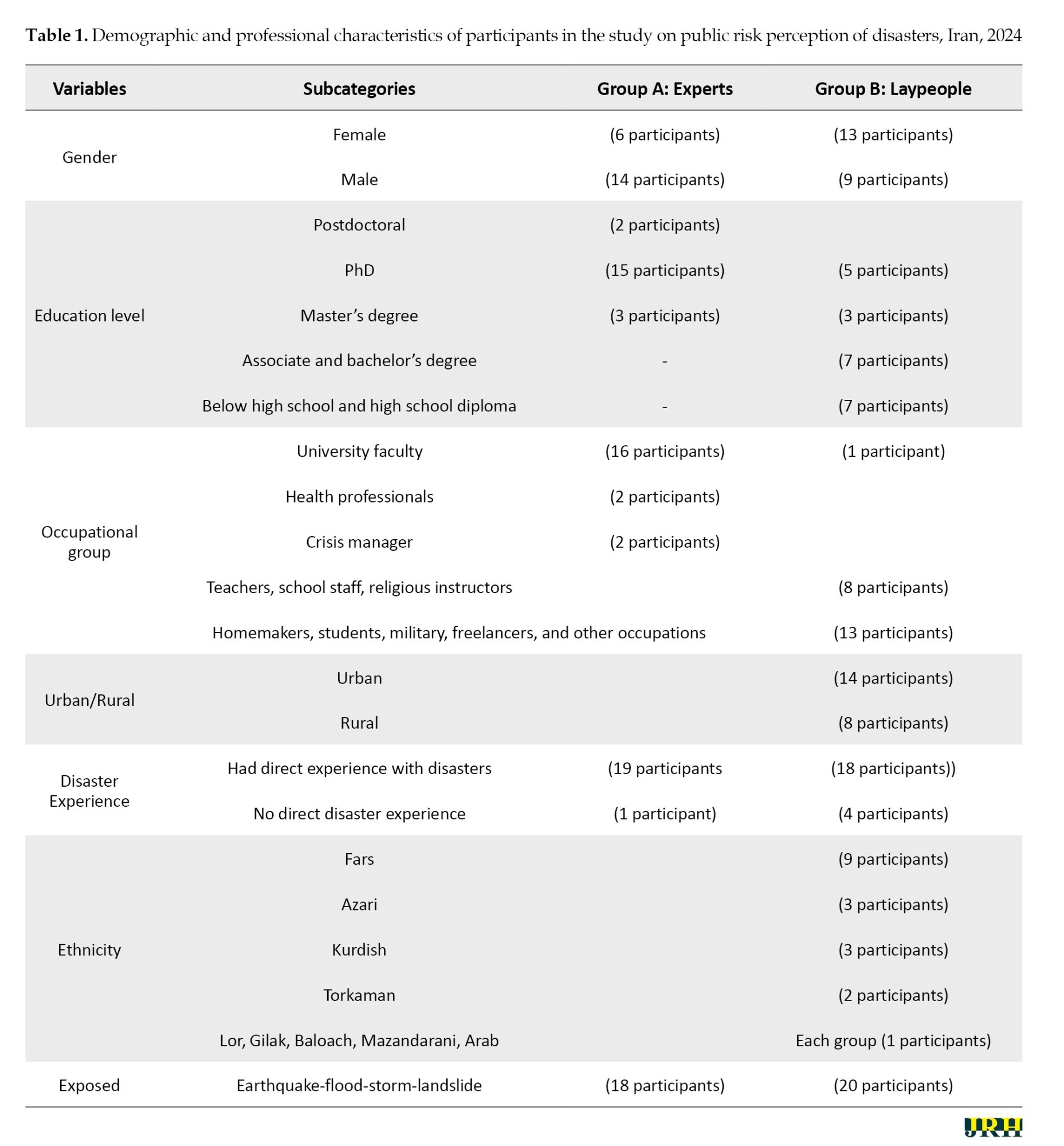
Purposive sampling ensured diverse representation to recruit participants [12], whose demographic characteristics are summarized in Table 1.
Data collection
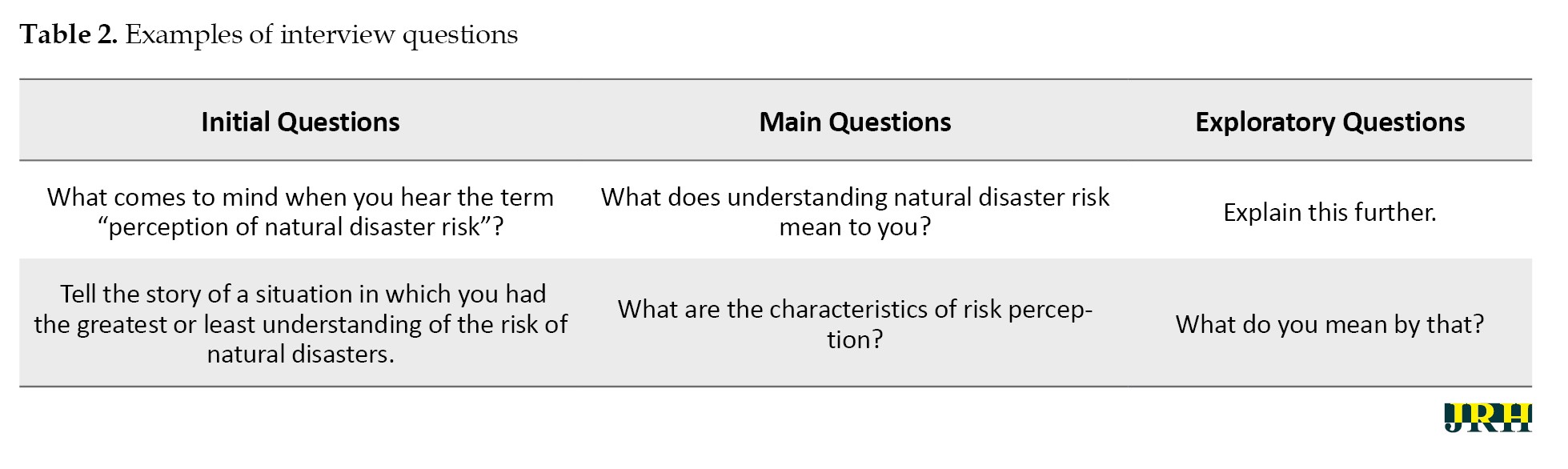
Data were collected through semi-structured interviews, conducted face-to-face or online. Each interview lasted between 40 and 90 minutes and was conducted in the participants’ work or living environment (at a location of their choice). Interview questions explored disaster risk perception components, personal experiences, influencing factors, and how individual and social characteristics shape risk perception (Table 2).
Data collection continued until saturation was reached, confirmed when the codes from the last three interviews repeated prior codes and no new subcategories or categories emerged. Saturation was considered overall, not separately for each participant group.
Data analysis
Data were analyzed qualitatively following the Elo and Kyngas method [13]. Initially, two researchers independently reviewed the interview transcripts, reading them multiple times. Open coding was then conducted, resulting in 1,427 initial codes. These codes were subsequently organized into main and specific categories, yielding 22 categories across seven main themes.
MAXQDA software, version 2018 was used to facilitate coding and data analysis. When the team disagreed on coding or categorization, they resolved discrepancies through discussion and consensus.
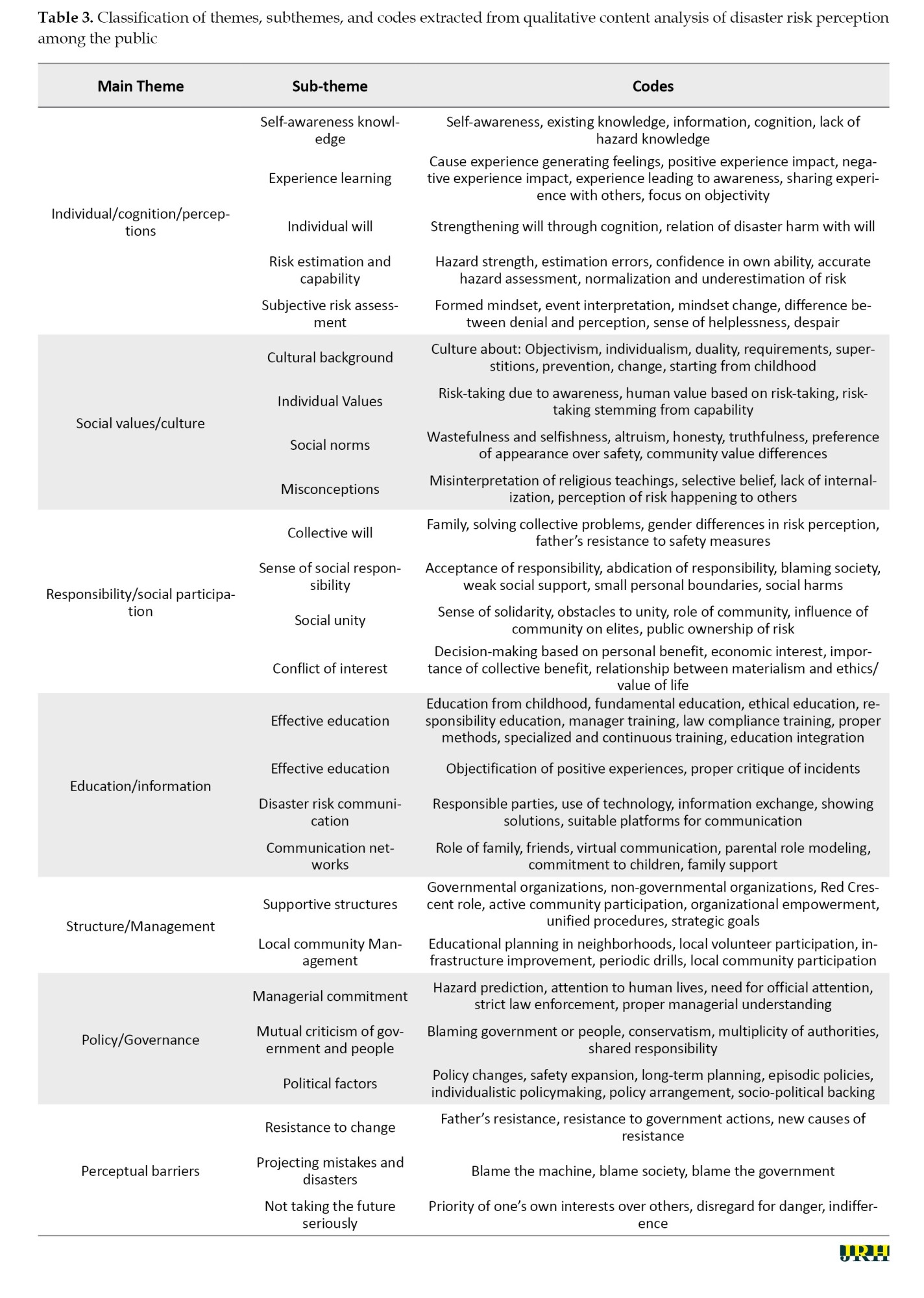
In the next stage, similar codes were merged, and primary codes related to a central concept were grouped into subgroups. The team reviewed these subgroups several times and compared similarities and differences to form categories and themes. Finally, the results were summarized, and a conceptual framework, solutions, and barriers to natural disaster risk perceptions were extracted. Table 3 presents examples of codes, themes, and categories.
Trustworthiness
To ensure the trustworthiness of the findings, the Guba and Lincoln criteria were utilized to enhance the rigor of the research. To enhance credibility, member checking was employed [14]; interview summaries were returned to participants to confirm data accuracy. Furthermore, multiple independent researchers reviewed the coding and analyses to ensure the reliability and consistency of the coding process. Expert opinions in qualitative analysis were also sought to optimize the categorization and extraction of final themes.
Ethical considerations
First, after obtaining the ethical approval and following legal procedures, the interviews were planned. Before conducting the interviews, the researchers explained the study objectives to participants and obtained informed consent. Participants were assured that their information would remain confidential and that they could withdraw from the study at any time without consequence.
Results
This study included 42 participants. The duration ranged, with a mean of 46.63±17 minutes. In-depth analysis of the interviews resulted in seven main themes and 22 sub-themes, as described below.
Individual cognition and perceptions
Self-awareness and knowledge
Many participants emphasized the role of individual knowledge in shaping risk perception. Participants identified understanding disasters, familiarity with warning signs, and basic information on how to face risks as key sources of self-awareness. Without this knowledge, people cannot make appropriate decisions during crises.
“... Awareness must be created; if awareness is not established, no one understands. The essence is awareness. If you want individuals’ knowledge about risk to increase, you must raise awareness” (interview 4, man, 57 years old, physician).
Experience and learning
Direct experience with disasters was effective in increasing awareness and internalizing risk-related concepts. Some experiences led to the development of traits, such as patience, gratitude, and enhanced emotional and social intelligence. Participants also noted that personal experiences were shared with others, contributing to collective awareness within social contexts.
“We should transfer that experience to others and objectify it. Archive it, turn it into films, documentaries, and documents. We should even establish a university dedicated to disaster education....”(interview16, man, 53 years old, PhD).
Individual willpower
Awareness of disasters and their consequences led some individuals to increased willpower and motivation for prevention and care. Several participants also mentioned that facing disasters strengthened their spirit and self-efficacy. “... Willpower is the coordinating axis of human existential dimensions …which is closely related to the system of human moods and thoughts ”(Interview 18, 59 years old, man, faculty member).
Risk estimation and capability
Some overestimated or underestimated the threat level. Others were overconfidence in their abilities and thus did not take preventive measures seriously. Cognitive errors in risk assessment were identified as a major factor in neglecting risks.
“... Based on his previous experience, he believed he could cross, but the wave’s force and, as we say, the water’s splash caused the mud on the pipe to become slippery, making him slip and be carried away. His car was a light Pride model...”(Interview 9, man, 46 years old, teacher).
Subjective risk evaluation
Individuals’ mental interpretations of disasters often differed significantly from reality. Some perceived events symbolically or as fate-driven. Negative mentalities such as feelings of helplessness and despair after experiencing a disaster led to withdrawal from responsibility and reduced sensitivity toward risk.
“Risk perception is a mental construct formed in individuals based on their conditions and life experiences. This mental construct can be objectified and continuously modulated over time. The concept of risk perception may fluctuate, increase, or decrease for them ”(Interview 7, woman, health manager).
Social values and culture
Cultural background
An individualistic culture, superstitious beliefs, and a superficial approach to life contributed to weakening risk perception. Participants particularly emphasized cultural dualities (between traditional and modern values) and cultural norms, such as reluctance to issue public warnings.
“Perhaps this culture was functional at that time, but it is no longer effective. However, time must pass—time is needed; eventually, it must start from somewhere. In historical matters, time matters more, but it still has to start somewhere. We must accept that our overall benefit lies in society’s welfare. If this is corrected, many disaster-related problems will be resolved.”(Interview 11, woman, 21 years old, student)
Individual values
Some considered risk-taking as a sign of courage and strength and proudly spoke about facing disasters fearlessly. This mindset led to a decreased tendency to take precautionary measures and disregard warnings.
“Risk-taking and confronting danger, and the degree of risk we face against multiple hazards, are measures of our strength. In fact, if we want to define a person’s value, we say it is their value of risk-taking” (Interview 40, 53 years old, man, faculty member).
Social norms
Norms such as altruism and honesty were effective in increasing collective responsibility. Conversely, wastefulness, selfishness, and prioritizing appearances and luxury over safety were significant barriers to improving risk perception.
“When society, for any reason, does not respect an individual, that person will not respect themselves either. Naturally, their life’s value decreases, and they stop caring about it. One reason is the social perspective.”
“In the past couple of years, neighbors spent so much on their houses, but if you tell them to reinforce the building for safety, they laugh at you. They spend on luxury, but not on safety—they even mock you” (Interview 23, 55 years old, man, physician).
Misconceptions
Some misconceptions and wrong beliefs from religious teachings or selective interpretation became an obstacle to preventive measures.
«I know we always think accidents happen to others, not to ourselves. We think we are always safe, and nothing ever happens to us. Because of this mindset, people do not feel the risk. I feel people only imagine death for others because they are too confident about themselves (Interview 27, 35 years old, woman, housewife).
Responsibility and social participation
Collective will
The role of family and small communities in enhancing risk perception was highly prominent. Participants noted that group decisions and collective deliberation made risk more seriously considered. However, in some cases, the father’s resistance to safety compliance—especially against the recommendations of younger family members—was cited as a factor reducing family resilience.
“My father was so anxious; he was running around collecting everything. Maybe he had some childhood experience, and I think our life’s experiences have an impact. The support we receive might also have an effect, and the trainings provided might help—but the trainings I received did not help. (I just got scared within minutes; maybe then I realized I should also support someone else...)” (Interview 5, 41 years old, woman, housewife).
Sense of social responsibility
Some felt responsible, while others considered themselves innocent and blamed society or the authorities. Lack of effective social support and small social boundaries contributed to psychological and social damage after disasters.
“Our people have large personal boundaries but small public boundaries. We Iranians consider what is ours really ours. We have clean houses but dirty alleys.... It means personal space is big but public space is not ours” (Interview 3, man, 53 years old, faculty member).
Social unity
The sense of solidarity and public ownership of risk was stronger in communities with greater cohesion. However, obstacles such as social distrust and weak cohesion hindered effective collective responses to risk.
“Societies where trust is fragmented—each individual or family trusts only themselves, and different parts of society do not trust each other—there is no social unity. For example, if you say gossiping is a big danger, people say, ‘How do we avoid it?’ They say, ‘Run away quickly,’ which means they order you to flee. They do not stay in the gathering.” (Interview 19, man, 55 years old, military)
Conflict of interest
Decision-making based on personal interests was identified as a factor weakening risk management. In many cases, individual economic benefit was prioritized over collective benefit, which relates directly to materialism and the neglect of the value of human life.
“Later on, I thought maybe if I go forward, they might hit me. I said to myself, well, let them hit me—I will just die. In spiritual matters, you have to trust and move forward; in other matters, you must prioritize what is important. Some are stubborn, brave, and fearless, and some say they will not even take a small risk. They say, ‘I will not do this.’ Depending on the benefit and profit, they decide whether to act or not” (Interview 32, woman, 32 years old, employee)”.
Training and information dissemination
Effective training
Participants emphasized that training should start from childhood and be based on fundamental methods. Ethical training, training on regulations, continuous training of managers, and the use of cumulative methods were considered essential from their perspective. Occasional, superficial training did not have the necessary impact.
“Many of the issues in our lives we can manage; God also says in the Quran that God does not change the fate of any people unless they themselves want it. This also goes back to the fact that they have not been trained” (Interview 17, woman, 35 years old, teacher).
“I think that happens through training; we must make the danger tangible. It is not necessary that the danger must happen for someone to learn — the knife does not have to cut the hand for us to learn that it is sharp” (Interview 8, man, 48 years old, manager).
Learning from experience
Reviewing past experiences and properly critiquing them was introduced as a tool for collective learning. Participants wanted to turn experiences into tangible lessons to prevent repeating mistakes.
“Whatever is experience or lesson helps you know what to do. If a flood comes, what should you do to save yourself from the flood, or anything that helps keep you safe from disasters” (Interview 33, man, 45 years old, teacher).
Disaster risk communication
The lack of a specific reference for communication, the dispersion of information, and weak use of technology caused distrust. Participants requested an appropriate platform for exchanging information and providing practical solutions.
“First, we must identify the hazards of the province, prioritize them, and with the help of national media and virtual spaces, which currently work better and people get information through virtual space, raise public awareness about these provincial hazards even before they turn into dangers so that we reduce and minimize physical and financial damages to the people” (Interview 14, woman, 48 years old, faculty member).
Communication networks
Family, friends, and virtual space played an important role in shaping or changing attitudes towards risk. Parents, as behavioral role models, had an important role in instilling a sense of responsibility in their children.
«In my opinion, it is a public duty. Of course, education is at the top of all; radio, television, and families are very influential... Families must also be involved with this education and upbringing. Other organizations, such as health, have influence (Interview 7, woman, 49 years old, PhD student).
Structure and management
Supportive structures
Participants criticized the weak performance of governmental and non-governmental organizations in disaster management. Highlighted challenges included a lack of uniformity, weak empowerment of institutions, and limited public participation in these structures.
“Social support here has been weak. If people knew that even if their entire life went under rubble, insurance would cover their damages, they would never have stayed there; they would have evacuated early” (Interview 37, man, 55 years old, educational manager).
Local community management
Participants emphasized that education and planning must be conducted at the neighborhood level. Local volunteer participation, periodic drills, and improving local infrastructure were among the factors that increased risk perception in the community.
“Encouraging people to participate in local programs and decision-making regarding disaster risk management, which essentially includes community participation in risk perception programs. We should develop local infrastructures — I mean improve local infrastructures for crisis management and establish early warning systems so that people feel secure and aware” (Interview 24, man, 50 years old, health manager).
Policy and governance
Commitment of managers
Failure to predict risks, negligence toward people’s lives, and poor law enforcement were cited as serious problems. Participants demanded more active and responsible presence of managers at various levels.
“We must educate that humans have dignity... We must also learn that instead of condemning our people and imposing our values, we need to update our laws. Our laws are sometimes unjust. We say pedestrians have the highest casualties and blame that they are uneducated, but first, we must correct the drivers” (Interview 13, man, 49 years old, faculty member).
Mutual criticism between government and people
The relationship between the people and the government was marked by mutual distrust and blame. Conservatism and fragmentation among decision-makers hindered unified planning and effective accountability.
“But the core issue is that they do not feel ownership, belonging, participation, or impact; thus, they lose trust. When they lose trust, they reject the message. Whatever you say, they think you want to take money from them” (Interview 12, 48 years old, research manager).
Political factors
Participants criticized short-term policies, individualism in policymaking, and lack of socio-political backing for safety. They called for a shift toward macro, sustainable crisis-management policies.
“This must be integrated into all organizational domains and actually be one of the governance priorities, seen at all levels. Certainly, universities alone cannot have all these impacts. Safety culture is a multi-faceted issue influenced by various factors... First, the Ministry of Health’s macro policies must prioritize this, so that lower levels are obligated to implement it. Senior managers themselves must believe in risk perception and be able to carry out practical measures” (Interview 2, man, 49 years old, faculty member).
Perceptual barriers
Resistance to change
Some participants mentioned resistance to change, especially from fathers or older individuals. Additionally, some new policies faced social resistance, partly due to a lack of public persuasion.
“Right now, my own father does not accept it at all. He says, ‘I have lived in my home and life here for years.’ Despite the many losses he has experienced, my father does not accept it....” (Interview 33, woman, 45 years old, housewife).
Projecting mistakes and disasters
People sometimes did not take the risk seriously or attributed it to the future or others. This projection led to inaction, passivity, and repeated harm when facing danger.
“The low perception of disaster risk among people is because disasters happen so often that disasters have become normal for us. We face them every day; thus, no one feels that something must happen, that action must be taken, or that prevention must occur. It has become very normal because now we have all kinds of crises” (Interview 41, woman, 47 years old, health manager).
Not taking the future seriously
This reflects a tendency to ignore future consequences, leading to underestimating long-term risks and overemphasizing immediate needs or desires. “He gets out of the car. The signs installed next to the bridge have gone underwater, and the side of the bridge is not clear; it has gone underwater. He does not pay attention to what they tell him not to cross” (Interview 29, 45 years old, man, teacher).
Discussion
Disaster risk perception is a complex, multifaceted process shaped by cognitive, cultural, social, institutional, and political determinants. Transforming perception requires addressing perceptual barriers and promoting social participation and accountability to foster authentic preparedness and resilience. This localized study identified seven themes—encompassing individual cognition and perceptions, social values, and cultural influences—and delineated 22 subthemes, thereby offering a comprehensive understanding of the components that shape risk perception within the community.
Individual cognition and perceptions
Risk perception often drives information-seeking behavior, sometimes more than faith or fatalism. Across contexts, individual cognition and disaster perception centralize understanding of risk. Self-awareness and disaster knowledge, reinforced through education and experience, enhance vigilance and elicit appropriate responses [5, 15, 16]. Previous experiences, shape how people interpret risk; positive experiences can bolster resilience [17], while misestimation and cognitive biases hinder effective responses. Feelings of helplessness or hopelessness act as cognitive barriers to appropriate action. These findings align with broader literature on biases in risk perception [18-20].
Social values and culture
Cultural theory posits that social structures, worldviews, subcultures, and group affiliations shape risk perception. Group and network attachment influence risk-taking and coping during crises. A strong sense of social responsibility and collective will enhances resilience and reduces vulnerability.
Cultural background and values further shape risk views. Individualistic cultures may underestimate risks, while religious or superstitious beliefs can impede preparedness [9, 21, 22]. Personal dispositions (risk-seeking or risk averse) also matter [15]. Norms, such as altruism, promote cooperation; selfishness can undermine collective action [16].
Responsibility and social participation
Social responsibility and collective will strengthen resilience and reduce vulnerability. Family units influence protective behaviors [17], while conflicts of personal interest and materialism can undermine safety commitments [23]. Social solidarity supports effective response, but barriers to collective action, such as competing interests or mistrust, can impair readiness [24, 25].
Education and communication
Ongoing education, from childhood onward, strengthens risk perception [26]. Ethical education and responsibility reinforce this process [27]. Accurate information and modern communication technologies aid risk messaging, with interpersonal networks (family and friends) playing critical roles [28]. Providing information alone is insufficient; spaces for deep, realistic understanding are essential.
Structure and management
Cohesive support structures, including government bodies and non-governmental organizations, and active local participation are foundational for effective disaster management [29]. Local coordination and unified procedures improve preparedness and reduce impacts [30]. Regular drills and local planning further strengthen resilience.
Politics and governance
Managerial commitment and accurate risk understanding shape policymaking and safety regulation enforcement [31]. Mutual accountability between the government and public remains a challenge [32]. Political dynamics, policy changes, and policymaker individualism can hinder long-term risk reduction efforts [33, 34].
Perceptual barriers
Self-centeredness can distort judgment, causing dismissal of risks that seem unlikely. Resistance to change within families, particularly among fathers, is a notable barrier to improved perception [35]. Fears, lack of awareness, or adherence to tradition may underlie this resistance [36, 37]. Delaying concerns and projecting mistakes into the future impede preparedness, and these psychological and behavioral barriers hinder accurate risk assessment and preventive actions. Understanding these components clarifies how individuals and groups perceive and respond to potential dangers.
Limitations
This study has limitations. Some participants practice religions other than Islam, as no religious restrictions were set for the lay population. Additionally, access to first-level managers was challenging, and in some cases, middle managers replaced them, potentially affecting the data.
Conclusion
Effective risk perception requires multidimensional approaches—tailored education, inclusive participation, and economic/social/cultural interventions. Programs should leverage media, digital platforms, and AI, with practical training and simulations to strengthen community preparedness. Governments and organizations must invest in infrastructure and safety standards to support these efforts.
Ethical Considerations
Compliance with ethical guidelines
This study was approved by the Ethics Committee of Red Crescent Society of the Islamic Republic of Iran (Code: IR.RCS.REC.1403.016), and Tabriz University of Medical Sciences, Tabriz, Iran (Code: IR.TBZMED.REC.1404.073).
Funding
This article is the product of a joint inter-organizational research project between the Research Ethics Committees of the Education, Research, and Technology Division of the Iranian Red Crescent Society and the Trauma Care Research Center of Tabriz University of Medical Sciences.
Authors' contributions
Data collection and formal analysis: Ezat Samadipour and Leila Mohammadinia; Funding acquisition, investigation, visualization and methodology: Leila Mohammadinia and Javad Babaie; Supervision: Ezat Samadipour; Writing the original draft: Leila Mohammadinia; Conceptualization, project administration, validation, software and final approval: All authors.
Conflict of interest
The authors declared no conflict of interest.
Acknowledgments
The authors express their sincere gratitude to the Deputy of Education, Research, and Technology of the Iranian Red Crescent Society for their scientific support and for providing a suitable platform to conduct this research. They thank the Emergency and Trauma Research Center of Tabriz University of Medical Sciences for their valuable guidance and continued cooperation throughout the design and implementation of this study. The support and collaboration of these two institutions have played a fundamental role in enhancing the quality of this research and are greatly appreciated.
Natural and human-made disasters pose substantial threats to the lives and well-being of millions worldwide [1]. In such situations, disaster risk perception is vital for reducing community vulnerability and serves as a foundational element of risk-reduction strategies and the promotion of social resilience [2]. How individuals and communities perceive risk directly influences their preventive actions, preparedness levels, decisions regarding emergency evacuations, and acceptance of risk-mitigation policies [3]. International frameworks, such as the Sendai framework, emphasize the importance of enhancing public understanding of hazards and fostering a culture of prevention; analyzing disaster risk perception in its social, cultural, and historical contexts is essential for developing effective and culturally appropriate interventions [4–6]. While numerous studies have examined individual-level factors affecting risk perception [7–9], less attention has been given to broader structural elements, including political influences, media impact, public policies, and environmental characteristics [10].
Based on previous studies, the gap in identifying factors that influence risk perception necessitates fundamental (infrastructural) research. Since qualitative research is inherently fundamental and aims to provide a deep, detailed understanding of related phenomena and processes [11], we conducted this qualitative study in the cultural, geographical, and historical context of Iran. This study seeks to identify key components of public perception of natural disaster risk in Iran.
Methods
This study examined disaster risk perception in Iran during 2024-2025 to identify key components and influencing factors. Participants were selected through purposive sampling with maximum diversity (n=42) across demographic, geographic, and experiential traits, forming two groups. Interviews were recorded, and data were analyzed by three researchers to code concepts, subthemes, and themes. The following sections detail the procedures.
Selection of participants
Purposive sampling ensured diverse representation to recruit participants [12], whose demographic characteristics are summarized in Table 1.
Data collection
Data were collected through semi-structured interviews, conducted face-to-face or online. Each interview lasted between 40 and 90 minutes and was conducted in the participants’ work or living environment (at a location of their choice). Interview questions explored disaster risk perception components, personal experiences, influencing factors, and how individual and social characteristics shape risk perception (Table 2).
Data collection continued until saturation was reached, confirmed when the codes from the last three interviews repeated prior codes and no new subcategories or categories emerged. Saturation was considered overall, not separately for each participant group.
Data analysis
Data were analyzed qualitatively following the Elo and Kyngas method [13]. Initially, two researchers independently reviewed the interview transcripts, reading them multiple times. Open coding was then conducted, resulting in 1,427 initial codes. These codes were subsequently organized into main and specific categories, yielding 22 categories across seven main themes.
MAXQDA software, version 2018 was used to facilitate coding and data analysis. When the team disagreed on coding or categorization, they resolved discrepancies through discussion and consensus.
In the next stage, similar codes were merged, and primary codes related to a central concept were grouped into subgroups. The team reviewed these subgroups several times and compared similarities and differences to form categories and themes. Finally, the results were summarized, and a conceptual framework, solutions, and barriers to natural disaster risk perceptions were extracted. Table 3 presents examples of codes, themes, and categories.
Trustworthiness
To ensure the trustworthiness of the findings, the Guba and Lincoln criteria were utilized to enhance the rigor of the research. To enhance credibility, member checking was employed [14]; interview summaries were returned to participants to confirm data accuracy. Furthermore, multiple independent researchers reviewed the coding and analyses to ensure the reliability and consistency of the coding process. Expert opinions in qualitative analysis were also sought to optimize the categorization and extraction of final themes.
Ethical considerations
First, after obtaining the ethical approval and following legal procedures, the interviews were planned. Before conducting the interviews, the researchers explained the study objectives to participants and obtained informed consent. Participants were assured that their information would remain confidential and that they could withdraw from the study at any time without consequence.
Results
This study included 42 participants. The duration ranged, with a mean of 46.63±17 minutes. In-depth analysis of the interviews resulted in seven main themes and 22 sub-themes, as described below.
Individual cognition and perceptions
Self-awareness and knowledge
Many participants emphasized the role of individual knowledge in shaping risk perception. Participants identified understanding disasters, familiarity with warning signs, and basic information on how to face risks as key sources of self-awareness. Without this knowledge, people cannot make appropriate decisions during crises.
“... Awareness must be created; if awareness is not established, no one understands. The essence is awareness. If you want individuals’ knowledge about risk to increase, you must raise awareness” (interview 4, man, 57 years old, physician).
Experience and learning
Direct experience with disasters was effective in increasing awareness and internalizing risk-related concepts. Some experiences led to the development of traits, such as patience, gratitude, and enhanced emotional and social intelligence. Participants also noted that personal experiences were shared with others, contributing to collective awareness within social contexts.
“We should transfer that experience to others and objectify it. Archive it, turn it into films, documentaries, and documents. We should even establish a university dedicated to disaster education....”(interview16, man, 53 years old, PhD).
Individual willpower
Awareness of disasters and their consequences led some individuals to increased willpower and motivation for prevention and care. Several participants also mentioned that facing disasters strengthened their spirit and self-efficacy. “... Willpower is the coordinating axis of human existential dimensions …which is closely related to the system of human moods and thoughts ”(Interview 18, 59 years old, man, faculty member).
Risk estimation and capability
Some overestimated or underestimated the threat level. Others were overconfidence in their abilities and thus did not take preventive measures seriously. Cognitive errors in risk assessment were identified as a major factor in neglecting risks.
“... Based on his previous experience, he believed he could cross, but the wave’s force and, as we say, the water’s splash caused the mud on the pipe to become slippery, making him slip and be carried away. His car was a light Pride model...”(Interview 9, man, 46 years old, teacher).
Subjective risk evaluation
Individuals’ mental interpretations of disasters often differed significantly from reality. Some perceived events symbolically or as fate-driven. Negative mentalities such as feelings of helplessness and despair after experiencing a disaster led to withdrawal from responsibility and reduced sensitivity toward risk.
“Risk perception is a mental construct formed in individuals based on their conditions and life experiences. This mental construct can be objectified and continuously modulated over time. The concept of risk perception may fluctuate, increase, or decrease for them ”(Interview 7, woman, health manager).
Social values and culture
Cultural background
An individualistic culture, superstitious beliefs, and a superficial approach to life contributed to weakening risk perception. Participants particularly emphasized cultural dualities (between traditional and modern values) and cultural norms, such as reluctance to issue public warnings.
“Perhaps this culture was functional at that time, but it is no longer effective. However, time must pass—time is needed; eventually, it must start from somewhere. In historical matters, time matters more, but it still has to start somewhere. We must accept that our overall benefit lies in society’s welfare. If this is corrected, many disaster-related problems will be resolved.”(Interview 11, woman, 21 years old, student)
Individual values
Some considered risk-taking as a sign of courage and strength and proudly spoke about facing disasters fearlessly. This mindset led to a decreased tendency to take precautionary measures and disregard warnings.
“Risk-taking and confronting danger, and the degree of risk we face against multiple hazards, are measures of our strength. In fact, if we want to define a person’s value, we say it is their value of risk-taking” (Interview 40, 53 years old, man, faculty member).
Social norms
Norms such as altruism and honesty were effective in increasing collective responsibility. Conversely, wastefulness, selfishness, and prioritizing appearances and luxury over safety were significant barriers to improving risk perception.
“When society, for any reason, does not respect an individual, that person will not respect themselves either. Naturally, their life’s value decreases, and they stop caring about it. One reason is the social perspective.”
“In the past couple of years, neighbors spent so much on their houses, but if you tell them to reinforce the building for safety, they laugh at you. They spend on luxury, but not on safety—they even mock you” (Interview 23, 55 years old, man, physician).
Misconceptions
Some misconceptions and wrong beliefs from religious teachings or selective interpretation became an obstacle to preventive measures.
«I know we always think accidents happen to others, not to ourselves. We think we are always safe, and nothing ever happens to us. Because of this mindset, people do not feel the risk. I feel people only imagine death for others because they are too confident about themselves (Interview 27, 35 years old, woman, housewife).
Responsibility and social participation
Collective will
The role of family and small communities in enhancing risk perception was highly prominent. Participants noted that group decisions and collective deliberation made risk more seriously considered. However, in some cases, the father’s resistance to safety compliance—especially against the recommendations of younger family members—was cited as a factor reducing family resilience.
“My father was so anxious; he was running around collecting everything. Maybe he had some childhood experience, and I think our life’s experiences have an impact. The support we receive might also have an effect, and the trainings provided might help—but the trainings I received did not help. (I just got scared within minutes; maybe then I realized I should also support someone else...)” (Interview 5, 41 years old, woman, housewife).
Sense of social responsibility
Some felt responsible, while others considered themselves innocent and blamed society or the authorities. Lack of effective social support and small social boundaries contributed to psychological and social damage after disasters.
“Our people have large personal boundaries but small public boundaries. We Iranians consider what is ours really ours. We have clean houses but dirty alleys.... It means personal space is big but public space is not ours” (Interview 3, man, 53 years old, faculty member).
Social unity
The sense of solidarity and public ownership of risk was stronger in communities with greater cohesion. However, obstacles such as social distrust and weak cohesion hindered effective collective responses to risk.
“Societies where trust is fragmented—each individual or family trusts only themselves, and different parts of society do not trust each other—there is no social unity. For example, if you say gossiping is a big danger, people say, ‘How do we avoid it?’ They say, ‘Run away quickly,’ which means they order you to flee. They do not stay in the gathering.” (Interview 19, man, 55 years old, military)
Conflict of interest
Decision-making based on personal interests was identified as a factor weakening risk management. In many cases, individual economic benefit was prioritized over collective benefit, which relates directly to materialism and the neglect of the value of human life.
“Later on, I thought maybe if I go forward, they might hit me. I said to myself, well, let them hit me—I will just die. In spiritual matters, you have to trust and move forward; in other matters, you must prioritize what is important. Some are stubborn, brave, and fearless, and some say they will not even take a small risk. They say, ‘I will not do this.’ Depending on the benefit and profit, they decide whether to act or not” (Interview 32, woman, 32 years old, employee)”.
Training and information dissemination
Effective training
Participants emphasized that training should start from childhood and be based on fundamental methods. Ethical training, training on regulations, continuous training of managers, and the use of cumulative methods were considered essential from their perspective. Occasional, superficial training did not have the necessary impact.
“Many of the issues in our lives we can manage; God also says in the Quran that God does not change the fate of any people unless they themselves want it. This also goes back to the fact that they have not been trained” (Interview 17, woman, 35 years old, teacher).
“I think that happens through training; we must make the danger tangible. It is not necessary that the danger must happen for someone to learn — the knife does not have to cut the hand for us to learn that it is sharp” (Interview 8, man, 48 years old, manager).
Learning from experience
Reviewing past experiences and properly critiquing them was introduced as a tool for collective learning. Participants wanted to turn experiences into tangible lessons to prevent repeating mistakes.
“Whatever is experience or lesson helps you know what to do. If a flood comes, what should you do to save yourself from the flood, or anything that helps keep you safe from disasters” (Interview 33, man, 45 years old, teacher).
Disaster risk communication
The lack of a specific reference for communication, the dispersion of information, and weak use of technology caused distrust. Participants requested an appropriate platform for exchanging information and providing practical solutions.
“First, we must identify the hazards of the province, prioritize them, and with the help of national media and virtual spaces, which currently work better and people get information through virtual space, raise public awareness about these provincial hazards even before they turn into dangers so that we reduce and minimize physical and financial damages to the people” (Interview 14, woman, 48 years old, faculty member).
Communication networks
Family, friends, and virtual space played an important role in shaping or changing attitudes towards risk. Parents, as behavioral role models, had an important role in instilling a sense of responsibility in their children.
«In my opinion, it is a public duty. Of course, education is at the top of all; radio, television, and families are very influential... Families must also be involved with this education and upbringing. Other organizations, such as health, have influence (Interview 7, woman, 49 years old, PhD student).
Structure and management
Supportive structures
Participants criticized the weak performance of governmental and non-governmental organizations in disaster management. Highlighted challenges included a lack of uniformity, weak empowerment of institutions, and limited public participation in these structures.
“Social support here has been weak. If people knew that even if their entire life went under rubble, insurance would cover their damages, they would never have stayed there; they would have evacuated early” (Interview 37, man, 55 years old, educational manager).
Local community management
Participants emphasized that education and planning must be conducted at the neighborhood level. Local volunteer participation, periodic drills, and improving local infrastructure were among the factors that increased risk perception in the community.
“Encouraging people to participate in local programs and decision-making regarding disaster risk management, which essentially includes community participation in risk perception programs. We should develop local infrastructures — I mean improve local infrastructures for crisis management and establish early warning systems so that people feel secure and aware” (Interview 24, man, 50 years old, health manager).
Policy and governance
Commitment of managers
Failure to predict risks, negligence toward people’s lives, and poor law enforcement were cited as serious problems. Participants demanded more active and responsible presence of managers at various levels.
“We must educate that humans have dignity... We must also learn that instead of condemning our people and imposing our values, we need to update our laws. Our laws are sometimes unjust. We say pedestrians have the highest casualties and blame that they are uneducated, but first, we must correct the drivers” (Interview 13, man, 49 years old, faculty member).
Mutual criticism between government and people
The relationship between the people and the government was marked by mutual distrust and blame. Conservatism and fragmentation among decision-makers hindered unified planning and effective accountability.
“But the core issue is that they do not feel ownership, belonging, participation, or impact; thus, they lose trust. When they lose trust, they reject the message. Whatever you say, they think you want to take money from them” (Interview 12, 48 years old, research manager).
Political factors
Participants criticized short-term policies, individualism in policymaking, and lack of socio-political backing for safety. They called for a shift toward macro, sustainable crisis-management policies.
“This must be integrated into all organizational domains and actually be one of the governance priorities, seen at all levels. Certainly, universities alone cannot have all these impacts. Safety culture is a multi-faceted issue influenced by various factors... First, the Ministry of Health’s macro policies must prioritize this, so that lower levels are obligated to implement it. Senior managers themselves must believe in risk perception and be able to carry out practical measures” (Interview 2, man, 49 years old, faculty member).
Perceptual barriers
Resistance to change
Some participants mentioned resistance to change, especially from fathers or older individuals. Additionally, some new policies faced social resistance, partly due to a lack of public persuasion.
“Right now, my own father does not accept it at all. He says, ‘I have lived in my home and life here for years.’ Despite the many losses he has experienced, my father does not accept it....” (Interview 33, woman, 45 years old, housewife).
Projecting mistakes and disasters
People sometimes did not take the risk seriously or attributed it to the future or others. This projection led to inaction, passivity, and repeated harm when facing danger.
“The low perception of disaster risk among people is because disasters happen so often that disasters have become normal for us. We face them every day; thus, no one feels that something must happen, that action must be taken, or that prevention must occur. It has become very normal because now we have all kinds of crises” (Interview 41, woman, 47 years old, health manager).
Not taking the future seriously
This reflects a tendency to ignore future consequences, leading to underestimating long-term risks and overemphasizing immediate needs or desires. “He gets out of the car. The signs installed next to the bridge have gone underwater, and the side of the bridge is not clear; it has gone underwater. He does not pay attention to what they tell him not to cross” (Interview 29, 45 years old, man, teacher).
Discussion
Disaster risk perception is a complex, multifaceted process shaped by cognitive, cultural, social, institutional, and political determinants. Transforming perception requires addressing perceptual barriers and promoting social participation and accountability to foster authentic preparedness and resilience. This localized study identified seven themes—encompassing individual cognition and perceptions, social values, and cultural influences—and delineated 22 subthemes, thereby offering a comprehensive understanding of the components that shape risk perception within the community.
Individual cognition and perceptions
Risk perception often drives information-seeking behavior, sometimes more than faith or fatalism. Across contexts, individual cognition and disaster perception centralize understanding of risk. Self-awareness and disaster knowledge, reinforced through education and experience, enhance vigilance and elicit appropriate responses [5, 15, 16]. Previous experiences, shape how people interpret risk; positive experiences can bolster resilience [17], while misestimation and cognitive biases hinder effective responses. Feelings of helplessness or hopelessness act as cognitive barriers to appropriate action. These findings align with broader literature on biases in risk perception [18-20].
Social values and culture
Cultural theory posits that social structures, worldviews, subcultures, and group affiliations shape risk perception. Group and network attachment influence risk-taking and coping during crises. A strong sense of social responsibility and collective will enhances resilience and reduces vulnerability.
Cultural background and values further shape risk views. Individualistic cultures may underestimate risks, while religious or superstitious beliefs can impede preparedness [9, 21, 22]. Personal dispositions (risk-seeking or risk averse) also matter [15]. Norms, such as altruism, promote cooperation; selfishness can undermine collective action [16].
Responsibility and social participation
Social responsibility and collective will strengthen resilience and reduce vulnerability. Family units influence protective behaviors [17], while conflicts of personal interest and materialism can undermine safety commitments [23]. Social solidarity supports effective response, but barriers to collective action, such as competing interests or mistrust, can impair readiness [24, 25].
Education and communication
Ongoing education, from childhood onward, strengthens risk perception [26]. Ethical education and responsibility reinforce this process [27]. Accurate information and modern communication technologies aid risk messaging, with interpersonal networks (family and friends) playing critical roles [28]. Providing information alone is insufficient; spaces for deep, realistic understanding are essential.
Structure and management
Cohesive support structures, including government bodies and non-governmental organizations, and active local participation are foundational for effective disaster management [29]. Local coordination and unified procedures improve preparedness and reduce impacts [30]. Regular drills and local planning further strengthen resilience.
Politics and governance
Managerial commitment and accurate risk understanding shape policymaking and safety regulation enforcement [31]. Mutual accountability between the government and public remains a challenge [32]. Political dynamics, policy changes, and policymaker individualism can hinder long-term risk reduction efforts [33, 34].
Perceptual barriers
Self-centeredness can distort judgment, causing dismissal of risks that seem unlikely. Resistance to change within families, particularly among fathers, is a notable barrier to improved perception [35]. Fears, lack of awareness, or adherence to tradition may underlie this resistance [36, 37]. Delaying concerns and projecting mistakes into the future impede preparedness, and these psychological and behavioral barriers hinder accurate risk assessment and preventive actions. Understanding these components clarifies how individuals and groups perceive and respond to potential dangers.
Limitations
This study has limitations. Some participants practice religions other than Islam, as no religious restrictions were set for the lay population. Additionally, access to first-level managers was challenging, and in some cases, middle managers replaced them, potentially affecting the data.
Conclusion
Effective risk perception requires multidimensional approaches—tailored education, inclusive participation, and economic/social/cultural interventions. Programs should leverage media, digital platforms, and AI, with practical training and simulations to strengthen community preparedness. Governments and organizations must invest in infrastructure and safety standards to support these efforts.
Ethical Considerations
Compliance with ethical guidelines
This study was approved by the Ethics Committee of Red Crescent Society of the Islamic Republic of Iran (Code: IR.RCS.REC.1403.016), and Tabriz University of Medical Sciences, Tabriz, Iran (Code: IR.TBZMED.REC.1404.073).
Funding
This article is the product of a joint inter-organizational research project between the Research Ethics Committees of the Education, Research, and Technology Division of the Iranian Red Crescent Society and the Trauma Care Research Center of Tabriz University of Medical Sciences.
Authors' contributions
Data collection and formal analysis: Ezat Samadipour and Leila Mohammadinia; Funding acquisition, investigation, visualization and methodology: Leila Mohammadinia and Javad Babaie; Supervision: Ezat Samadipour; Writing the original draft: Leila Mohammadinia; Conceptualization, project administration, validation, software and final approval: All authors.
Conflict of interest
The authors declared no conflict of interest.
Acknowledgments
The authors express their sincere gratitude to the Deputy of Education, Research, and Technology of the Iranian Red Crescent Society for their scientific support and for providing a suitable platform to conduct this research. They thank the Emergency and Trauma Research Center of Tabriz University of Medical Sciences for their valuable guidance and continued cooperation throughout the design and implementation of this study. The support and collaboration of these two institutions have played a fundamental role in enhancing the quality of this research and are greatly appreciated.
References
- Guo J, Yang L, Cao S. Mitigating risks of natural and human-made disasters caused by excessive urbanization. Journal of Chinese Architecture and Urbanism. 2025; 1-7. [DOI:10.36922/jcau.5320]
- Naheed S. Understanding disaster risk reduction and resilience: A conceptual framework. In: Eslamian S, Eslamian F, editors. Handbook of disaster risk reduction for resilience: New frameworks for building resilience to disasters. New York: Springer; 2021. [DOI:10.1007/978-3-030-61278-8_1]
- Polcarová E, Pupíková J. Analysis of socially vulnerable communities and factors affecting their safety and resilience in disaster risk reduction. Sustainability. 2022; 14(18):11380. [DOI:10.3390/su141811380]
- Imperiale AJ, Vanclay F. Conceptualizing community resilience and the social dimensions of risk to overcome barriers to disaster risk reduction and sustainable development. Sustainable Development. 2021; 29(5):891-905. [DOI:10.1002/sd.2182]
- Chassang I, Rohmer O, Chauvin B. Cultural values, risk characteristics, and risk perceptions of controversial issues: How does cultural theory work? Risk Analysis. 2025; 45(3):682-700. [DOI:10.1111/risa.17636] [PMID] [PMCID]
- Hermans TD, Šakić Trogrlić R, van den Homberg MJ, Bailon H, Sarku R, Mosurska A. Exploring the integration of local and scientific knowledge in early warning systems for disaster risk reduction: A review. Natural Hazards. 2022; 114(2):1125-52. [DOI:10.1007/s11069-022-05468-8]
- Zhang Y, Wang Y, Ahmad AB, Shah AA, Qing W. How do individual-level characteristics influence cross-domain risk perceptions among Chinese urban residents? Sage Open. 2021; 11(2):21582440211003570. [DOI:10.1177/21582440211003570]
- Savadori L, Lauriola M. Risk perception and protective behaviors during the rise of the COVID-19 outbreak in Italy. Frontiers in Psychology. 2021; 11:577331. [DOI:10.3389/fpsyg.2020.577331] [PMID] [PMCID]
- Shan B, Liu X, Gu A, Zhao R. The effect of occupational health risk perception on job satisfaction. International Journal of Environmental Research and Public Health. 2022; 19(4):2111. [DOI:10.3390/ijerph19042111] [PMID] [PMCID]
- Stack S. Contributing factors to suicide: Political, social, cultural and economic. Preventive Medicine. 2021; 152:106498. [DOI:10.1016/j.ypmed.2021.106498] [PMID]
- Jesmi AA, Taj A, Ardane F. Targeted care in comatose patients with head injury: A qualitative content analysis. Journal of Qualitative Research in Health Sciences. 2024; 13(1):28-33. [DOI:10.34172/jqr.2024.05]
- Andrade C. The inconvenient truth about convenience and purposive samples. Indian Journal of Psychological Medicine. 2021; 43(1):86-8. [DOI:10.1177/0253717620977000] [PMID] [PMCID]
- Elo S, Kyngäs H. The qualitative content analysis process.Journal of Advanced Nursing. 2008; 62(1):107-15. [DOI:10.1111/j.1365-2648.2007.04569.x] [PMID]
- Tracy SJ. Qualitative quality: Eight “big-tent” criteria for excellent qualitative research Qualitative Inquiry. 2010; 16(10): 837–51. [DOI:10.1177/1077800410376224]
- Pierro R, Ember CR, Pitek E, Skoggard I. Local knowledge and practice in disaster relief: A worldwide cross-cultural comparison of coping mechanisms. International Journal of Disaster Risk Reduction. 2022; 76:102988. [DOI:10.1016/j.ijdrr.2022.102988]
- Thalgi MJ. Altruism and Social Cohesion: An Islamic perspective of charitable acts for sustainable development. Journal of Islamic Thought and Civilization. 2024; 14(2):42-62. [DOI:10.32350/jitc.142.04]
- Morsut C, Kuran C, Kruke BI, Orru K, Hansson S. Linking resilience, vulnerability, social capital and risk awareness for crisis and disaster research. Journal of Contingencies and Crisis Management. 2022; 30(2):137-47. [DOI:10.1111/1468-5973.12375.]
- Omar S, Van Belle JP. Disaster misinformation management: Strategies for mitigating the effects of fake news on emergency response. In: Rocha Á, Ferrás C, Hochstetter Diez J, Diéguez Rebolledo M, editors. Information technology and systems. Cham: Springer; 2024. [DOI:10.1007/978-3-031-54235-0_29]
- Minotra D, Feigh K. Reviewing linkages between display design and cognitive biases in decision making: An emergency response perspective. Theoretical Issues in Ergonomics Science. 2024; 25(6):776-803. [DOI:10.1080/1463922X.2024.2337681]
- Sarwar R, Asmat A. Mental health expert’s perspective on risk and protective factors of suicide ideation in Patients with OCD and depression. BMC Psychiatry. 2025; 25(1):1-4. [DOI:10.1186/s12888-024-06404-9] [PMID]
- Nadarajah S, Liu B, Atif M, Richardson G. Individualistic culture and firm default risk: Cross‐country evidence. International Review of Finance. 2024; 24(2):166-94. [DOI:10.1111/irfi.12442]
- Zeng J, Yuan M, Huang G. Individual characteristics or cultures? Public risk perception in the coronavirus pandemic. Journal of Risk Research. 2022; 25(11-12):1413-43. [DOI:10.1080/13669877.2022.2142951]
- Junaidi J, Wicaksono R, Hamka H. The consumers’ commitment and materialism on Islamic banking: The role of religiosity. Journal of Islamic Marketing. 2022; 13(8):1786-806. [DOI:10.1108/JIMA-12-2020-0378]
- Sevinç T. Three approaches to social unity and solidarity. Critical Review of International Social and Political Philosophy. 2022; 25(4):459-79. [DOI:10.1080/13698230.2019.1697843]
- Seyedin H, Samadipour E, Salmani I. Intervention strategies for improvement of disasters risk perception: Family-centered approach. Journal of Education and Health Promotion. 2019; 8(1):63. [DOI:10.4103/jehp.jehp_200_18]
- Tan J, Lin L. Rural residents’ participation in community-based disaster risk reduction (CBDRR): The role of moral self-identity, perceived responsibility and face consciousness. Journal of Environmental Planning and Management. 2025; 68(2):290-308. [DOI:10.1080/09640568.2023.2245561]
- Shah AA, Khan A, Ullah A, Khan NA, Alotaibi BA. The role of social capital as a key player in disaster risk comprehension and dissemination: Lived experience of rural communities in Pakistan. Natural Hazards. 2024; 120(5):4131-57. [DOI:10.1007/s11069-023-06372-5]
- Ngaire M. The role of non-governmental organizations in disaster management: case studies from Japan and New Zealand. Studies in Social Science & Humanities. 2023; 2(11):20-9. [DOI:10.56397/SSSH.2023.11.04]
- Farcas A, Ko J, Chan J, Malik S, Nono L, Chiampas G. Use of incident command system for disaster preparedness: A model for an emergency department COVID-19 response. Disaster Medicine and Public Health Preparedness. 2021; 15(3):e31-6. [DOI:10.1017/dmp.2020.210] [PMID] [PMCID]
- Zara J, Nordin SM, Isha AS. Influence of communication determinants on safety commitment in a high-risk workplace: A systematic literature review of four communication dimensions. Frontiers in Public Health. 2023; 11:1225995. [DOI:10.3389/fpubh.2023.1225995] [PMID] [PMCID]
- Lægreid P, Rykkja LH. Accountability and inter-organizational collaboration within the state. Public Management Review. 2022; 24(5):683-703. [DOI:10.1080/14719037.2021.1963822]
- Hossain MA, Raza MA, Rahman JY. Human factors and employee resistance to adopting new cybersecurity protocols and technologies. SSRN. 2024; 1-26. [DOI:10.2139/ssrn.5207157]
- Evans MI, Britt DW. Resistance to Change. Reproductive Sciences. 2023; 30(3):835-53. [DOI:10.1007/s43032-022-01015-9] [PMID] [PMCID]
- Samadipour E, Seyedin H, Ravaghi H. Roles, responsibilities, and strategies for enhancing disaster risk perception: A quantitative study. Journal of Education and Health Promotion. 2019; 8(1):9. [DOI:10.4103/jehp.jehp_185_18] [PMID] [PMCID]
- Cuartas J, Ramírez-Varela L, Spitzer J, Brieant A, Ghazanfar A, Lansford JE, et al. Climate change, families, and human development: Review of the evidence. Journal of Cognition and Development. 2025; 27:1-23. [DOI:10.1080/15248372.2025.2468187]
- George J. Cognitive inertia in the digital age: How information overload reinforces habitual thinking; 1-5. [DOI:10.56975/jnrid.v3i4.701293]
- Alagesan SP. Conservation policing in the capitalocene: An exploratory case study in the mudumalai tiger reserve, western ghats of Tamil Nadu (India). CrimRxiv. 2025; 1-18. [DOI:10.21428/cb6ab371.891a7895]
Type of Study: Orginal Article |
Subject:
● International Health
Received: 2025/07/14 | Accepted: 2025/11/22 | Published: 2026/08/23
Received: 2025/07/14 | Accepted: 2025/11/22 | Published: 2026/08/23
| Rights and permissions | |
 |
This work is licensed under a Creative Commons Attribution-NonCommercial 4.0 International License. |

This is an open access article distributed under the terms of the Creative Commons Attribution License (CC-By-NC), which permits use, distribution, and reproduction in any medium, provided the original work is properly cited and is not used for commercial purposes.
Contact Information
