

Volume 16, Issue 5 (Sep & Oct 2026)
J Research Health 2026, 16(5): 519-530 |
Back to browse issues page


Ethics code: 3298 /UN25.8/KEPK/DL/2025


Download citation:
BibTeX | RIS | EndNote | Medlars | ProCite | Reference Manager | RefWorks
Send citation to:


BibTeX | RIS | EndNote | Medlars | ProCite | Reference Manager | RefWorks
Send citation to:
Eka Pranata A, Susanto T, Sulistyaningsih E, Narulita E. Protocol for a Nurse-led Collaborative Community Care Model for Patients With Tuberculosis and Type 2 Diabetes Mellitus. J Research Health 2026; 16 (5) :519-530
URL: http://jrh.gmu.ac.ir/article-1-2908-en.html
URL: http://jrh.gmu.ac.ir/article-1-2908-en.html


1- Doctoral Program of Biotechnology, Graduate School, University of Jember, Jember, Indonesia.
2- Department of Community, Family and Geriatric Nursing, Faculty of Nursing, University of Jember, Jember, Indonesia. ,tantut_s.psik@unej.ac.id
3- Department of Parasitology, Faculty of Medicine, University of Jember, Jember, Indonesia.
4- Department of Biology Education, Faculty of Teacher Training and Education, University of Jember, Jember, Indonesia.
2- Department of Community, Family and Geriatric Nursing, Faculty of Nursing, University of Jember, Jember, Indonesia. ,
3- Department of Parasitology, Faculty of Medicine, University of Jember, Jember, Indonesia.
4- Department of Biology Education, Faculty of Teacher Training and Education, University of Jember, Jember, Indonesia.
Full-Text [PDF 2182 kb]
(37 Downloads)
| Abstract (HTML) (640 Views)
Stage 1: Initial mapping
A cross-sectional design will map the TBDM situation and immediate patient needs in Jember to support the NaCo-care intervention. The study will provide a descriptive quantitative snapshot of clinical status, adherence, and QoL at baseline. Findings will identify service gaps and guide the selection of focal components for the nurse-led collaborative model, as well as sampling frames and sites for subsequent stages.
Population and sample
The target population includes all patients with TBDM within the public health center (Puskesmas) of Jember. The selected Puskesmas were chosen based on the high number of reported TBDM cases and accessibility for follow-up visits. The analytic sample will comprise patients with active TB who are currently on TB therapy or recently initiated treatment. The sample size will be calculated using the Slovin formula [17], with a population (N) of 4,419 TB patients and a 10% margin of error (e), resulting in a sample size (n) of approximately 98. Consecutive sampling will be applied at participating public health centers (Puskesmas) during the data-collection window to minimize selection bias and ensure feasibility across sites.
Inclusion criteria
Adults (≥18 years) with a confirmed diagnosis of active TB; currently undergoing or having started TB treatment within the last two months; able and willing to complete questionnaires and undergo laboratory testing. For the TBDM subgroup, a confirmed diagnosis of type 2 DM is required.
Exclusion criteria
Severe systemic infection (e.g. HIV/AIDS), ongoing long-term immunosuppression (e.g. chronic steroids), or refusal/withdrawal of consent.
Procedure
Eligible attendees at Puskesmas will be screened, consented, and enrolled consecutively. Trained nurses will capture demographics, clinical characteristics, treatment phase, and service-use data. Laboratory and patient-reported outcomes will then be obtained in a single visit. Data quality will be ensured through standardized operating procedures, double-entry checks, and daily monitoring. Descriptive statistics (means, medians, proportions, 95% confidence intervals [CIs]) will summarize HbA1c, ELISA (tumor necrosis factor-alpha [TNF-α], interferon-gamma [IF-γ]), MRT, AFB test, Morisky medication adherence scale (MMAS-8), and WHO quality of life (WHOQOL-BREF), depicting the population’s clinical and psychosocial profile.
Stage 2: Intervention model development
A qualitative design will be used to develop the NaCo-care model, centering lived experiences of patients and operational realities of providers. The approach prioritizes flexibility and depth, enabling the study team to surface barriers, facilitators, and collaboration opportunities specific to TBDM care in Puskesmas settings. Findings from the Stage 1 mapping will guide participant selection and question development in Stage 2 qualitative inquiry, focusing on the most influential determinants identified quantitatively. The qualitative insights will then be synthesized to refine and contextualize the intervention components, ensuring that the NaCo-care model is both evidence-informed and responsive to local healthcare system constraints. Outputs will be translated into a pragmatic, nurse-led, team-based model.
Population and sample
This stage will involve three participant groups: TBDM patients, nurses, and doctors in selected Puskesmas. Patients will be purposively recruited until thematic saturation is achieved, typically within 12–26 participants, based on prior qualitative studies involving the T2DM population [18–20]. All nurses and physicians directly engaged in TBDM care will be included through total sampling to capture comprehensive provider perspectives. Previous qualitative studies suggest that 10–20 health workers are generally sufficient to reach thematic saturation [21, 22].
Inclusion criteria
Patients: confirmed active TB with type 2 DM; ≥1 month on treatment; age ≥18; able to communicate verbally; consent provided. Providers: nurses and doctors with ≥6 months’ experience directly delivering TBDM services at the site; consent provided.
Procedure
Data will be collected via in-depth interviews with patients and focus group discussions (FGDs) with providers, using semi-structured guides aligned to the TBDM care pathway. Topics include care coordination, adherence challenges, psychosocial needs, stigma, clinical monitoring, and interprofessional collaboration. Audio recordings will be transcribed verbatim. Thematic analysis will be conducted iteratively to identify essential functions, workflow, and role delineation. Findings will be synthesized into a draft NaCo-care model and patient/provider tools (education, monitoring, and support components). Themes identified from Stage 2 will be synthesized to refine the NaCo-care model components, ensuring that the intervention design reflects real contextual barriers and facilitators identified in the field.
Stage 3: Intervention model validation
A mixed-methods exploratory design will validate the NaCo-care model for feasibility, relevance, and implementability. Building on the qualitative insights from Stage 2, which identified key barriers, facilitators, and collaboration mechanisms in TBDM management, the qualitative core of Stage 3 will utilize the Delphi method with a multidisciplinary panel of experts [23, 24]—comprising nurses, physicians, and public health practitioners—to iteratively refine model components, workflow structures, and community engagement strategies until consensus is reached.
Population and sample
An expert panel of 8–10 members will be purposively selected from community nursing, infectious diseases, diabetes management, and health policy. The number of experts required for the Delphi method can vary widely. Small panels (as few as 8-10 experts) can be effective, especially if the experts are well-defined and the topic is specific [23, 24]. Additionally, a small convenience sample of TBDM patients (and, if appropriate, nurses) will be engaged for brief usability testing of patient-facing and provider-facing materials.
Inclusion criteria
Experts: recognized clinical/academic qualifications, active engagement in practice/research, and TBDM-relevant expertise; consent provided. Patients: confirmed TBDM; currently in care; able to provide feedback on clarity and practicality; consent provided.
Procedure
Delphi round 1 will gather structured ratings and free-text feedback on model components (e.g. nurse roles, monitoring cadence, education modules, and referral criteria). Summaries and revisions will be circulated for Round 2 or 3 until consensus is achieved, using agreement rates and Kendall’s W to quantify concordance. In parallel, content validity will be calculated (I-content validity index [CVI], S-CVI), with S-CVI ≥ 0.78 considered adequate. Usability testing (think-aloud/cognitive debriefs) with a few TBDM patients will assess clarity, perceived usefulness, and burden; findings will inform final edits. Delphi rating forms (Likert scales), consensus tracking sheets, Kendall’s W calculator/spreadsheet, CVI scoring matrices (I-CVI, S-CVI), short usability questionnaires/interview guides, and a change-log to document decisions and finalize the NaCo-care package.
Stage 4: Effectiveness testing
A quasi-experimental pre-test–post-test control-group design will evaluate the NaCo-care effectiveness versus standard care. The intervention consists of a 24-week, nurse-led program using NaCo-care that integrates community-based care, structured education, clinical monitoring, and psychosocial support through in-person visits and telehealth or social media platforms to maintain engagement and adherence. The intervention begins at baseline, followed by scheduled follow-up assessments at Month 2, Month 5, and Month 6.
Population and sample
The population includes all TBDM patients in Jember. Using SPSS software, Version 23.0 (IBM Corp., Armonk, NY, USA). and allowing for attrition, 60 participants will be enrolled: 30 in the intervention group and 30 in the control group. Purposive sampling at participating Puskesmas will identify eligible participants, with non-random allocation at the facility or patient level consistent with quasi-experimental practice.
Inclusion criteria
Adults (≥18) with confirmed TBDM; currently on TB treatment; willing to participate for six months and complete all assessments; consent provided.
Exclusion criteria
Severe systemic infection (e.g. HIV/AIDS), long-term immunosuppression, or refusal/withdrawal of consent.
Procedure
After baseline (pre-test, Month 0), the intervention group receives NaCo-care ; the control group continues standard puskesmas care. follow-up measurements occur at month 2 (observation 1), month 5 (observation 2), and month 6 (observation 3). measurement schedule per diagram:
Pre-test (baseline, month 0): HbA1c, ELISA (TNF-α, IF-γ), MRT, AFB test, MMAS-8, WHOQOL-BREF. Post-test 1 (observation 1, month 2): ELISA (TNF-α, IF-γ), AFB test, MMAS-8, WHOQOL-BREF. Post-test 2 (observation 2, month 5): HbA1c, AFB test, MMAS-8, WHOQOL-BREF. Post-test 3 (observation 3, month 6): AFB test, MMAS-8, WHOQOL-BREF.
Instruments
Quantitative design
Glycated hemoglobin: Glycated hemoglobin (HbA1c) testing is performed using standard laboratory equipment based on immunoturbidimetry or high-performance liquid chromatography, depending on available facilities. HbA1c reflects the average blood glucose level over the past 2–3 months and is a crucial indicator in managing DM. HbA1c values are usually expressed as a percentage, with a normal range of <5.7%, prediabetes 5.7–6.4%, and diabetes ≥6.5% according to the American Diabetes Association. This test has high reliability, with a coefficient of variation of <3%, and has been widely used in clinical studies and primary health care [25].
Molecular rapid test: The molecular rapid test (MRT) detects the presence of M. tuberculosis and rifampicin resistance using a PCR-based genetic amplification technique. This test is recommended by the WHO (2016) as a rapid TB diagnostic tool with high sensitivity and specificity (sensitivity >90% for pulmonary TB cases). This instrument requires trained laboratory personnel and equipment validation before routine use [26].
Acid-fast bacillus test: In this study, the AFB test confirms the presence of M. tuberculosis infection among participants diagnosed with TBDM [27]. The test serves as an essential baseline diagnostic tool to verify TB status before implementing the NaCo-care intervention, ensuring that all enrolled participants meet the inclusion criteria for active or previously treated TB [28]. Furthermore, AFB results are utilized to monitor treatment progress and bacteriological conversion during follow-up assessments, supporting evaluation of clinical outcomes associated with the integrated nurse-led and collaborative community care model.
Enzyme-linked immunosorbent assay: ELISA is a laboratory method used to detect specific antibodies or antigens in a blood sample. In this study, ELISA was used to detect antibodies against M. tuberculosis, specifically to assess a patient’s immunological status. Its working principle is the interaction of enzyme-labeled antigens with antibodies, with the results converted into a color reading (optical density). ELISA has high sensitivity and specificity, depending on the kit used, with validity determined by WHO standards and the kit manufacturer. ELISA results are typically qualitative (positive/negative) or quantitative, based on the antibody titer [29].
Morisky medication adherence scale: The MMAS-8 is a questionnaire developed by Morisky et al. in 2008 to measure patient adherence to self-administered medications. The instrument consists of eight closed-ended questions: Seven yes/no and one 5-point Likert-scale question. The total score ranges from 0 to 8, with the following categories: high adherence (score 8), moderate adherence (score 6–7), and low adherence (score<6). The construct validity of the MMAS-8 has been tested in various chronic disease populations, including diabetes and TB, with internal reliability Cronbach’s α>0.759 [30].
World Health Organization quality of life: The WHOQOL-BREF is a quality-of-life instrument developed by the WHO and is a shortened version of the WHOQOL-100. Consisting of 26 questions, this instrument covers four domains: Physical health, psychological health, social relationships, and the environment. Each item is measured on a 5-point Likert scale (1–5), with the total score converted to a scale of 0–100. The WHOQOL-BREF has been proven valid and reliable internationally, including in Indonesia, with Cronbach’s α values ranging from 0.816 for each domain. Scores are categorized based on percentiles: low QoL (≤25th percentile), moderate (P25
Qualitative design
Intervention model development: A qualitative instrument will consist of semi-structured interview guides for patients and FGD guides for healthcare providers. The interview guide for patients will include open-ended questions exploring their experiences with TBDM treatment, barriers to adherence, psychosocial needs, perceptions of healthcare support, and suggestions for improving care delivery. The FGD guide for nurses and doctors will focus on collaborative practices, interprofessional communication, role clarity, workload management, and perceived challenges in managing TBDM cases. Both guides will be developed based on literature review, expert consultation, and pilot testing to ensure cultural appropriateness and clarity. Supporting instruments will include audio recorders for capturing verbatim data, transcription templates for data management, and reflexive journals for researchers to document observations, contextual nuances, and non-verbal cues during data collection. NVivo software will be employed to code and analyze transcripts, enabling systematic identification of key themes that inform the initial NaCo-care model framework.
Intervention model validation: The qualitative instrument will center on structured Delphi questionnaires for experts, designed to collect iterative feedback on each component of the NaCo-care model. The questionnaire will include rating scales (e.g. relevance, feasibility, clarity, and comprehensiveness) and open-text boxes for detailed qualitative feedback. Each Delphi round will refine the model by integrating expert comments and presenting revised versions back to the panel. Additionally, short usability interview guides will be employed with a small group of TBDM patients to test the clarity and practicality of educational materials, monitoring tools, and psychosocial support modules. Field notes and observation checklists will complement the data, capturing usability issues such as comprehension difficulties, time burden, or acceptability. Together, these instruments will provide rich qualitative insights to validate the NaCo-care model before broader implementation.
Data analysis
Data will be analyzed in four sequential stages according to the research design, and missing data will be handled using the intention-to-treat (ITT) approach to ensure that all participants initially enrolled are included in the final analysis according to their original group allocation.
Stage 1: Quantitative data will be analyzed using structural equation modeling (SEM) to identify and examine the most influential determinants of treatment adherence and QoL. SEM is chosen because it allows simultaneous testing of multiple interrelated variables and provides a comprehensive understanding of the direct and indirect pathways influencing the outcomes. This analysis will produce a conceptual structure of factors that form the foundation for developing the NaCo-care model.
Stage 2: Thematic analysis will be used to analyze qualitative data from in-depth interviews and FGDs with patients, physicians, and nurses. This approach will capture the contextual and behavioral aspects underlying the findings from Stage 1, allowing a deeper interpretation of barriers and facilitators to care adherence and patient well-being. The results of this stage will serve to refine and strengthen the conceptual framework of the NACoCare model.
Stage 3: Data from the Delphi method will be analyzed descriptively to assess expert consensus on the relevance, clarity, and feasibility of each component of the NACoCare model. Consensus will be determined based on agreement percentages and the interquartile range criteria. This stage ensures the content validity and practical applicability of the developed model before implementation.
Stage 4: The effectiveness of the validated NACoCare model will be evaluated using a quasi-experimental design with repeated measurements. Data will be analyzed using both within-group and between-group approaches. For within-group comparisons across four measurement points (month 0, 2, 5, and 6), repeated-measures analysis of variance will be applied to examine time-related effects. For between-group comparisons, analysis of covariance will be employed to compare post-intervention outcomes between the intervention and control groups while controlling for baseline values. Data normality will be tested using the Shapiro–Wilk test, and the assumption of sphericity will be verified with Mauchly’s test. Analyses will be performed using SPSS software, version 23 with a significance level set at P<0.05. Missing data will be handled using the ITT approach, ensuring that all participants initially enrolled are included in the final analysis according to their original group allocation.
Results
The established protocol defines the NaCo-care model as a structured, nurse-led, community-based collaborative care model for the integrated management of tuberculosis and type 2 diabetes mellitus (TB-DM) in rural agricultural settings. Findings from the initial prospective mapping phase are expected to provide a comprehensive characterization of patients with TB-DM, including their demographic profiles, clinical status, treatment adherence, quality of life, and barriers to accessing care. These findings will subsequently inform the identification of priority components and contextual requirements for the development of an integrated, community-based care model.
The model development phase is expected to generate a contextually tailored NaCo-care framework incorporating nurse-led care coordination, collaborative management among healthcare providers, patient education, medication adherence support, clinical monitoring, and community engagement. Qualitative data obtained from patients, nurses, and physicians are also expected to identify key barriers, facilitators, and contextual factors that influence the management of TB-DM.
The validation phase is designed to establish the feasibility, relevance, and content validity of the NaCo-care model through expert consensus using the Delphi method, together with usability testing. The validated model is expected to include standardized intervention components, implementation strategies, monitoring tools, and multidisciplinary care pathways that are appropriate for community healthcare settings.
The effectiveness-testing phase will evaluate whether participants receiving the NaCo-care intervention achieve better outcomes than those receiving usual care. Expected improvements include enhanced glycemic control, as reflected by HbA1c levels; improved tuberculosis treatment indicators, including AFB conversion and molecular diagnostic profiles; and more favorable immunological responses, including TNF-α and IFN-γ levels. Treatment adherence will also be assessed during the 180-day follow-up using the Morisky medication adherence scale-8 (MMAS-8), with the intervention arm expected to demonstrate a higher adherence rate than the usual-care arm.
Discussion
This study explores the effectiveness of NaCo-care in managing the dual burden of TBDM in rural Indonesia. The findings are expected to provide evidence of how integrated, nurse-led interventions can address the intertwined challenges of metabolic and infectious diseases. The discussion centers on four interrelated themes: clinical efficacy, the role of community nurses, holistic patient care, and policy implications.
The anticipated improvements in HbA1c levels, AFB, and ELISA results are expected to demonstrate the clinical efficacy of the NaCo-care model. Glycemic control, as reflected by reduced HbA1c, is a well-established predictor of better diabetes outcomes, and its improvement also has implications for TB management [32]. Prior studies have shown that hyperglycemia impairs macrophage activation and cytokine balance, promoting TB reactivation [33]. Therefore, improvements in both metabolic (HbA1c) and immunologic (ELISA) parameters highlight that TBDM management requires integrated interventions rather than isolated disease-focused care [34, 35]. The expected reduction in AFB positivity across post-test stages further reinforces the model’s potential to improve treatment outcomes.
Nurses play a pivotal role in coordinating and implementing care in rural settings where physician access is limited. The NaCo-care model positions community nurses as both clinical practitioners and care coordinators who connect national guidelines with local realities. Through partnerships with health cadres, families, and community leaders, nurses ensure that TBDM care remains culturally appropriate, context-sensitive, and sustainable [36, 37]. This aligns with global health evidence emphasizing task-shifting and empowering nurses to address workforce shortages in primary care [38]. By fostering long-term adherence and providing continuous support, nurses can ensure continuity and trust, both essential for chronic disease management.
Beyond clinical indicators, improvements in medication adherence (MMAS-8) and WHOQOL-BREF are expected to reflect the holistic benefits of the NaCo-care approach. These outcomes underscore the importance of considering psychosocial and behavioral factors alongside biomedical management in TBDM care. Patient education, family engagement, and ongoing nurse follow-up enhance patient empowerment, motivation, and health literacy [39, 40]. These outcomes reflect the principles of patient-centered care, which recognizes patients as active agents in managing their conditions and improving overall well-being [41].
The NaCo-care model offers a scalable and sustainable framework that supports the national agenda for integrating TB and DM services at the puskesmas level. By utilizing existing community-based infrastructure, such as posyandu and local health cadres, the model leverages local resources, minimizes costs, and enhances feasibility [42]. Rather than creating parallel programs, this approach strengthens existing systems and supports the long-term sustainability of TBDM control efforts [43, 44].
A pivotal theme emerging from the results is the central role of nurses in delivering and coordinating care. In rural Indonesia, where access to specialized physicians is limited, community nurses often represent the frontline of health care. The NaCo-care model empowers nurses not only to deliver clinical interventions but also to coordinate care and bridge national guidelines with local realities. By collaborating with community health cadres, families, and local leaders, nurses can ensure that care is culturally appropriate, locally feasible, and responsive to community needs [37].
This study’s most significant contribution lies in its policy implications. Indonesia, like many other low- and middle-income countries, faces the dual challenge of high TB prevalence and rising diabetes incidence. National health policies already emphasize integrating TB and DM services at the primary care level, but implementation remains uneven, particularly in rural areas [45]. The successful application of the NaCo-care model may provide an evidence-based framework for strengthening the integration of TBDM services within Indonesia’s primary healthcare system.
However, several potential challenges must be acknowledged. Participant dropout may affect the consistency of follow-up data over 24 weeks, especially in mobile rural populations. Inter-facility variability, including differences in staff competencies and resource availability, may influence intervention fidelity. Limited laboratory capacity could also hinder the regular testing of ELISA, HbA1c, and AFB samples. Addressing these challenges through standardized protocols, periodic nurse retraining, and integrated data monitoring will be essential to maintain the reliability and reproducibility of the NaCo-care model.
Regarding generalizability, while this study was conducted in rural agricultural communities in Jember, its conceptual framework is adaptable to other low-resource regions with similar TBDM burdens. The structured collaboration among nurses, local health authorities, and communities can inform broader applications in other provinces or LMICs facing similar comorbidity challenges. Long-term sustainability will depend on policy adoption, integration into public health financing systems, and continued professional development for nurses.
This study represents the first implementation of the NaCo-care model in rural agricultural areas of Indonesia, addressing the gap in integrated TBDM management at the community level. Its novelty lies in adapting a nurse-led framework to a community-based primary care context, supported by collaborative intersectoral engagement.
The research is projected to follow a 12-month timeline covering model development, pilot implementation, and evaluation phases, which will serve as the foundation for future scaling and policy integration across other rural regions.
Study limitations
As with any study, the findings must be interpreted within the context of certain limitations. The quasi-experimental design may introduce selection bias, as participants are not randomly assigned to intervention and control groups. Additionally, the relatively short intervention duration and variability among participating facilities may influence the consistency of the observed effects. Differences in healthcare infrastructure, availability of diagnostic tools such as the MRT and AFB test, as well as variations in nurse competencies and patient engagement, may also impact the intervention outcomes. Furthermore, self-reported measures used to assess adherence and QoL may be subject to response bias. Despite these limitations, the study provides valuable real-world insights into the feasibility and potential impact of a nurse-led, community-based model for managing TBDM comorbidity in rural settings.
Conclusion
Upon completion, this study is expected to conclude that the NaCo-care model is an effective and evidence-based intervention for managing patients with TBDM in rural agricultural areas. The intervention is anticipated to demonstrate significant improvements in clinical, adherence, and QoL outcomes for patients who receive the NaCo-care intervention compared to those receiving standard care. Furthermore, the findings are expected to contribute to clinical practice by strengthening nurse-led community care, inform nursing education by integrating collaborative chronic disease management into curricula, and support public health policy by providing empirical evidence to scale up nurse-led TBDM programs in resource-limited settings.
Ethical Considerations
Compliance with ethical guidelines
This study was approved by the Ethics Committee of University of Jember, Jember, Indonesia (Code: 3298UN25.8/KEPK/DL/2025). All participants signed an informed consent form before the study commenced, ensuring voluntary participation and protecting their confidentiality throughout the study.
Funding
This research did not receive any specific grant from funding agencies in the public, commercial, or not-for-profit sectors.
Authors' contributions
Drafting the protocol, literature review, and manuscript preparation: Andi Eka Pranata; Conceptualization, methodology design, and supervision: Tantut Susanto; Medical aspects, clinical expertise, and critical revision of the manuscript: Erma Sulistyaningsih; Health education aspects, data analysis framework, and manuscript editing: Erlia Narulita.
Conflict of interest
The authors declared no conflict of interest.
Acknowledgments
The authors thank the University of Jember and the collaborating faculties for their support in developing this research protocol. They also extend our appreciation to the healthcare providers and patients who will participate in this study.
Full-Text: (41 Views)
Introduction
Tuberculosis (TB) remains a major global health challenge, ranking as the second leading cause of death from infectious diseases worldwide [1]. The World Health Organization (WHO) estimates that approximately one-third of the global population is infected with Mycobacterium tuberculosis, with about 10.8 million new cases of active TB annually. The disease disproportionately affects low- and middle-income countries, where limitations in healthcare systems exacerbate its impact [2, 3].
A growing concern in global TB control is its interaction with chronic non-communicable diseases, particularly type 2 diabetes mellitus (DM). The co-existence of TB and DM, known as TBDM, is linked to delayed TB diagnosis, poor treatment outcomes, and higher mortality rates. A global meta-analysis found a 13.73% prevalence of DM among pulmonary TB patients, with the regional average in Southeast Asia at 14.62% [4]. Conversely, patients with type 2 DM face a higher risk of developing TB, with an incidence of approximately 130 cases per 100,000 people annually, highlighting a mutually exacerbating relationship between the two diseases [5].
Indonesia bears the second-highest TB burden globally after India [6]. In 2023, Indonesia reported an estimated 1.09 million TB cases and 125,000 TB-related deaths. Data from the Ministry of Health show that 41.6% of individuals with DM were suspected of having TB. In East Java, Jember Regency has the second-highest TB burden in the province. Although urban areas in Jember show high TBDM comorbidity, under-detection remains likely in rural agricultural areas, where access to diagnostic services and health literacy are limited [7, 8].
The Indonesian government has responded with policies, such as presidential regulation No. 67 of 2021, to integrate TBDM services into the national health system. These guidelines mandate bi-directional screening—screening for TB in DM patients and vice versa—and advocate for a co-management approach [9, 10]. However, implementing these integrated services remains challenging due to fragmented TB and non-communicable disease programs, weak intersectoral coordination, and a shortage of trained healthcare personnel in rural primary care facilities [11].
Nurses, especially community nurses, play a crucial role in managing TBDM. According to Minister of Health Regulation No. 26 of 2020, nurses play a central role in early detection, community empowerment, and managing chronic diseases in the community [12]. Their roles include conducting bi-directional screening, providing health education on glycemic control, and ensuring treatment adherence [13]. However, limited competence, heavy workloads, and the absence of a structured model for TBDM management reduce the effectiveness of nursing interventions in community settings.
To address these limitations, an innovative nursing approach is required. The nurse-led care model, in which nurses manage patient care independently or in collaboration with other health professionals, has shown effectiveness in various healthcare settings [14]. Studies have demonstrated that nurse-led educational interventions can significantly lower glycated hemoglobin (HbA1c) levels and improve TB treatment outcomes, such as sputum conversion [15]. However, most of these models have been designed for hospital or clinical contexts, and their applicability in rural community-based settings remains unclear.
This study protocol introduces the nurse-led and community collaborative care (NaCo-care ) model, designed specifically for TBDM management in rural agricultural communities. The research will proceed in four systematic stages: initial epidemiological mapping to identify TBDM distribution; qualitative exploration to understand barriers and facilitators of integrated care; model development and expert validation through the Delphi method; and quasi-experimental testing of the model’s effectiveness. This approach aims to fill the research gap in developing evidence-based, nurse-led community interventions for TBDM in resource-limited rural settings.
The study aims to evaluate the effectiveness of the NaCo-care model in improving care quality and patient outcomes, including HbA1c control, systemic inflammation, and immunological responses (measured with molecular rapid test [MRT], acid-fast bacillus [AFB] test, and enzyme-linked immunosorbent assay [ELISA]), as well as treatment adherence and quality of life (QoL). The findings are expected to inform scalable strategies for integrating TBDM care into Indonesia’s primary healthcare system, particularly in rural agricultural populations. This research represents the first attempt to apply the NaCo-care model in Indonesia’s rural TBDM context, highlighting its novelty and potential contribution to integrated community health services. The research is planned to be implemented over 12 months, encompassing model development, piloting, and evaluation to ensure sustainable application.
Methods
This study is a mixed-methods research protocol, using Sumarni’s (2019) five-stage research and development model [16]. The study will be executed in four main stages: initial mapping, model development, model validation, and effectiveness testing.
Study location and time
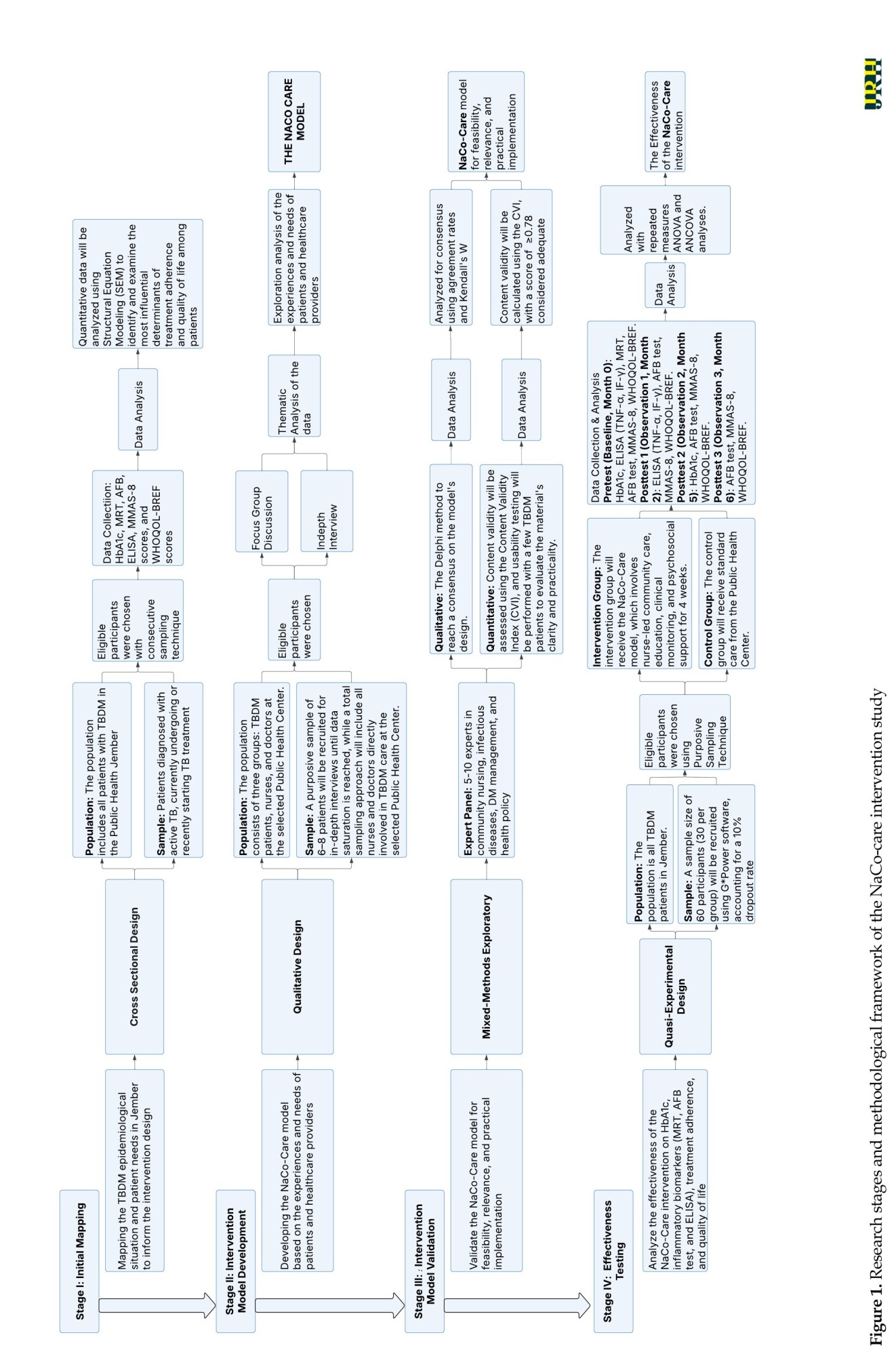
This research will be conducted in the rural agricultural areas of Jember Regency, East Java, at selected public health centers (Puskesmas). This location was chosen due to its high TBDM prevalence and limited integrated nursing interventions. The study will span approximately nine months: the first three months for stages 1-3 (mapping, model development, and validation), and the next six months for the quasi-experimental implementation (stage 4). The study stages are systematically designed to map patient needs, develop the NaCo-care model, validate its feasibility, and test its effectiveness, as illustrated in Figure 1.
Stage 1: Initial mapping
A cross-sectional design will map the TBDM situation and immediate patient needs in Jember to support the NaCo-care intervention. The study will provide a descriptive quantitative snapshot of clinical status, adherence, and QoL at baseline. Findings will identify service gaps and guide the selection of focal components for the nurse-led collaborative model, as well as sampling frames and sites for subsequent stages.
Population and sample
The target population includes all patients with TBDM within the public health center (Puskesmas) of Jember. The selected Puskesmas were chosen based on the high number of reported TBDM cases and accessibility for follow-up visits. The analytic sample will comprise patients with active TB who are currently on TB therapy or recently initiated treatment. The sample size will be calculated using the Slovin formula [17], with a population (N) of 4,419 TB patients and a 10% margin of error (e), resulting in a sample size (n) of approximately 98. Consecutive sampling will be applied at participating public health centers (Puskesmas) during the data-collection window to minimize selection bias and ensure feasibility across sites.
Inclusion criteria
Adults (≥18 years) with a confirmed diagnosis of active TB; currently undergoing or having started TB treatment within the last two months; able and willing to complete questionnaires and undergo laboratory testing. For the TBDM subgroup, a confirmed diagnosis of type 2 DM is required.
Exclusion criteria
Severe systemic infection (e.g. HIV/AIDS), ongoing long-term immunosuppression (e.g. chronic steroids), or refusal/withdrawal of consent.
Procedure
Eligible attendees at Puskesmas will be screened, consented, and enrolled consecutively. Trained nurses will capture demographics, clinical characteristics, treatment phase, and service-use data. Laboratory and patient-reported outcomes will then be obtained in a single visit. Data quality will be ensured through standardized operating procedures, double-entry checks, and daily monitoring. Descriptive statistics (means, medians, proportions, 95% confidence intervals [CIs]) will summarize HbA1c, ELISA (tumor necrosis factor-alpha [TNF-α], interferon-gamma [IF-γ]), MRT, AFB test, Morisky medication adherence scale (MMAS-8), and WHO quality of life (WHOQOL-BREF), depicting the population’s clinical and psychosocial profile.
Stage 2: Intervention model development
A qualitative design will be used to develop the NaCo-care model, centering lived experiences of patients and operational realities of providers. The approach prioritizes flexibility and depth, enabling the study team to surface barriers, facilitators, and collaboration opportunities specific to TBDM care in Puskesmas settings. Findings from the Stage 1 mapping will guide participant selection and question development in Stage 2 qualitative inquiry, focusing on the most influential determinants identified quantitatively. The qualitative insights will then be synthesized to refine and contextualize the intervention components, ensuring that the NaCo-care model is both evidence-informed and responsive to local healthcare system constraints. Outputs will be translated into a pragmatic, nurse-led, team-based model.
Population and sample
This stage will involve three participant groups: TBDM patients, nurses, and doctors in selected Puskesmas. Patients will be purposively recruited until thematic saturation is achieved, typically within 12–26 participants, based on prior qualitative studies involving the T2DM population [18–20]. All nurses and physicians directly engaged in TBDM care will be included through total sampling to capture comprehensive provider perspectives. Previous qualitative studies suggest that 10–20 health workers are generally sufficient to reach thematic saturation [21, 22].
Inclusion criteria
Patients: confirmed active TB with type 2 DM; ≥1 month on treatment; age ≥18; able to communicate verbally; consent provided. Providers: nurses and doctors with ≥6 months’ experience directly delivering TBDM services at the site; consent provided.
Procedure
Data will be collected via in-depth interviews with patients and focus group discussions (FGDs) with providers, using semi-structured guides aligned to the TBDM care pathway. Topics include care coordination, adherence challenges, psychosocial needs, stigma, clinical monitoring, and interprofessional collaboration. Audio recordings will be transcribed verbatim. Thematic analysis will be conducted iteratively to identify essential functions, workflow, and role delineation. Findings will be synthesized into a draft NaCo-care model and patient/provider tools (education, monitoring, and support components). Themes identified from Stage 2 will be synthesized to refine the NaCo-care model components, ensuring that the intervention design reflects real contextual barriers and facilitators identified in the field.
Stage 3: Intervention model validation
A mixed-methods exploratory design will validate the NaCo-care model for feasibility, relevance, and implementability. Building on the qualitative insights from Stage 2, which identified key barriers, facilitators, and collaboration mechanisms in TBDM management, the qualitative core of Stage 3 will utilize the Delphi method with a multidisciplinary panel of experts [23, 24]—comprising nurses, physicians, and public health practitioners—to iteratively refine model components, workflow structures, and community engagement strategies until consensus is reached.
Population and sample
An expert panel of 8–10 members will be purposively selected from community nursing, infectious diseases, diabetes management, and health policy. The number of experts required for the Delphi method can vary widely. Small panels (as few as 8-10 experts) can be effective, especially if the experts are well-defined and the topic is specific [23, 24]. Additionally, a small convenience sample of TBDM patients (and, if appropriate, nurses) will be engaged for brief usability testing of patient-facing and provider-facing materials.
Inclusion criteria
Experts: recognized clinical/academic qualifications, active engagement in practice/research, and TBDM-relevant expertise; consent provided. Patients: confirmed TBDM; currently in care; able to provide feedback on clarity and practicality; consent provided.
Procedure
Delphi round 1 will gather structured ratings and free-text feedback on model components (e.g. nurse roles, monitoring cadence, education modules, and referral criteria). Summaries and revisions will be circulated for Round 2 or 3 until consensus is achieved, using agreement rates and Kendall’s W to quantify concordance. In parallel, content validity will be calculated (I-content validity index [CVI], S-CVI), with S-CVI ≥ 0.78 considered adequate. Usability testing (think-aloud/cognitive debriefs) with a few TBDM patients will assess clarity, perceived usefulness, and burden; findings will inform final edits. Delphi rating forms (Likert scales), consensus tracking sheets, Kendall’s W calculator/spreadsheet, CVI scoring matrices (I-CVI, S-CVI), short usability questionnaires/interview guides, and a change-log to document decisions and finalize the NaCo-care package.
Stage 4: Effectiveness testing
A quasi-experimental pre-test–post-test control-group design will evaluate the NaCo-care effectiveness versus standard care. The intervention consists of a 24-week, nurse-led program using NaCo-care that integrates community-based care, structured education, clinical monitoring, and psychosocial support through in-person visits and telehealth or social media platforms to maintain engagement and adherence. The intervention begins at baseline, followed by scheduled follow-up assessments at Month 2, Month 5, and Month 6.
Population and sample
The population includes all TBDM patients in Jember. Using SPSS software, Version 23.0 (IBM Corp., Armonk, NY, USA). and allowing for attrition, 60 participants will be enrolled: 30 in the intervention group and 30 in the control group. Purposive sampling at participating Puskesmas will identify eligible participants, with non-random allocation at the facility or patient level consistent with quasi-experimental practice.
Inclusion criteria
Adults (≥18) with confirmed TBDM; currently on TB treatment; willing to participate for six months and complete all assessments; consent provided.
Exclusion criteria
Severe systemic infection (e.g. HIV/AIDS), long-term immunosuppression, or refusal/withdrawal of consent.
Procedure
After baseline (pre-test, Month 0), the intervention group receives NaCo-care ; the control group continues standard puskesmas care. follow-up measurements occur at month 2 (observation 1), month 5 (observation 2), and month 6 (observation 3). measurement schedule per diagram:
Pre-test (baseline, month 0): HbA1c, ELISA (TNF-α, IF-γ), MRT, AFB test, MMAS-8, WHOQOL-BREF. Post-test 1 (observation 1, month 2): ELISA (TNF-α, IF-γ), AFB test, MMAS-8, WHOQOL-BREF. Post-test 2 (observation 2, month 5): HbA1c, AFB test, MMAS-8, WHOQOL-BREF. Post-test 3 (observation 3, month 6): AFB test, MMAS-8, WHOQOL-BREF.
Instruments
Quantitative design
Glycated hemoglobin: Glycated hemoglobin (HbA1c) testing is performed using standard laboratory equipment based on immunoturbidimetry or high-performance liquid chromatography, depending on available facilities. HbA1c reflects the average blood glucose level over the past 2–3 months and is a crucial indicator in managing DM. HbA1c values are usually expressed as a percentage, with a normal range of <5.7%, prediabetes 5.7–6.4%, and diabetes ≥6.5% according to the American Diabetes Association. This test has high reliability, with a coefficient of variation of <3%, and has been widely used in clinical studies and primary health care [25].
Molecular rapid test: The molecular rapid test (MRT) detects the presence of M. tuberculosis and rifampicin resistance using a PCR-based genetic amplification technique. This test is recommended by the WHO (2016) as a rapid TB diagnostic tool with high sensitivity and specificity (sensitivity >90% for pulmonary TB cases). This instrument requires trained laboratory personnel and equipment validation before routine use [26].
Acid-fast bacillus test: In this study, the AFB test confirms the presence of M. tuberculosis infection among participants diagnosed with TBDM [27]. The test serves as an essential baseline diagnostic tool to verify TB status before implementing the NaCo-care intervention, ensuring that all enrolled participants meet the inclusion criteria for active or previously treated TB [28]. Furthermore, AFB results are utilized to monitor treatment progress and bacteriological conversion during follow-up assessments, supporting evaluation of clinical outcomes associated with the integrated nurse-led and collaborative community care model.
Enzyme-linked immunosorbent assay: ELISA is a laboratory method used to detect specific antibodies or antigens in a blood sample. In this study, ELISA was used to detect antibodies against M. tuberculosis, specifically to assess a patient’s immunological status. Its working principle is the interaction of enzyme-labeled antigens with antibodies, with the results converted into a color reading (optical density). ELISA has high sensitivity and specificity, depending on the kit used, with validity determined by WHO standards and the kit manufacturer. ELISA results are typically qualitative (positive/negative) or quantitative, based on the antibody titer [29].
Morisky medication adherence scale: The MMAS-8 is a questionnaire developed by Morisky et al. in 2008 to measure patient adherence to self-administered medications. The instrument consists of eight closed-ended questions: Seven yes/no and one 5-point Likert-scale question. The total score ranges from 0 to 8, with the following categories: high adherence (score 8), moderate adherence (score 6–7), and low adherence (score<6). The construct validity of the MMAS-8 has been tested in various chronic disease populations, including diabetes and TB, with internal reliability Cronbach’s α>0.759 [30].
World Health Organization quality of life: The WHOQOL-BREF is a quality-of-life instrument developed by the WHO and is a shortened version of the WHOQOL-100. Consisting of 26 questions, this instrument covers four domains: Physical health, psychological health, social relationships, and the environment. Each item is measured on a 5-point Likert scale (1–5), with the total score converted to a scale of 0–100. The WHOQOL-BREF has been proven valid and reliable internationally, including in Indonesia, with Cronbach’s α values ranging from 0.816 for each domain. Scores are categorized based on percentiles: low QoL (≤25th percentile), moderate (P25
Qualitative design
Intervention model development: A qualitative instrument will consist of semi-structured interview guides for patients and FGD guides for healthcare providers. The interview guide for patients will include open-ended questions exploring their experiences with TBDM treatment, barriers to adherence, psychosocial needs, perceptions of healthcare support, and suggestions for improving care delivery. The FGD guide for nurses and doctors will focus on collaborative practices, interprofessional communication, role clarity, workload management, and perceived challenges in managing TBDM cases. Both guides will be developed based on literature review, expert consultation, and pilot testing to ensure cultural appropriateness and clarity. Supporting instruments will include audio recorders for capturing verbatim data, transcription templates for data management, and reflexive journals for researchers to document observations, contextual nuances, and non-verbal cues during data collection. NVivo software will be employed to code and analyze transcripts, enabling systematic identification of key themes that inform the initial NaCo-care model framework.
Intervention model validation: The qualitative instrument will center on structured Delphi questionnaires for experts, designed to collect iterative feedback on each component of the NaCo-care model. The questionnaire will include rating scales (e.g. relevance, feasibility, clarity, and comprehensiveness) and open-text boxes for detailed qualitative feedback. Each Delphi round will refine the model by integrating expert comments and presenting revised versions back to the panel. Additionally, short usability interview guides will be employed with a small group of TBDM patients to test the clarity and practicality of educational materials, monitoring tools, and psychosocial support modules. Field notes and observation checklists will complement the data, capturing usability issues such as comprehension difficulties, time burden, or acceptability. Together, these instruments will provide rich qualitative insights to validate the NaCo-care model before broader implementation.
Data analysis
Data will be analyzed in four sequential stages according to the research design, and missing data will be handled using the intention-to-treat (ITT) approach to ensure that all participants initially enrolled are included in the final analysis according to their original group allocation.
Stage 1: Quantitative data will be analyzed using structural equation modeling (SEM) to identify and examine the most influential determinants of treatment adherence and QoL. SEM is chosen because it allows simultaneous testing of multiple interrelated variables and provides a comprehensive understanding of the direct and indirect pathways influencing the outcomes. This analysis will produce a conceptual structure of factors that form the foundation for developing the NaCo-care model.
Stage 2: Thematic analysis will be used to analyze qualitative data from in-depth interviews and FGDs with patients, physicians, and nurses. This approach will capture the contextual and behavioral aspects underlying the findings from Stage 1, allowing a deeper interpretation of barriers and facilitators to care adherence and patient well-being. The results of this stage will serve to refine and strengthen the conceptual framework of the NACoCare model.
Stage 3: Data from the Delphi method will be analyzed descriptively to assess expert consensus on the relevance, clarity, and feasibility of each component of the NACoCare model. Consensus will be determined based on agreement percentages and the interquartile range criteria. This stage ensures the content validity and practical applicability of the developed model before implementation.
Stage 4: The effectiveness of the validated NACoCare model will be evaluated using a quasi-experimental design with repeated measurements. Data will be analyzed using both within-group and between-group approaches. For within-group comparisons across four measurement points (month 0, 2, 5, and 6), repeated-measures analysis of variance will be applied to examine time-related effects. For between-group comparisons, analysis of covariance will be employed to compare post-intervention outcomes between the intervention and control groups while controlling for baseline values. Data normality will be tested using the Shapiro–Wilk test, and the assumption of sphericity will be verified with Mauchly’s test. Analyses will be performed using SPSS software, version 23 with a significance level set at P<0.05. Missing data will be handled using the ITT approach, ensuring that all participants initially enrolled are included in the final analysis according to their original group allocation.
Results
The established protocol defines the NaCo-care model as a structured, nurse-led, community-based collaborative care model for the integrated management of tuberculosis and type 2 diabetes mellitus (TB-DM) in rural agricultural settings. Findings from the initial prospective mapping phase are expected to provide a comprehensive characterization of patients with TB-DM, including their demographic profiles, clinical status, treatment adherence, quality of life, and barriers to accessing care. These findings will subsequently inform the identification of priority components and contextual requirements for the development of an integrated, community-based care model.
The model development phase is expected to generate a contextually tailored NaCo-care framework incorporating nurse-led care coordination, collaborative management among healthcare providers, patient education, medication adherence support, clinical monitoring, and community engagement. Qualitative data obtained from patients, nurses, and physicians are also expected to identify key barriers, facilitators, and contextual factors that influence the management of TB-DM.
The validation phase is designed to establish the feasibility, relevance, and content validity of the NaCo-care model through expert consensus using the Delphi method, together with usability testing. The validated model is expected to include standardized intervention components, implementation strategies, monitoring tools, and multidisciplinary care pathways that are appropriate for community healthcare settings.
The effectiveness-testing phase will evaluate whether participants receiving the NaCo-care intervention achieve better outcomes than those receiving usual care. Expected improvements include enhanced glycemic control, as reflected by HbA1c levels; improved tuberculosis treatment indicators, including AFB conversion and molecular diagnostic profiles; and more favorable immunological responses, including TNF-α and IFN-γ levels. Treatment adherence will also be assessed during the 180-day follow-up using the Morisky medication adherence scale-8 (MMAS-8), with the intervention arm expected to demonstrate a higher adherence rate than the usual-care arm.
Discussion
This study explores the effectiveness of NaCo-care in managing the dual burden of TBDM in rural Indonesia. The findings are expected to provide evidence of how integrated, nurse-led interventions can address the intertwined challenges of metabolic and infectious diseases. The discussion centers on four interrelated themes: clinical efficacy, the role of community nurses, holistic patient care, and policy implications.
The anticipated improvements in HbA1c levels, AFB, and ELISA results are expected to demonstrate the clinical efficacy of the NaCo-care model. Glycemic control, as reflected by reduced HbA1c, is a well-established predictor of better diabetes outcomes, and its improvement also has implications for TB management [32]. Prior studies have shown that hyperglycemia impairs macrophage activation and cytokine balance, promoting TB reactivation [33]. Therefore, improvements in both metabolic (HbA1c) and immunologic (ELISA) parameters highlight that TBDM management requires integrated interventions rather than isolated disease-focused care [34, 35]. The expected reduction in AFB positivity across post-test stages further reinforces the model’s potential to improve treatment outcomes.
Nurses play a pivotal role in coordinating and implementing care in rural settings where physician access is limited. The NaCo-care model positions community nurses as both clinical practitioners and care coordinators who connect national guidelines with local realities. Through partnerships with health cadres, families, and community leaders, nurses ensure that TBDM care remains culturally appropriate, context-sensitive, and sustainable [36, 37]. This aligns with global health evidence emphasizing task-shifting and empowering nurses to address workforce shortages in primary care [38]. By fostering long-term adherence and providing continuous support, nurses can ensure continuity and trust, both essential for chronic disease management.
Beyond clinical indicators, improvements in medication adherence (MMAS-8) and WHOQOL-BREF are expected to reflect the holistic benefits of the NaCo-care approach. These outcomes underscore the importance of considering psychosocial and behavioral factors alongside biomedical management in TBDM care. Patient education, family engagement, and ongoing nurse follow-up enhance patient empowerment, motivation, and health literacy [39, 40]. These outcomes reflect the principles of patient-centered care, which recognizes patients as active agents in managing their conditions and improving overall well-being [41].
The NaCo-care model offers a scalable and sustainable framework that supports the national agenda for integrating TB and DM services at the puskesmas level. By utilizing existing community-based infrastructure, such as posyandu and local health cadres, the model leverages local resources, minimizes costs, and enhances feasibility [42]. Rather than creating parallel programs, this approach strengthens existing systems and supports the long-term sustainability of TBDM control efforts [43, 44].
A pivotal theme emerging from the results is the central role of nurses in delivering and coordinating care. In rural Indonesia, where access to specialized physicians is limited, community nurses often represent the frontline of health care. The NaCo-care model empowers nurses not only to deliver clinical interventions but also to coordinate care and bridge national guidelines with local realities. By collaborating with community health cadres, families, and local leaders, nurses can ensure that care is culturally appropriate, locally feasible, and responsive to community needs [37].
This study’s most significant contribution lies in its policy implications. Indonesia, like many other low- and middle-income countries, faces the dual challenge of high TB prevalence and rising diabetes incidence. National health policies already emphasize integrating TB and DM services at the primary care level, but implementation remains uneven, particularly in rural areas [45]. The successful application of the NaCo-care model may provide an evidence-based framework for strengthening the integration of TBDM services within Indonesia’s primary healthcare system.
However, several potential challenges must be acknowledged. Participant dropout may affect the consistency of follow-up data over 24 weeks, especially in mobile rural populations. Inter-facility variability, including differences in staff competencies and resource availability, may influence intervention fidelity. Limited laboratory capacity could also hinder the regular testing of ELISA, HbA1c, and AFB samples. Addressing these challenges through standardized protocols, periodic nurse retraining, and integrated data monitoring will be essential to maintain the reliability and reproducibility of the NaCo-care model.
Regarding generalizability, while this study was conducted in rural agricultural communities in Jember, its conceptual framework is adaptable to other low-resource regions with similar TBDM burdens. The structured collaboration among nurses, local health authorities, and communities can inform broader applications in other provinces or LMICs facing similar comorbidity challenges. Long-term sustainability will depend on policy adoption, integration into public health financing systems, and continued professional development for nurses.
This study represents the first implementation of the NaCo-care model in rural agricultural areas of Indonesia, addressing the gap in integrated TBDM management at the community level. Its novelty lies in adapting a nurse-led framework to a community-based primary care context, supported by collaborative intersectoral engagement.
The research is projected to follow a 12-month timeline covering model development, pilot implementation, and evaluation phases, which will serve as the foundation for future scaling and policy integration across other rural regions.
Study limitations
As with any study, the findings must be interpreted within the context of certain limitations. The quasi-experimental design may introduce selection bias, as participants are not randomly assigned to intervention and control groups. Additionally, the relatively short intervention duration and variability among participating facilities may influence the consistency of the observed effects. Differences in healthcare infrastructure, availability of diagnostic tools such as the MRT and AFB test, as well as variations in nurse competencies and patient engagement, may also impact the intervention outcomes. Furthermore, self-reported measures used to assess adherence and QoL may be subject to response bias. Despite these limitations, the study provides valuable real-world insights into the feasibility and potential impact of a nurse-led, community-based model for managing TBDM comorbidity in rural settings.
Conclusion
Upon completion, this study is expected to conclude that the NaCo-care model is an effective and evidence-based intervention for managing patients with TBDM in rural agricultural areas. The intervention is anticipated to demonstrate significant improvements in clinical, adherence, and QoL outcomes for patients who receive the NaCo-care intervention compared to those receiving standard care. Furthermore, the findings are expected to contribute to clinical practice by strengthening nurse-led community care, inform nursing education by integrating collaborative chronic disease management into curricula, and support public health policy by providing empirical evidence to scale up nurse-led TBDM programs in resource-limited settings.
Ethical Considerations
Compliance with ethical guidelines
This study was approved by the Ethics Committee of University of Jember, Jember, Indonesia (Code: 3298UN25.8/KEPK/DL/2025). All participants signed an informed consent form before the study commenced, ensuring voluntary participation and protecting their confidentiality throughout the study.
Funding
This research did not receive any specific grant from funding agencies in the public, commercial, or not-for-profit sectors.
Authors' contributions
Drafting the protocol, literature review, and manuscript preparation: Andi Eka Pranata; Conceptualization, methodology design, and supervision: Tantut Susanto; Medical aspects, clinical expertise, and critical revision of the manuscript: Erma Sulistyaningsih; Health education aspects, data analysis framework, and manuscript editing: Erlia Narulita.
Conflict of interest
The authors declared no conflict of interest.
Acknowledgments
The authors thank the University of Jember and the collaborating faculties for their support in developing this research protocol. They also extend our appreciation to the healthcare providers and patients who will participate in this study.
References
- Parvez FM. Prevention and control of tuberculosis in correctional facilities. In: Greifinger RB, editor. Public health behind bars: From prisons to communities. New York: Springer US; 2021. [DOI:10.1007/978-1-0716-1807-3_11]
- López-López JP, Posada-Martínez EL, Saldarriaga C, Farina JM, Liblik K, Baranchuk A. Tuberculosis & heart. In: Saldarriaga C, Baranchuk A, editors. Neglected tropical diseases and other infectious diseases affecting the heart. Cambridge: Academic Press; 2022. [DOI:10.1016/B978-0-323-91122-1.00001-5]
- Kupz A. Live attenuated vaccines for tuberculosis. Biochemist. 2021; 43(4):28-32. [DOI:10.1042/bio_2021_149]
- Li M, Chen T, Hua Z, Yan H, Wang D, Li Z, et al. Global, regional, and national prevalence of diabetes mellitus in patients with pulmonary tuberculosis: A systematic review and meta-analysis. Diabetology & Metabolic Syndrome. 2021; 13(1):127. [DOI:10.1186/s13098-021-00743-3] [PMID] [PMCID]
- Wu Q, Liu Y, Ma YB, Liu K, Chen SH. Incidence and prevalence of pulmonary tuberculosis among patients with type 2 diabetes mellitus: A systematic review and meta-analysis. Annals of Medicine. 2022; 54(1):1657-66. [DOI:10.1080/07853890.2022.2085318] [PMID] [PMCID]
- Putri EIS, Indriati DW, Wahyunitisari MR. The prevalence of diabetes mellitus among hospitalized tuberculosis positive case admitted in Hajj Hospital, Surabaya, Indonesia. Malaysian Journal of Medicine and Health Sciences. 2020; 16(1):235-9. [Link]
- Ministry of Health of the Republic of Indonesia. Tuberculosis control program report 2023. Jakarta: Ministry of Health of the Republic of Indonesia. 2024. [Link]
- Awad SF, Critchley JA, Abu-Raddad LJ. Impact of diabetes mellitus on tuberculosis epidemiology in Indonesia: A mathematical modeling analysis. Tuberculosis. 2022; 134:102164. [DOI:10.1016/j.tube.2022.102164] [PMID]
- Peraturan Presiden RI. [Presidential regulation of the republic of Indonesia number 67 of 2021 concerning tuberculosis control (Indonesian)]. Ministry of Health of the Republic of Indonesia. 2021; 67(069394):107. [Link]
- Kemenkes. Strategi nasional penanggulangan tuberkulosis di Indonesia 2020-2024. Jakarta: Ministry of Health of the Republic of Indonesia; 2020. [Link]
- Arini M, Prakoso DA, Suryanto F, Dewi A, Basha MABMK. Navigating barriers: The need for integrated health information system for tuberculosis-diabetes co-screening. Indonesian Journal of Health Administration. 2024; 12(1):162-77. [Link]
- Ministry of Education and Culture. [Social assistance grant reference number for prospective book authors (Indonesian)]. Jakarta: Ministry of Education and Culture; 2010. [Link]
- Joshi R, Behera D, Di Tanna GL, Ameer MA, Yakubu K, Praveen D. Integrated management of diabetes and tuberculosis in rural India-results from a pilot study. Frontiers in Public Health. 2022; 10:766847. [DOI:10.3389/fpubh.2022.766847] [PMID] [PMCID]
- Hatchett R. How to set up a nurse-led clinic. Nursing Standard. 2016; 30(37):64-5. [DOI:10.7748/ns.30.37.64.s45] [PMID]
- Godwin IU, Atulomah N. Effect of lifestyle modification intervention on diabetes mellitus treatment outcomes in tuberculosis patients with diabetes mellitus in Southwest Nigeria. Texila International Journal. 2023; 11(2):329-42. [DOI:10.21522/TIJPH.2013.11.02.Art030]
- Sumarni S. [Five-stage research and development (R&D) model (MANTAP) (Indonesian)]. Yogyakarta: Faculty of Tarbiyah and Teacher Training, UIN Sunan Kalijaga; 2019. [Link]
- Mukti BH. Sample size determination: Principles and applications for health research. Health Sciences International Journal. 2025; 3(1):127-43. [DOI:10.71357/hsij.v3i1.63]
- Rezaei M, Valiee S, Tahan M, Ebtekar F, Ghanei Gheshlagh R. Barriers of medication adherence in patients with type-2 diabetes: A pilot qualitative study. Diabetes, Metabolic Syndrome and Obesity. 2019; 12:589-99. [DOI:10.2147/DMSO.S197159]
- Semerci Çakmak V, Sönmez Sari E, Çetinkaya Özdemir S. Experiences of adults with type 2 diabetes mellitus with low socioeconomic status: A qualitative study. BMC public health. 2025; 25(1):381. [DOI:10.1186/s12889-025-21582-1]
- Dehdari L, Dehdari T. The determinants of anti-diabetic medication adherence based on the experiences of patients with type 2 diabetes. Archives of Public Health. 2019; 77(1):21. [DOI:10.1186/s13690-019-0347-z]
- Fofana F, Bazeley P, Regnault A. Applying a mixed methods design to test saturation for qualitative data in health outcomes research. Plos One. 2020; 15(6):e0234898. [DOI:10.1371/journal.pone.0234898]
- Liebzeit D, Haske-Palomino M, Gatley L, Boltz M. Nurses’ experiences with an inpatient geriatric consulting service at a Midwestern Veterans’ hospital: The elder veteran program. Geriatric Nursing. 2021; 42(2):317-24. [DOI:10.1016/j.gerinurse.2021.01.004]
- Campbell D, Ramsey S, Veenstra D, Pan M, Sen S, Litton G, et al. Diagnosis, treatment, and unmet needs of dedifferentiated liposarcoma in the United States: A multidisciplinary Delphi study. Cancers. 2025; 17(17):2815. [DOI:10.3390/cancers17172815]
- Zeeman JM, Petersen AE, Colmenares EW, Schenkat DH, Vest MH. Identifying health-system pharmacy operational process categories and corresponding tasks across a diverse health system using a modified Delphi process. American Journal of Health-System Pharmacy. 2022; 79(13):1070-8. [DOI:10.1093/ajhp/zxac072]
- ElSayed NA, Aleppo G, Aroda VR, Bannuru RR, Brown FM, Bruemmer D, et al. Introduction and methodology: Standards of care in diabetes-2023. Diabetes Care. 2022; 46(Supplement_1):S1-4. [DOI:10.2337/dc23-Sint] [PMID] [PMCID]
- Pepys MB, Hirschfield GM. C-reactive protein: A critical update. Journal of Clinical Investigation. 2003; 111(12):1805-12. [DOI:10.1172/JCI200318921] [PMID]
- Zahoor D, Farhana A, Manzoor M, Kanth F, Nasir R. Detection of mycobacterium tuberculosis in pulmonary and extrapulmonary samples using different methods: Experience of a tertiary care center in North India. Infection, Epidemiology and Microbiology. 2023; 9(2):191-9. [DOI:10.52547/iem.9.2.191]
- Slail MJ, Booq RY, Al-Ahmad IH, Alharbi AA, Alharbi SF, Alotaibi MZ, et al. Evaluation of xpert MTB/RIF Ultra for the diagnosis of extrapulmonary tuberculosis: a Retrospective Analysis in Saudi Arabia. Journal of Epidemiology and Global Health. 2023; 13(4):782-93. [DOI:10.1007/s44197-023-00150-z]
- Engvall E, Perlmann P. Enzyme-linked immunosorbent assay (ELISA) quantitative assay of immunoglobulin G. Immunochemistry. 1971; 8(9):871-4. [DOI:10.1016/0019-2791(71)90454-X] [PMID]
- Siagian M, Wangge G. Validity and reliability of Morisky medication adherence scale 8 Bahasa version to measure statin adherence among military pilots. Health Science Journal of Indonesia. 2016; 7(2):129-33. [DOI:10.22435/hsji.v7i2.5343.129-133]
- Yulianti S, Azzam R, Rayasari F, Susanti HD, AW WA, Saadulloh D, et al. The psychometric properties of Indonesian version of WHO quality of life 100 in tuberculosis patients. Jurnal Keperawatan Padjadjaran. 2024; 12(2):135-43. [DOI:10.24198/jkp.v12i2.2500]
- Zahid M, Afaq S, Shafique K, Qazi FK, Ashfaq U, Asim M, et al. Effect of glycemic control on tuberculosis treatment outcomes among patients with tuberculosis and diabetes mellitus: A systematic review and meta-analysis. Tropical Medicine and International Health. 2025; 30(8):749-62. [DOI:10.1111/tmi.14140]
- Torres M, Herrera MT, Fabián-San-Miguel G, Gonzalez Y. The intracellular growth of M. Tuberculosis is more Associated with high glucose levels than with impaired responses of monocytes from T2D patients. Journal of Immunology Research. 2019; 2019(1):1462098. [DOI:10.1155/2019/1462098]
- Gupta A, Chandra E, Mrigpuri P. Navigating the dual burden of diabetes mellitus and tuberculosis: A comprehensive review of clinical and public health strategies. Indian Journal of Tuberculosis. 2025; 72(2):253-8. [DOI:10.1016/j.ijtb.2025.03.011]
- Milice DM, Macicame I, L.Peñalvo J. The collaborative framework for the management of tuberculosis and type 2 diabetes syndemic in low- and middle-income countries: A rapid review. BMC Public Health. 2024; 24(1):738. [DOI:10.1186/s12889-024-18256-9]
- Sejie GA, Mahomed OH. Potential facilitators and inhibitors to the implementation and sustainability of the community-based tuberculosis care interventions. A case study from Moshupa, Botswana. Plos One. 2023; 18(8):e0290010. [DOI:10.1371/journal.pone.0290010]
- Enriquez M, Molina R, Alvarez N, Barbosa M, Cheng AL, Collette J, et al. A community-partnered approach to address excess type 2 diabetes Mellitus in a midwestern community. Journal of Community Health Nursing. 2025; 42(4):269-79. [DOI:10.1080/07370016.2025.2522172]
- Mutiara E, Novita S. Cadre behavior as social capital for the development of TB care community in the management of tuberculosis in Medan City. Indian Journal of Public Health Research & Development. 2019; 10(8):1309. [DOI:10.5958/0976-5506.2019.02077.1]
- Gomes LA, Reis G. Learning to live with chronic disease: Coronary artery disease. In: Information Resources Management Association, editor. Research anthology on improving health literacy through patient communication and mass media. Amsterdam: Elsevier; 2021. [DOI:10.4018/978-1-6684-2414-8.ch016]
- Kucukakgun H, Can G. Patient and family education. In: Gulbeyaz G, Zeliha T, editors. Medical nursing. Amsterdam: Elsevier; 2023. [Link]
- Krist AH, Tong ST, Aycock RA, Longo DR. Engaging patients in decision-making and behavior change to promote prevention. Information Services and Use. 2017; 37(2):105-22. [DOI:10.3233/978-1-61499-790-0-284]
- Setiyadi A, Noviana U, Sholikhah EN, Mufarokhah H. Community empowerment through cadres in the tuberculosis program: A scoping review. Iranian Journal of Public Health. 2025; 54(7):1339. [DOI:10.18502/ijph.v54i7.19113]
- Masita M, Hairi FM, Bachtiar A, Mulyana N, Andriani H. Community-driven strategies and policies for drug-resistant tuberculosis control in banyumas regency, Indonesia: A comprehensive 2023 analysis. Journal of Public Health Research. 2025; 14(3):22799036251376872. [DOI:10.1177/22799036251376872]
- Purnaningsih N, Palupi E, Sulassih S, Widhiani AP. Optimizing local resources for stunting prevention and community health promotion in Indonesia: A mixed-methods study on collaborative communication and extension. Media Publikasi Promosi Kesehatan Indonesia. 2025; 8(8):676-88. [DOI:10.56338/mppki.v8i8.7520]
- Prakoso DA, Istiono W, Mahendradhata Y, Arini M. Acceptability and feasibility of tuberculosis-diabetes mellitus screening implementation in private primary care clinics in Yogyakarta, Indonesia: A qualitative study. BMC Public Health. 2023; 23(1):1908. [DOI:10.1186/s12889-023-16840-z]
Type of Study: Study Protocol |
Subject:
● Service Quality
Received: 2025/09/13 | Accepted: 2026/01/27 | Published: 2026/08/23
Received: 2025/09/13 | Accepted: 2026/01/27 | Published: 2026/08/23
| Rights and permissions | |
 |
This work is licensed under a Creative Commons Attribution-NonCommercial 4.0 International License. |

This is an open access article distributed under the terms of the Creative Commons Attribution License (CC-By-NC), which permits use, distribution, and reproduction in any medium, provided the original work is properly cited and is not used for commercial purposes.
Contact Information
