

Volume 16, Issue 3 (May & June 2026)
J Research Health 2026, 16(3): 267-274 |
Back to browse issues page


Ethics code: IR.MEDILAM.REC.1400.050


Download citation:
BibTeX | RIS | EndNote | Medlars | ProCite | Reference Manager | RefWorks
Send citation to:


BibTeX | RIS | EndNote | Medlars | ProCite | Reference Manager | RefWorks
Send citation to:
Naeem Kareem H, Salam H. Al-Salih S, Hamza Hermis A, K. Hajwal S, Kareem Jawad M, Mohamadian F et al . The Relationship Between the Misery Index, Socio-demographic Index, and Suicide: A 10-year Analysis. J Research Health 2026; 16 (3) :267-274
URL: http://jrh.gmu.ac.ir/article-1-2924-en.html
URL: http://jrh.gmu.ac.ir/article-1-2924-en.html
Hasan Naeem Kareem1 

 , Sadiq Salam H. Al-Salih1 , Alaa Hamza Hermis1 , Salim K. Hajwal2 , Mustafa Kareem Jawad3 , Fathola Mohamadian4 , Yousef Veisani5
, Sadiq Salam H. Al-Salih1 , Alaa Hamza Hermis1 , Salim K. Hajwal2 , Mustafa Kareem Jawad3 , Fathola Mohamadian4 , Yousef Veisani5
1- College of Nursing, University of Al-Qadisiyah, Al-Diwaniyah, Iraq.
2- College of Nursing, Al-Mustaqbal University, Babil, Iraq.
3- College of Nursing, AL-Mustafa University, Baghdad, Iraq.
4- Department of Psychology, Non-communicable Diseases Research Center, School of Medicine, Ilam University of Medical Sciences, Ilam, Iran.
5- Psychosocial Injuries Research Center, Ilam University of Medical Sciences, Ilam, Iran. ,yousefveisani@yahoo.com
2- College of Nursing, Al-Mustaqbal University, Babil, Iraq.
3- College of Nursing, AL-Mustafa University, Baghdad, Iraq.
4- Department of Psychology, Non-communicable Diseases Research Center, School of Medicine, Ilam University of Medical Sciences, Ilam, Iran.
5- Psychosocial Injuries Research Center, Ilam University of Medical Sciences, Ilam, Iran. ,
Keywords: Suicide, Socioeconomic factors, Unemployment, Inflation, Iran, Time series analysis, Sociodemographic index
Full-Text [PDF 636 kb]
(190 Downloads)
| Abstract (HTML) (590 Views)
Full-Text: (33 Views)
Introduction
Suicide is one of the most serious yet preventable causes of death worldwide. According to the World Health Organization (WHO), over 700,000 people died by suicide in 2019, representing a global age-standardized rate of approximately 9.0 per 100,000 population [1]. While the overall suicide rate in Iran has been reported to be around 5.2 per 100,000, which is below the global average, these figures mask significant regional disparities [2]. Ilam Province, located in western Iran on the border with Iraq, has consistently recorded rates far exceed the national average. For instance, a 2024 study reported Ilam’s age-standardized rate to be 16.3 per 100,000, nearly three times the national figure and highlighting it as a persistent high-risk region for over a decade [2, 3]. This concerning trend underscores the critical need to investigate the unique social and economic determinants of mental health within this specific provincial context.
To understand the economic drivers of mental health outcomes, researchers often employ composite indices. The misery index, a simple economic indicator first popularized in the 1970s, is calculated as the sum of the unemployment rate and the inflation rate [4]. It serves as a barometer of economic distress, where higher scores indicate greater levels of joblessness and rising living costs, conditions strongly linked to psychological stress, despair, and suicidal behavior [5, 6]. In Iran, economic instability has led to significant fluctuations in the national misery index, with episodes of critical elevation that likely impact vulnerable regions, such as Ilam Province [7]. Analyzing these economic pressures at a subnational level is crucial, as local economic conditions can differ substantially from national trends.
Conversely, long-term structural development is hypothesized to exert a protective effect. The socio-demographic index (SDI) is a composite measure of a population’s overall development based on income per capita, educational attainment, and fertility rates [8]. Higher SDI is generally associated with better health outcomes, greater opportunities, and stronger social support systems, all of which may mitigate suicide risk [9].
Existing literature provides robust evidence linking economic recessions and rising unemployment to increased suicide rates at national levels [6, 10]. However, most studies focus on high-income countries or short-term shocks, leaving a gap in understanding how these factors interact in a sustained, high-risk, localized setting like Ilam Province. A systematic search reveals that while ecological studies on suicide in Iran exist, few have conducted a multivariable, longitudinal analysis of Ilam Province specifically that incorporates both short-term economic distress (misery index) and long-term development (SDI) [11, 12].
Therefore, this study aims to fill this gap by quantifying the temporal associations between province-level misery index, SDI, and suicide rates in Ilam Province from 2010 to 2019. The findings will provide localized evidence to inform public health strategies tailored to the specific socioeconomic realities of this high-risk region.
Methods
Study design
This longitudinal ecological study was conducted in Ilam Province, Iran, over a ten-year period (2010-2019).
Data Sources and Measurement of Variables
The data for this study were collected in collaboration with several key institutions: Ilam University of Medical Sciences, the Statistical Center of Iran (SCI), and the Iranian Legal Medicine Organization [2, 11]. Suicide statistics were assessed and validated through the national suicide registration system.
Suicide incidence
Monthly data on suicide counts (fatal and nonfatal) were obtained from the Iranian Legal Medicine Organization. To ensure reliability, incomplete, unreadable or contradictory records were removed. The remaining data were cleaned, standardized, and converted to monthly rates per 100,000 population using annual population estimates from the SCI.
Composite indices
Misery index: This index measures the level of economic distress experienced by a population. It was calculated monthly for Ilam Province using data from the SCI. The Equation 1 is:
1. Misery index=Unemployment rate (%)+Inflation rate (%)
The unemployment rate reflects the proportion of the labor force that is jobless and actively seeking work. The inflation rate measures the annual percentage change in the consumer price index, representing the increase in the cost of living. A higher index value indicates greater economic hardship [4, 5].
SDI: This is a composite measure of a region›s overall development level, developed by the global burden of disease study [7, 8]. Annual SDI scores for Ilam Province, ranging from 0 (lowest development) to 1 (highest development), were used. The SDI is calculated as the geometric mean of three underlying indices:
Income per capita: Based on lag-distributed income (LDI), which is a measure of average income that accounts for purchasing power parity.
Educational attainment: The average number of years of education received by individuals aged 15 and older.
Fertility rate: The total fertility rate under the age of 25 (TFU25), which reflects the status of women and family planning.
Data quality assurance
Ensuring data quality enhances the reliability and reproducibility of findings. Three key steps were applied to achieve this goal: First, missing data were imputed using multiple imputation methods. Next, data from various sources were compared to reduce potential errors.Lastly, longitudinal time-based comparisons of variables were conducted for greater accuracy.
Statistical analysis
Descriptive statistics, including Mean±SD, median, and range, were used to illustrate general trends over the decade. Pearson correlation coefficients were used to assess the strength and direction of the relationship between suicide rates, the misery index, and SDI. Subsequently, multivariate linear regression models were applied to evaluate both individual and combined effects of the indices. The models included the misery index and SDI as predictor variables for suicide incidence, with adjustment for underlying time trend and monthly seasonality.
All statistical analyses were conducted using SPSS software, version 26 and Stata software, version 18.
Results
Descriptive statistics and time trends
Table 1 presents the annual suicide rates, misery index, and SDI for Ilam Province from 2010 to 2019.
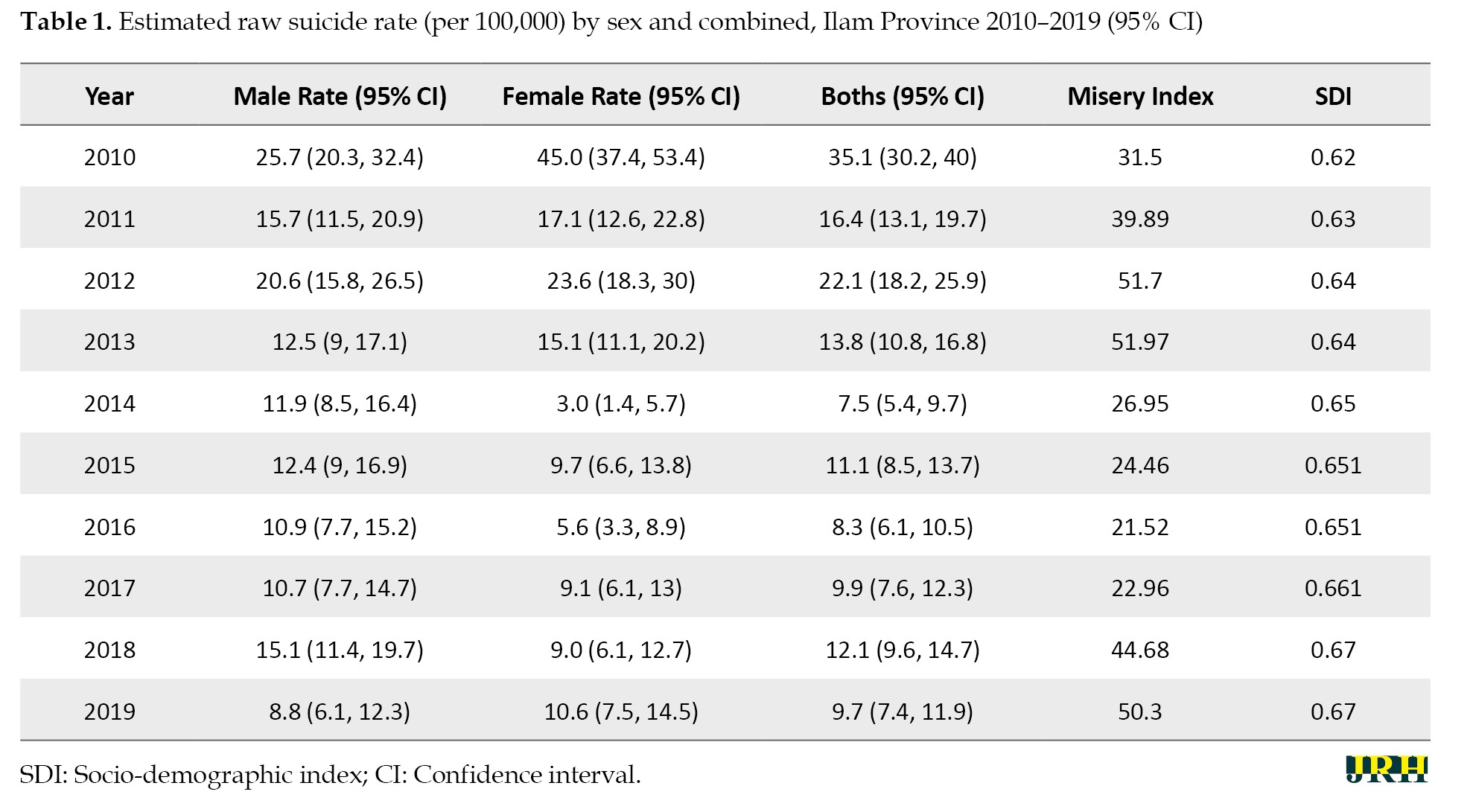
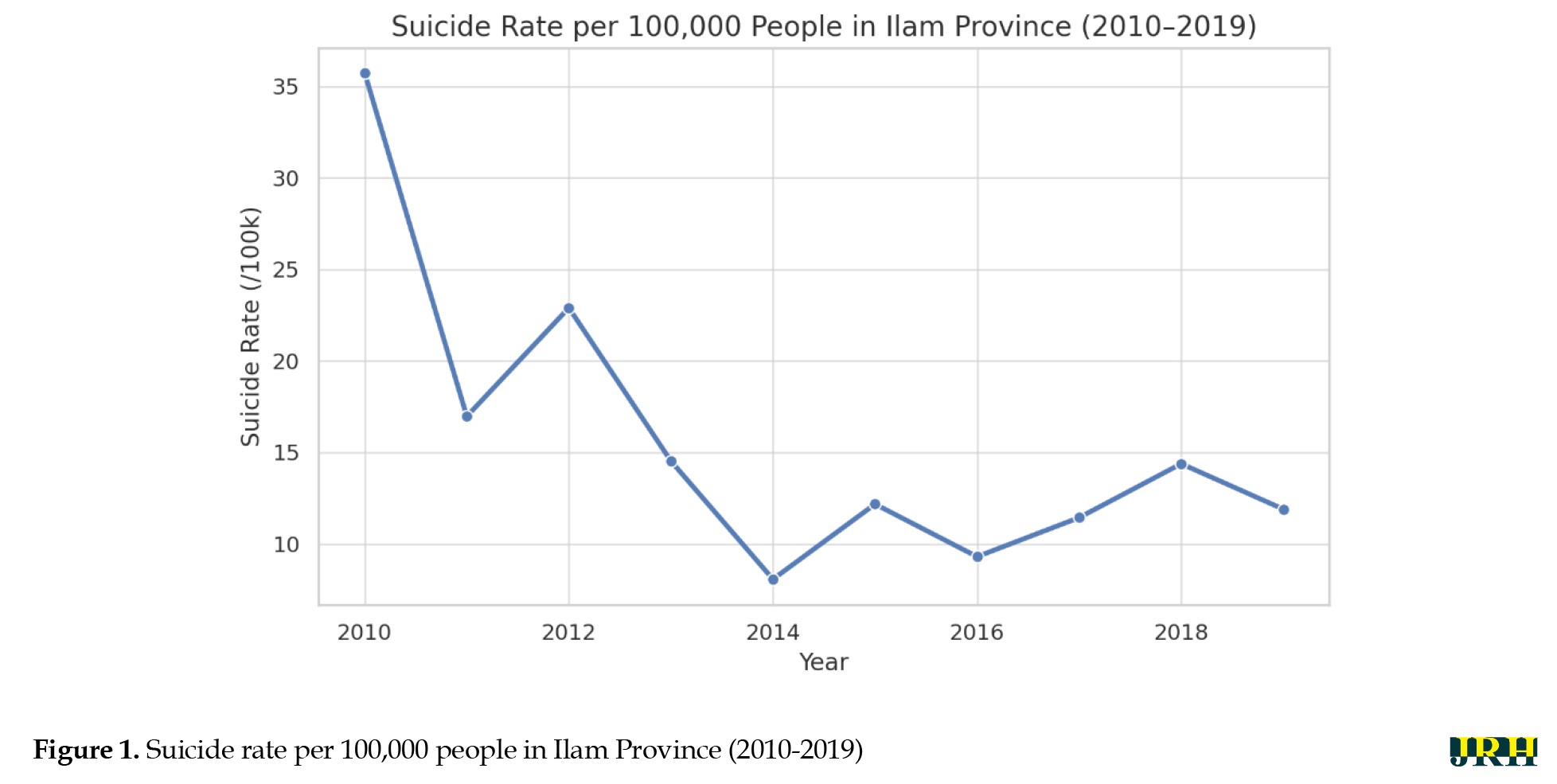
The data reveal a clear, nonlinear downward trend in the overall suicide rate, which declined from a peak of 35.1 per 100,000 in 2010 to 9.7 per 100,000 in 2019. This trend is visualized in Figure 1, which shows a steep decline from 2010 to 2014, followed by a period of relative stabilization at lower levels with minor fluctuations.
Suicide is one of the most serious yet preventable causes of death worldwide. According to the World Health Organization (WHO), over 700,000 people died by suicide in 2019, representing a global age-standardized rate of approximately 9.0 per 100,000 population [1]. While the overall suicide rate in Iran has been reported to be around 5.2 per 100,000, which is below the global average, these figures mask significant regional disparities [2]. Ilam Province, located in western Iran on the border with Iraq, has consistently recorded rates far exceed the national average. For instance, a 2024 study reported Ilam’s age-standardized rate to be 16.3 per 100,000, nearly three times the national figure and highlighting it as a persistent high-risk region for over a decade [2, 3]. This concerning trend underscores the critical need to investigate the unique social and economic determinants of mental health within this specific provincial context.
To understand the economic drivers of mental health outcomes, researchers often employ composite indices. The misery index, a simple economic indicator first popularized in the 1970s, is calculated as the sum of the unemployment rate and the inflation rate [4]. It serves as a barometer of economic distress, where higher scores indicate greater levels of joblessness and rising living costs, conditions strongly linked to psychological stress, despair, and suicidal behavior [5, 6]. In Iran, economic instability has led to significant fluctuations in the national misery index, with episodes of critical elevation that likely impact vulnerable regions, such as Ilam Province [7]. Analyzing these economic pressures at a subnational level is crucial, as local economic conditions can differ substantially from national trends.
Conversely, long-term structural development is hypothesized to exert a protective effect. The socio-demographic index (SDI) is a composite measure of a population’s overall development based on income per capita, educational attainment, and fertility rates [8]. Higher SDI is generally associated with better health outcomes, greater opportunities, and stronger social support systems, all of which may mitigate suicide risk [9].
Existing literature provides robust evidence linking economic recessions and rising unemployment to increased suicide rates at national levels [6, 10]. However, most studies focus on high-income countries or short-term shocks, leaving a gap in understanding how these factors interact in a sustained, high-risk, localized setting like Ilam Province. A systematic search reveals that while ecological studies on suicide in Iran exist, few have conducted a multivariable, longitudinal analysis of Ilam Province specifically that incorporates both short-term economic distress (misery index) and long-term development (SDI) [11, 12].
Therefore, this study aims to fill this gap by quantifying the temporal associations between province-level misery index, SDI, and suicide rates in Ilam Province from 2010 to 2019. The findings will provide localized evidence to inform public health strategies tailored to the specific socioeconomic realities of this high-risk region.
Methods
Study design
This longitudinal ecological study was conducted in Ilam Province, Iran, over a ten-year period (2010-2019).
Data Sources and Measurement of Variables
The data for this study were collected in collaboration with several key institutions: Ilam University of Medical Sciences, the Statistical Center of Iran (SCI), and the Iranian Legal Medicine Organization [2, 11]. Suicide statistics were assessed and validated through the national suicide registration system.
Suicide incidence
Monthly data on suicide counts (fatal and nonfatal) were obtained from the Iranian Legal Medicine Organization. To ensure reliability, incomplete, unreadable or contradictory records were removed. The remaining data were cleaned, standardized, and converted to monthly rates per 100,000 population using annual population estimates from the SCI.
Composite indices
Misery index: This index measures the level of economic distress experienced by a population. It was calculated monthly for Ilam Province using data from the SCI. The Equation 1 is:
1. Misery index=Unemployment rate (%)+Inflation rate (%)
The unemployment rate reflects the proportion of the labor force that is jobless and actively seeking work. The inflation rate measures the annual percentage change in the consumer price index, representing the increase in the cost of living. A higher index value indicates greater economic hardship [4, 5].
SDI: This is a composite measure of a region›s overall development level, developed by the global burden of disease study [7, 8]. Annual SDI scores for Ilam Province, ranging from 0 (lowest development) to 1 (highest development), were used. The SDI is calculated as the geometric mean of three underlying indices:
Income per capita: Based on lag-distributed income (LDI), which is a measure of average income that accounts for purchasing power parity.
Educational attainment: The average number of years of education received by individuals aged 15 and older.
Fertility rate: The total fertility rate under the age of 25 (TFU25), which reflects the status of women and family planning.
Data quality assurance
Ensuring data quality enhances the reliability and reproducibility of findings. Three key steps were applied to achieve this goal: First, missing data were imputed using multiple imputation methods. Next, data from various sources were compared to reduce potential errors.Lastly, longitudinal time-based comparisons of variables were conducted for greater accuracy.
Statistical analysis
Descriptive statistics, including Mean±SD, median, and range, were used to illustrate general trends over the decade. Pearson correlation coefficients were used to assess the strength and direction of the relationship between suicide rates, the misery index, and SDI. Subsequently, multivariate linear regression models were applied to evaluate both individual and combined effects of the indices. The models included the misery index and SDI as predictor variables for suicide incidence, with adjustment for underlying time trend and monthly seasonality.
All statistical analyses were conducted using SPSS software, version 26 and Stata software, version 18.
Results
Descriptive statistics and time trends
Table 1 presents the annual suicide rates, misery index, and SDI for Ilam Province from 2010 to 2019.
The data reveal a clear, nonlinear downward trend in the overall suicide rate, which declined from a peak of 35.1 per 100,000 in 2010 to 9.7 per 100,000 in 2019. This trend is visualized in Figure 1, which shows a steep decline from 2010 to 2014, followed by a period of relative stabilization at lower levels with minor fluctuations.
A notable gender disparity was observed. In 2010, the female suicide rate (45.0 per 100,000) was substantially higher than the male rate (25.7). However, this pattern shifted progressively, with the female rate decreasing dramatically to 10.6 per 100,000 by 2019, while the male rate was 8.8 per 100,000, indicating a marked reduction in the gender gap over the study period.
The two composite indices showed distinct trajectories. The SDI demonstrated a consistent, steady increase from 0.620 in 2010 to 0.670 in 2019, reflecting gradual but sustained developmental progress. In sharp contrast, the misery index showed marked volatility, with notable peaks in 2012–2013 and again in 2018–2019, indicating repeated episodes of pronounced economic stress interrupting periods of relative stability.
Table 2 summarizes the bivariate relationships between the variables.
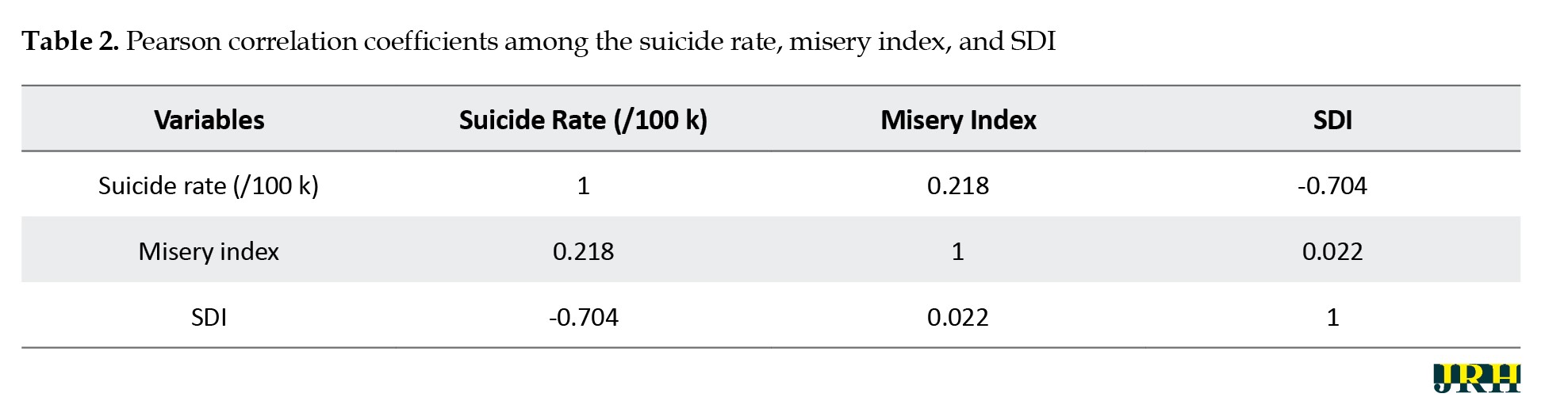
The analysis revealed a weak positive correlation between the misery index and suicide rates (r=0.218), suggesting a modest tendency for suicide incidence to be higher during periods of economic distress. In contrast, a moderate-to-strong negative correlation was observed between the SDI and suicide rates (r=-0.704), indicating that higher levels of development were consistently associated with lower suicide rates over the study period. Furthermore, approximately zero correlation between the misery index and SDI (r=0.022) confirms that these two indices measure fundamentally distinct aspects of the provincial context, with short-term economic volatility being independent of the long-term, gradual trajectory of sociodemographic development.
The results of the multiple linear regression analysis, presented in Table 3, elucidate the independent associations of these indices with suicide rates after controlling for each other, underlying time trends, and seasonal effects.
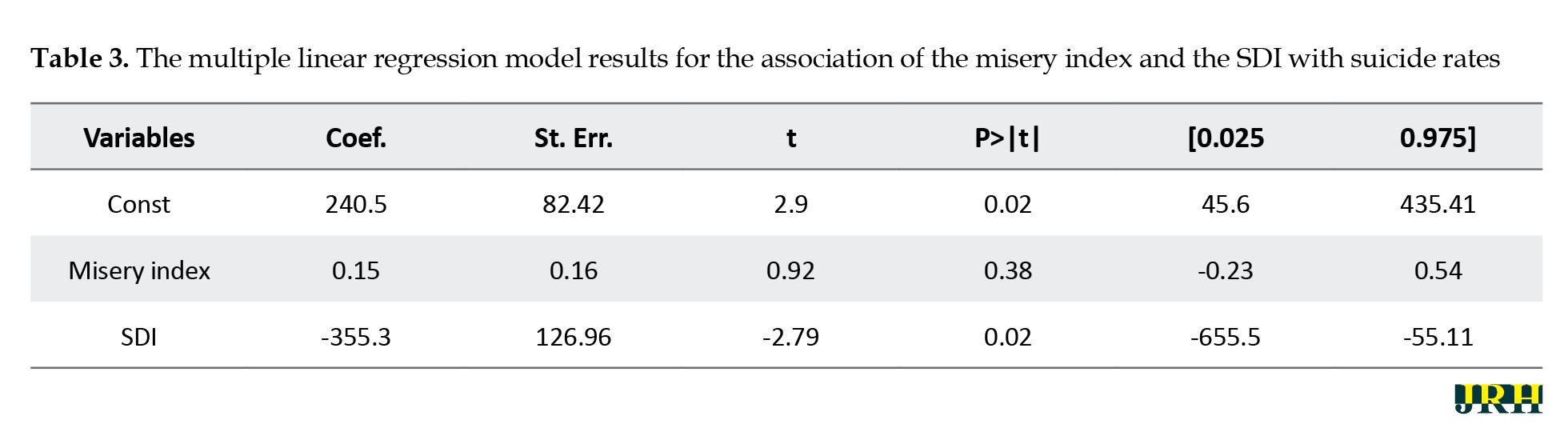
The model identifies SDI as a strong, independent, and statistically significant protective factor (β=-355.3, P=0.02). This coefficient implies that for every 0.01 unit increase in the SDI, the suicide rate is expected to decrease by approximately 3.55 per 100,000 population, holding the misery index constant. Conversely, the misery index showed a small, non-significant positive association (β=0.15, P=0.38), indicating that its apparent bivariate relationship with suicide does not hold as an independent predictor once the strong effect of sociodemographic development is accounted for in the model. Collectively, the predictors in this model explained a substantial proportion of the variance in suicide rates, as evidenced by an adjusted R² of 0.807.
Discussion
This longitudinal study reveals a complex relationship between economic distress, sociodemographic development, and suicide incidence in Ilam Province. The central finding is that long-term improvements in sociodemographic conditions, as measured by the SDI, demonstrated a strong and independent inverse association with suicide rates [12-14]. In contrast, short-term economic fluctuations, captured by the misery index, showed a significant bivariate correlation but a non-significant independent effect in the multivariable model, suggesting its influence may be mediated or overshadowed by broader developmental factors [15-17].
The volatile nature of the misery index in Ilam reflects periods of severe economic pressure, consistent with national trends of inflation and unemployment [5, 18]. The observed positive correlation between economic distress and suicide is supported by a body of global literature. For instance, a multi-country study found that rises in unemployment were significantly associated with increased suicide rates, particularly among males [11]. Similarly, research from Greece during its financial crisis demonstrated that austerity measures and rising economic misery were linked to a sharp deterioration in mental health and a rise in suicidality [3]. The reason this relationship may be weaker as an independent predictor in Ilam could be attributed to the province’s unique socio-cultural context. The presence of strong familial and tribal support structures, which are prominent in Western Iran, may provide a protective buffer against the immediate psychological impact of economic shocks [19]. This communal resilience could mitigate what would otherwise be a more direct pathway from economic hardship to suicide.
Conversely, the strong protective association of the SDI is a pivotal finding. This aligns with the fundamental premise of social determinant models of health, which posit that factors like education, income, and gender equity are foundational to population well-being [13, 20]. Our results corroborate global evidence; for example, a systematic analysis of the global burden of disease study consistently found that regions with higher SDI had lower rates of suicide and fatal self-harm, as development facilitates greater access to resources, knowledge, and opportunities [1, 8]. The steady improvement in SDI in Ilam, driven by investments in education and healthcare, likely fostered this protective environment by enhancing individual capabilities, improving health literacy, and empowering women, as reflected in the changing fertility rate component of the SDI. The dramatic decline in female suicide rates over the decade may be a direct outcome of these developmental gains, offering women more avenues for social and economic participation [21].
The reversal of the gender gap in suicide rates, from female-dominated to near convergence, is a noteworthy finding that warrants further investigation. While the global pattern often shows higher male suicide mortality, the initially high rate among females in Ilam has been documented in other studies within the province and neighboring regions [2, 19]. The significant reduction in female rates could be attributed to targeted national and provincial public health initiatives, improved access to education for girls, and changing social norms. However, the persistent, albeit lower, rate among males highlights the need for gender-sensitive prevention strategies that address male-specific risk factors, such as help-seeking behaviors and coping mechanisms for economic pressures.
Conclusion
In conclusion, this decade-long analysis of Ilam Province demonstrates that while acute economic distress is correlated with suicide rates, the sustained improvement in socio-demographic development exhibits a far stronger and independent protective association. A comprehensive prevention strategy must therefore be dual-pronged, combining robust, timely responses to economic shocks with a steadfast commitment to long-term developmental policies that build community resilience from the ground up.
Limitations
Several limitations of this study should be acknowledged. First, the ecological design precludes inferences at the individual level, known as the ecological fallacy. While we identified associations at the population level, these relationships may not hold for individuals. Second, despite data cleaning and validation, the underreporting of suicide, particularly due to social and religious stigma, remains a potential source of bias, which is a common challenge in suicide research in the region. Third, the analysis did not include other potentially confounding variables, such as access to mental health services, substance use patterns, or media reporting on suicide, which could influence incidence rates. Finally, the use of annual SDI data, while informative, may not capture more granular temporal changes within each year.
Implications and recommendations
Despite these limitations, these findings carry crucial implications for public health policy. The strong association with SDI suggests that sustainable suicide prevention requires a multi-sectoral approach that extends beyond the healthcare system. Policymakers should prioritize long-term investments in education, economic development, and programs that enhance gender equality. Simultaneously, the correlation with the misery index indicates that social protection systems must be strengthened to act as automatic stabilizers during economic downturns. This includes expanding unemployment benefits, implementing active labor market programs, and providing accessible mental health first aid in primary care settings, especially in periods of economic crisis.
Future research should employ individual-level case-control or cohort studies to identify specific risk and protective factors within the Ilam population. Qualitative inquiries are also needed to better understand the lived experiences and motivations behind suicidal behavior, particularly the shifting gender dynamics, to inform the design of culturally resonant and effective prevention interventions.
Ethical Considerations
Compliance with ethical guidelines
This study was approved by the Ethics Committee of Ilam University of Medical Sciences, Ilam, Iran (Code: IR.MEDILAM.REC.1400.050). This study was conducted in accordance with ethical research standards. All individual data were anonymized to protect confidentiality.
Funding
This research was financially supported by Ilam University of Medical Sciences, Ilam, Iran.
Authors' contributions
Study design and conduct: Yousef Veisani, Fathola Mohamadian and Hasan Naeem Kareem; Statistical analysis: Mustafa Kareem Jawad and Yousef Veisani; Writing the original draft: Yousef Veisani, Hasan Naeem Kareem, Sadiq Salam H. Al-Salih, Alaa Hamza Hermis, Mustafa Kareem Jawad, and Salim K. Hajwal; Review, editing and final approval: All authors.
Conflict of interest
The authors declared no conflict of interest.
Acknowledgments
The researchers sincerely express their gratitude to the staff of the poisoning ward and their colleagues at Shahid Mostafa Khomeini Hospital of Ilam for their invaluable cooperation in conducting this research.
The two composite indices showed distinct trajectories. The SDI demonstrated a consistent, steady increase from 0.620 in 2010 to 0.670 in 2019, reflecting gradual but sustained developmental progress. In sharp contrast, the misery index showed marked volatility, with notable peaks in 2012–2013 and again in 2018–2019, indicating repeated episodes of pronounced economic stress interrupting periods of relative stability.
Table 2 summarizes the bivariate relationships between the variables.
The analysis revealed a weak positive correlation between the misery index and suicide rates (r=0.218), suggesting a modest tendency for suicide incidence to be higher during periods of economic distress. In contrast, a moderate-to-strong negative correlation was observed between the SDI and suicide rates (r=-0.704), indicating that higher levels of development were consistently associated with lower suicide rates over the study period. Furthermore, approximately zero correlation between the misery index and SDI (r=0.022) confirms that these two indices measure fundamentally distinct aspects of the provincial context, with short-term economic volatility being independent of the long-term, gradual trajectory of sociodemographic development.
The results of the multiple linear regression analysis, presented in Table 3, elucidate the independent associations of these indices with suicide rates after controlling for each other, underlying time trends, and seasonal effects.
The model identifies SDI as a strong, independent, and statistically significant protective factor (β=-355.3, P=0.02). This coefficient implies that for every 0.01 unit increase in the SDI, the suicide rate is expected to decrease by approximately 3.55 per 100,000 population, holding the misery index constant. Conversely, the misery index showed a small, non-significant positive association (β=0.15, P=0.38), indicating that its apparent bivariate relationship with suicide does not hold as an independent predictor once the strong effect of sociodemographic development is accounted for in the model. Collectively, the predictors in this model explained a substantial proportion of the variance in suicide rates, as evidenced by an adjusted R² of 0.807.
Discussion
This longitudinal study reveals a complex relationship between economic distress, sociodemographic development, and suicide incidence in Ilam Province. The central finding is that long-term improvements in sociodemographic conditions, as measured by the SDI, demonstrated a strong and independent inverse association with suicide rates [12-14]. In contrast, short-term economic fluctuations, captured by the misery index, showed a significant bivariate correlation but a non-significant independent effect in the multivariable model, suggesting its influence may be mediated or overshadowed by broader developmental factors [15-17].
The volatile nature of the misery index in Ilam reflects periods of severe economic pressure, consistent with national trends of inflation and unemployment [5, 18]. The observed positive correlation between economic distress and suicide is supported by a body of global literature. For instance, a multi-country study found that rises in unemployment were significantly associated with increased suicide rates, particularly among males [11]. Similarly, research from Greece during its financial crisis demonstrated that austerity measures and rising economic misery were linked to a sharp deterioration in mental health and a rise in suicidality [3]. The reason this relationship may be weaker as an independent predictor in Ilam could be attributed to the province’s unique socio-cultural context. The presence of strong familial and tribal support structures, which are prominent in Western Iran, may provide a protective buffer against the immediate psychological impact of economic shocks [19]. This communal resilience could mitigate what would otherwise be a more direct pathway from economic hardship to suicide.
Conversely, the strong protective association of the SDI is a pivotal finding. This aligns with the fundamental premise of social determinant models of health, which posit that factors like education, income, and gender equity are foundational to population well-being [13, 20]. Our results corroborate global evidence; for example, a systematic analysis of the global burden of disease study consistently found that regions with higher SDI had lower rates of suicide and fatal self-harm, as development facilitates greater access to resources, knowledge, and opportunities [1, 8]. The steady improvement in SDI in Ilam, driven by investments in education and healthcare, likely fostered this protective environment by enhancing individual capabilities, improving health literacy, and empowering women, as reflected in the changing fertility rate component of the SDI. The dramatic decline in female suicide rates over the decade may be a direct outcome of these developmental gains, offering women more avenues for social and economic participation [21].
The reversal of the gender gap in suicide rates, from female-dominated to near convergence, is a noteworthy finding that warrants further investigation. While the global pattern often shows higher male suicide mortality, the initially high rate among females in Ilam has been documented in other studies within the province and neighboring regions [2, 19]. The significant reduction in female rates could be attributed to targeted national and provincial public health initiatives, improved access to education for girls, and changing social norms. However, the persistent, albeit lower, rate among males highlights the need for gender-sensitive prevention strategies that address male-specific risk factors, such as help-seeking behaviors and coping mechanisms for economic pressures.
Conclusion
In conclusion, this decade-long analysis of Ilam Province demonstrates that while acute economic distress is correlated with suicide rates, the sustained improvement in socio-demographic development exhibits a far stronger and independent protective association. A comprehensive prevention strategy must therefore be dual-pronged, combining robust, timely responses to economic shocks with a steadfast commitment to long-term developmental policies that build community resilience from the ground up.
Limitations
Several limitations of this study should be acknowledged. First, the ecological design precludes inferences at the individual level, known as the ecological fallacy. While we identified associations at the population level, these relationships may not hold for individuals. Second, despite data cleaning and validation, the underreporting of suicide, particularly due to social and religious stigma, remains a potential source of bias, which is a common challenge in suicide research in the region. Third, the analysis did not include other potentially confounding variables, such as access to mental health services, substance use patterns, or media reporting on suicide, which could influence incidence rates. Finally, the use of annual SDI data, while informative, may not capture more granular temporal changes within each year.
Implications and recommendations
Despite these limitations, these findings carry crucial implications for public health policy. The strong association with SDI suggests that sustainable suicide prevention requires a multi-sectoral approach that extends beyond the healthcare system. Policymakers should prioritize long-term investments in education, economic development, and programs that enhance gender equality. Simultaneously, the correlation with the misery index indicates that social protection systems must be strengthened to act as automatic stabilizers during economic downturns. This includes expanding unemployment benefits, implementing active labor market programs, and providing accessible mental health first aid in primary care settings, especially in periods of economic crisis.
Future research should employ individual-level case-control or cohort studies to identify specific risk and protective factors within the Ilam population. Qualitative inquiries are also needed to better understand the lived experiences and motivations behind suicidal behavior, particularly the shifting gender dynamics, to inform the design of culturally resonant and effective prevention interventions.
Ethical Considerations
Compliance with ethical guidelines
This study was approved by the Ethics Committee of Ilam University of Medical Sciences, Ilam, Iran (Code: IR.MEDILAM.REC.1400.050). This study was conducted in accordance with ethical research standards. All individual data were anonymized to protect confidentiality.
Funding
This research was financially supported by Ilam University of Medical Sciences, Ilam, Iran.
Authors' contributions
Study design and conduct: Yousef Veisani, Fathola Mohamadian and Hasan Naeem Kareem; Statistical analysis: Mustafa Kareem Jawad and Yousef Veisani; Writing the original draft: Yousef Veisani, Hasan Naeem Kareem, Sadiq Salam H. Al-Salih, Alaa Hamza Hermis, Mustafa Kareem Jawad, and Salim K. Hajwal; Review, editing and final approval: All authors.
Conflict of interest
The authors declared no conflict of interest.
Acknowledgments
The researchers sincerely express their gratitude to the staff of the poisoning ward and their colleagues at Shahid Mostafa Khomeini Hospital of Ilam for their invaluable cooperation in conducting this research.
References
- Davis Weaver N, Bertolacci GJ, Rosenblad E, Ghoba S, Cunningham M, Ikuta KS, et al. Global, regional, and national burden of suicide, 1990-2021: a systematic analysis for the global burden of disease study 2021. The Lancet Public Health. 2025; 10(3):e189-e202. [DOI:10.1016/s2468-2667(25)00006-4]
- Rostami M, Jalilian A, Jalilian M, Mahdavi SA. Years of life lost due to complete suicide in Iran: a national registry-based study. Journal of Research in Health Sciences. 2024; 24(1):e00605. [DOI:10.34172/jrhs.2024.140]
- Economou M, Madianos M, Peppou LE, Patelakis A, Stefanis CN. Major depression in the era of economic crisis: A replication of a cross-sectional study across Greece. Journal of Affective Disorders. 2013; 145(3):308-14. [DOI:10.1016/j.jad.2012.08.008]
- Haagsma JA, James SL, Castle CD, Dingels ZV, Fox JT, Hamilton EB, et al. Burden of injury along the development spectrum: associations between the socio-demographic index and disability-adjusted life year estimates from the global burden of disease study 2017. Injury Prevention. 2020; 26(Suppl 2):i12-i26. [DOI:10.1136/injuryprev-2019-043296]
- Sotoudeh Nia Korrani S, Ziya A. The effect of economic growth and misery index on income inequality in Iran (Autoregressive Distributed Lag (ARDL)). International Journal of Nonlinear Analysis and Applications. 2023; 14(3):343-51. [DOI:10.22075/ijnaa.2022.25988.3181]
- Vafaei E, Rezvani M. Examining Factors affecting on the misery index in Iran. Parliament and Economy. 2025; 2(SPRING):21-40. [DOI:10.22034/mec.2024.16787.1032]
- Stuckler D, Basu S, Suhrcke M, Coutts A, McKee M. The public health effect of economic crises and alternative policy responses in Europe: An empirical analysis. The Lancet. 2009; 374(9686):315-23. [DOI:10.1016/s0140-6736(09)61124-7]
- Wu Y, Schwebel DC, Huang Y, Ning P, Cheng P, Hu G. Sex-specific and age-specific suicide mortality by method in 58 countries between 2000 and 2015. Injury Prevention. 2021; 27(1):61-70. [DOI:10.1136/injuryprev-2019-043601]
- Yang E, Chen F, Yang Y, Zhang Y, Lin H, Zhang Y, et al. Global trends in depressive disorder prevalence and DALYs among young populations: A comprehensive analysis from 1990 to 2021. BMC Psychiatry. 2024; 24(1):943. [DOI:10.1186/s12888-024-06419-2]
- Lew B, Lester D, Kõlves K, Yip PS, Chen YY, Chen WS, et al. An analysis of age-standardized suicide rates in Muslim-majority countries in 2000-2019. BMC Public Health. 2022; 22(1):882. [DOI:10.1186/s12889-022-13101-3]
- Elshamy F, Hamadeh A, Billings J, Alyafei A. Mental illness and help-seeking behaviours among Middle Eastern cultures: A systematic review and meta-synthesis of qualitative data. PLoS One. 2023; 18(10):e0293525. [DOI:10.1371/journal.pone.0293525]
- Salari M, Hasankhani MB, Rezaeian M. Spatial and temporal patterns of self-harm indicators and their association with the socio-demographic index (SDI) in Iran: Analysis of incidence, death, DALY, YLDs, and YLLs from 1990 to 2021–results from the global burden of disease study 2021. BMC Public Health. 2025; 25(1):1838. [DOI:10.1186/s12889-025-23085-5]
- Reeves A, McKee M, Stuckler D. Economic suicides in the great recession in Europe and North America. The British Journal of Psychiatry. 2014; 205(3):246-7. [DOI:10.1192/bjp.bp.114.144766]
- Alicandro G, Malvezzi M, Gallus S, La Vecchia C, Negri E, Bertuccio P. Worldwide trends in suicide mortality from 1990 to 2015 with a focus on the global recession time frame. International Journal of Public Health. 2019; 64:785-95. [DOI:10.1007/s00038-019-01219-y]
- Allen J, Balfour R, Bell R, Marmot M. Social determinants of mental health. International Review of Psychiatry. 2014; 26(4):392-407. [DOI:10.3109/09540261.2014.928270]
- Bartelink VH, Zay Ya K, Guldbrandsson K, Bremberg S. Unemployment among young people and mental health: A systematic review. Scandinavian Journal of Public Health. 2020; 48(5):544-58. [DOI:10.1177/1403494819852847]
- Barber JG. Relative misery and youth suicide. Australian & New Zealand Journal of Psychiatry. 2001; 35(1):49-57. [DOI:10.1046/j.1440-1614.2001.00854.x]
- Lee B, Pescosolido BA. Misery needs company: contextualizing the geographic and temporal link between unemployment and suicide. American Sociological Review. 2024; 89(6):1104-40. [DOI:10.1177/00031224241288179]
- Oyesanya M, Lopez-Morinigo J, Dutta R. Systematic review of suicide in economic recession. World Journal of Psychiatry. 2015; 5(2):243. [DOI:10.5498/wjp.v5.i2.243]
- Golarzi G, Khorasani M. Investigating Symmetrical and asymmetrical effects of exchange rate and its fluctuations on the return of the pharmaceutical industry stock using linear and nonlinear ARDL models. Iranian Journal of Economic Research. 2023; 28(96):253-300. [DOI:10.22054/ijer.2023.71242.1157]
- Rouzrokh P, Feijani FA, Moshiri Y, Ghahramani S, Lankarani KB. The pooled prevalence of attributed factors of suicide in Iran: A systematic review and meta-analysis. Archives of Iranian Medicine. 2025; 28(1):44. [DOI:10.34172/aim.31276]
Type of Study: Orginal Article |
Subject:
● Psychosocial Health
Received: 2025/09/28 | Accepted: 2025/12/14 | Published: 2026/03/14
Received: 2025/09/28 | Accepted: 2025/12/14 | Published: 2026/03/14
| Rights and permissions | |
 |
This work is licensed under a Creative Commons Attribution-NonCommercial 4.0 International License. |


This is an open access article distributed under the terms of the Creative Commons Attribution License (CC-By-NC), which permits use, distribution, and reproduction in any medium, provided the original work is properly cited and is not used for commercial purposes.
Contact Information
