

Volume 16, Issue 3 (May & June 2026)
J Research Health 2026, 16(3): 285-294 |
Back to browse issues page


Ethics code: MRDC/IEC/2024/107


Download citation:
BibTeX | RIS | EndNote | Medlars | ProCite | Reference Manager | RefWorks
Send citation to:


BibTeX | RIS | EndNote | Medlars | ProCite | Reference Manager | RefWorks
Send citation to:
Srivastava E, Paswan G, Trumboo F, Jain N. Knowledge and Practice Gaps in Medicolegal Aspects of Teledentistry Among Dentists in India. J Research Health 2026; 16 (3) :285-294
URL: http://jrh.gmu.ac.ir/article-1-2722-en.html
URL: http://jrh.gmu.ac.ir/article-1-2722-en.html


1- Manav Rachna International Institute of Research and Studies, Faridabad, India.
2- Department of Prosthodontics, Manav Rachna International Institute of Research and Studies, Faridabad, India. ,nejamaverick@gmail.com
2- Department of Prosthodontics, Manav Rachna International Institute of Research and Studies, Faridabad, India. ,
Keywords: Telemedicine, Telecommunication, Computerized patient records, Medico-legal aspects, Ethical issues
Full-Text [PDF 608 kb]
(224 Downloads)
| Abstract (HTML) (717 Views)
Full-Text: (84 Views)
Introduction
Teledentistry (TD) is defined as the use of telehealth systems and methods in the field of dentistry. Telehealth refers to a broad variety of technologies and tactics to deliver virtual healthcare and educational services mainly through audio-visual telecommunications or electronic communications technologies [1]. It has significantly reduced geographical barriers and aided in providing nearly the same quality of services as in-person delivery [2]. There has been a surge in the use of TD during the COVID-19 pandemic phase, as it helped in serving patients without the fear of transferring infection [3, 4]. This development has been facilitated by digitization in dentistry, enabling simultaneous execution of multiple procedures without direct physical interaction with patients [5, 6]. TD may be practiced for real-time consultation or remote counselling which may occur through video conferencing in the presence of the patient or using stored patient records in the absence of the patient [7].
While in countries, such as the United States and the United Kingdom TD operates under well-established telehealth laws and practice guidelines, there are no specific legal frameworks governing TD practice in India. In the U.S., the Health Insurance Portability and Accountability Act ensures patient data security, while the UK follows general data protection regulation for the practice of TD [8, 9]. In contrast, India primarily relies on the information technology act of 2000 regulations, the personal data protection bill (2019) and recently the digital personal data protection act 2023 which are not specific to healthcare [10]. There are “telemedicine practice guidelines” issued by the Government of India in 2020 which outline the delivery of medical services within the purview of legal and ethical standards [11]. However, such guidelines do not specifically address dentistry [10, 11].
This regulatory gap creates ambiguity among dental professionals. Despite the growing popularity of TD, this has led to limited awareness of its medico-legal aspects [6, 12-14]. A bibliometric analysis by Valeri et al. [15] published in 2023 on scientific publications on TD also highlighted the demand for more research efforts especially particularly in protocol development and risk assessment. The prime objective of this survey was to identify the knowledge and practice gaps related to medico-legal considerations in TD among dentists in the Delhi-NCR region of India. This area remains globally underexplored as most existing studies focus on feasibility and attitudes rather than ethical and legal preparedness, especially in low or middle-income countries. This study identifies the nature, distribution and extent of gaps within the dentists’ medico-legal knowledge and practices. The findings were investigated based on the difference in educational qualification among dental professionals, viz., bachelor of dental surgery (BDS) or master of dental surgery (MDS) to highlight knowledge-practice gaps and the need for curriculum reforms, continuing education and the development of clear regulatory guidelines.
Methods
Study design
The cross-sectional study was conducted among dental professionals in the Delhi-NCR region of India between May and July 2024 to evaluate their knowledge and practices regarding the medicolegal aspects of TD. The Delhi-NCR region was selected due to its high concentration of dental professionals, diversity in practice-settings and early adoption of digital health tools.
Sample size determination
The sample size was determined using nMaster2.0 (CMC, Vellore) and findings from a pilot study. The minimum required sample size was 236, based on 80% power and 5% precision. A total of 256 dentists participated in this survey.
Eligibility criteria
Participants were included in the study using convenience sampling and included all the dentists located in the Delhi-NCR region who were willing to participate. All participants were informed about the purpose of the study, and written informed consent was obtained.
Dentists who were not currently practicing or who did not provide informed consent were excluded from the study.
Data collection tool and validation
A self-designed questionnaire consisting of 19 items was used for this study. To ensure content validity, the questionnaire was evaluated by a panel of five experts (prosthodontist, public health dentist, endodontist, orthodontist and general dentist) with at least 15 years of experience. The content validity ratio (CVR) and content validity index (CVI) were calculated. The CVR ranged from 0.78 to 1.00, and the average CVI was 0.92, indicating strong agreement on item relevance and overall good content validity. The questionnaire was validated by pilot-testing with 25 dentists in the Delhi-NCR region. Internal consistency among the survey items was evaluated using Cronbach’s α, which was 0.8 and fell within the acceptable range. The questionnaire was divided into four sections: Demographic distribution of the participants (3 questions), knowledge regarding medicolegal considerations of TD (5 questions), practices regarding medicolegal considerations of TD (8 questions) and attitude of dentists towards future prospects of TD (3 questions). Each section contained fixed response items (yes/no/multiple-choice).
Data collection procedure
The closed-ended questionnaire was distributed through a fourpage Google Form while maintaining participant anonymity. The survey was announced through WhatsApp groups and shared via email to the willing participants. Each participant was required to answer all questions. Reminder emails were sent to the participants every fortnight to complete the questionnaire. Participants were able to review their answers using the back button in case they wanted to change them before final submission after which the responses were recorded permanently. There were no dropouts. The Google Form settings limited responses to one per participant to avoid duplicate entries. The survey was closed after achieving the desired number of responses.
Statistical analysis
Data were analyzed using the SPSS software, version 27 (IBM Corp., Armonk, NY). Descriptive data were reported for each variable. Summarized data were presented using tables and graphs. The chi-square test was used to analyse categorical variables. The level of statistical significance was set at P<0.05. Additionally, Phi and Cramer’s V values were reported as effect size measures to quantify the association between response and educational qualification.
Knowledge and practice correlation analysis
The questionnaire’s knowledge section included 12 items measuring participants’ understanding of TD, including its definition, usage modes, legality, regulations, ethical considerations, consent requirements, prescription capabilities, and potential applications in research and clinical practice. Correct answers (coded as 1) were summed to generate a knowledge score, while incorrect answers (coded as 0) received no points. The practice section consisted of five items assessing how participants applied TD, such as its use in practice, maintenance of electronic records, consentobtaining practices, prior experience before COVID19, and perceived need for training. Responses were coded similarly (yes=1, no=0). The relationship between these scores was examined using Spearman’s rank correlation coefficient because the data were not normally distribution.
Results
A total of 256 dentists aged 24-48 years participated in this survey, including 159 were females and 97 were males. Participants were grouped according to their qualification as MDS or BDS professionals (Table 1).
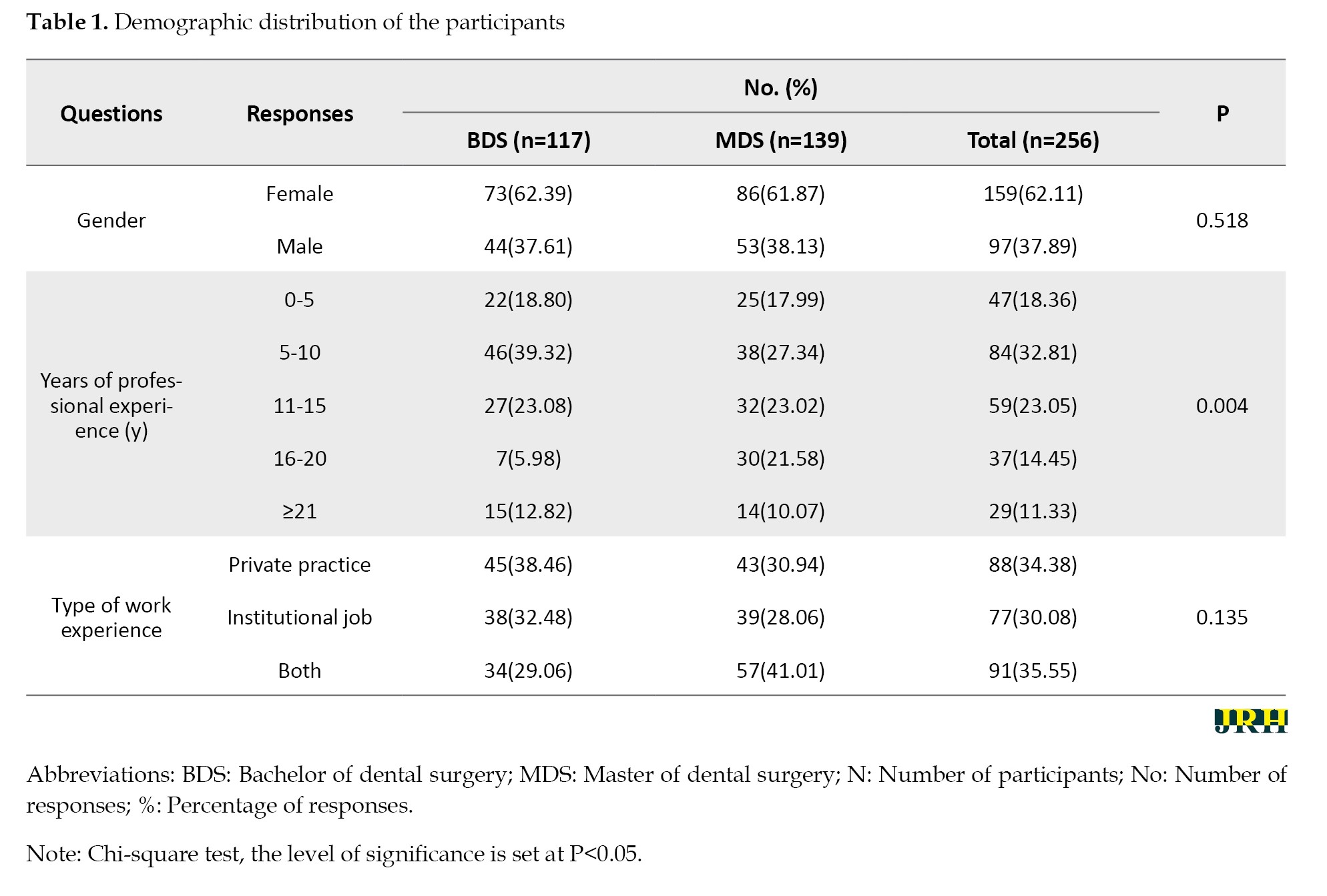
A statistically significant difference in the years of professional experience was observed between the two groups (P=0.004), with a greater proportion of MDS participants having more experience. A greater proportion of MDS participants reported experience in both private practice and institutional employment compared with BDS participants. However, the distribution of work experience did not differ significantly between groups (P=0.135).
The study assessed awareness of TD, and most participants demonstrate familiarity with the concept (Table 2).
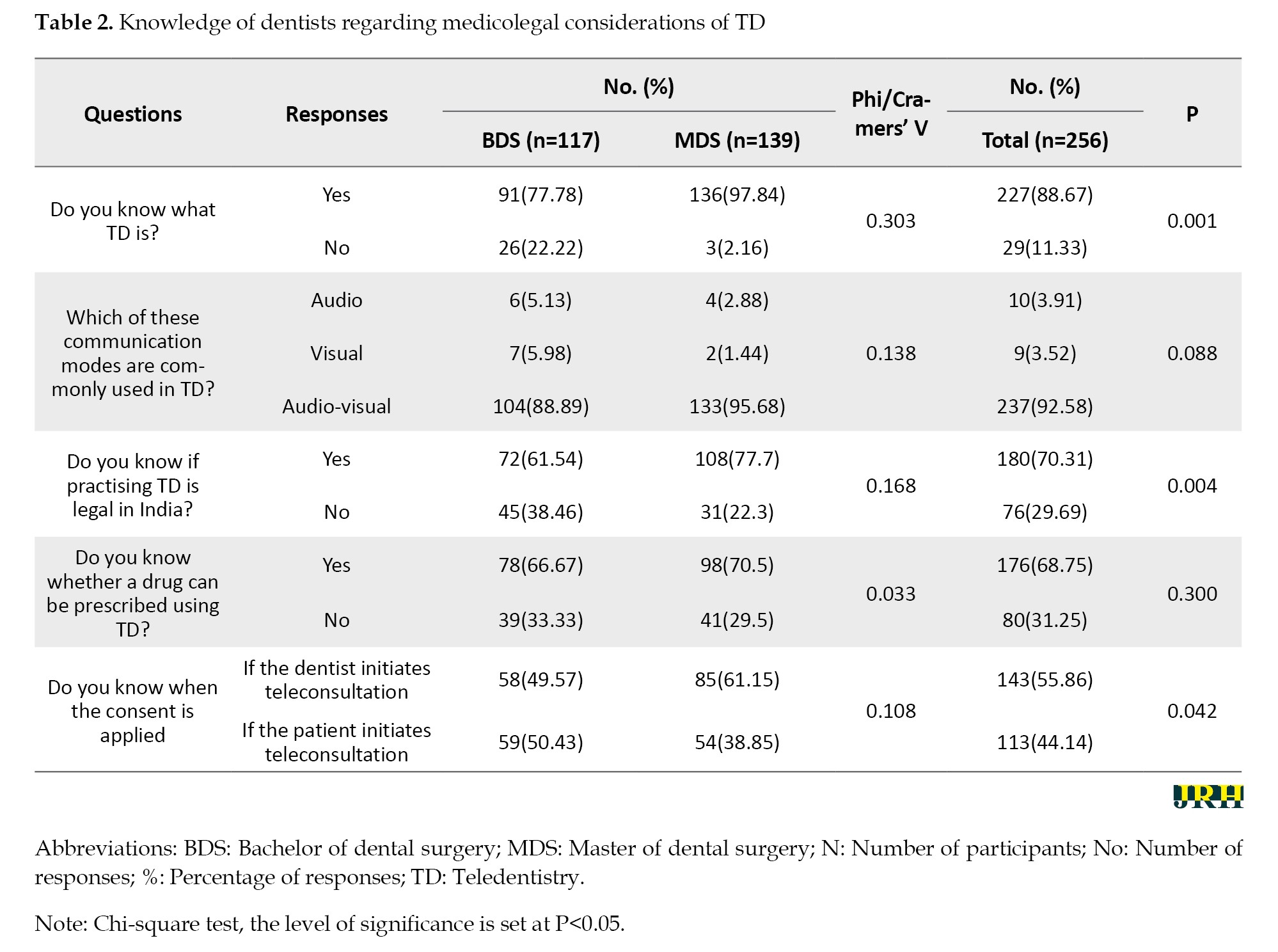
A significant difference in the basic knowledge of TD was observed between BDS and MDS professionals (P=0.001), with higher knowledge among MDS professionals.
Overall, 88.67% of respondents were aware of TD, with significantly higher awareness among MDS professionals (P=0.001), showing a moderate association with qualification (Cramer’s V=0.303). However, nearly 30% were unaware of the legal status of TD. Knowledge of the legal status of TD showed small association with higher qualification (Cramer’s V=0.168). A significant difference (P=0.042) was found in awareness about when patient consent is required, with MDS professionals showing slightly better understanding (Cramer’s V=0.108).
In terms of practising TD, overall 27.73% reported practicing it before the COVID-19 pandemic with numbers not increasing much (40.23%) in post-pandemic phase (Table 3).
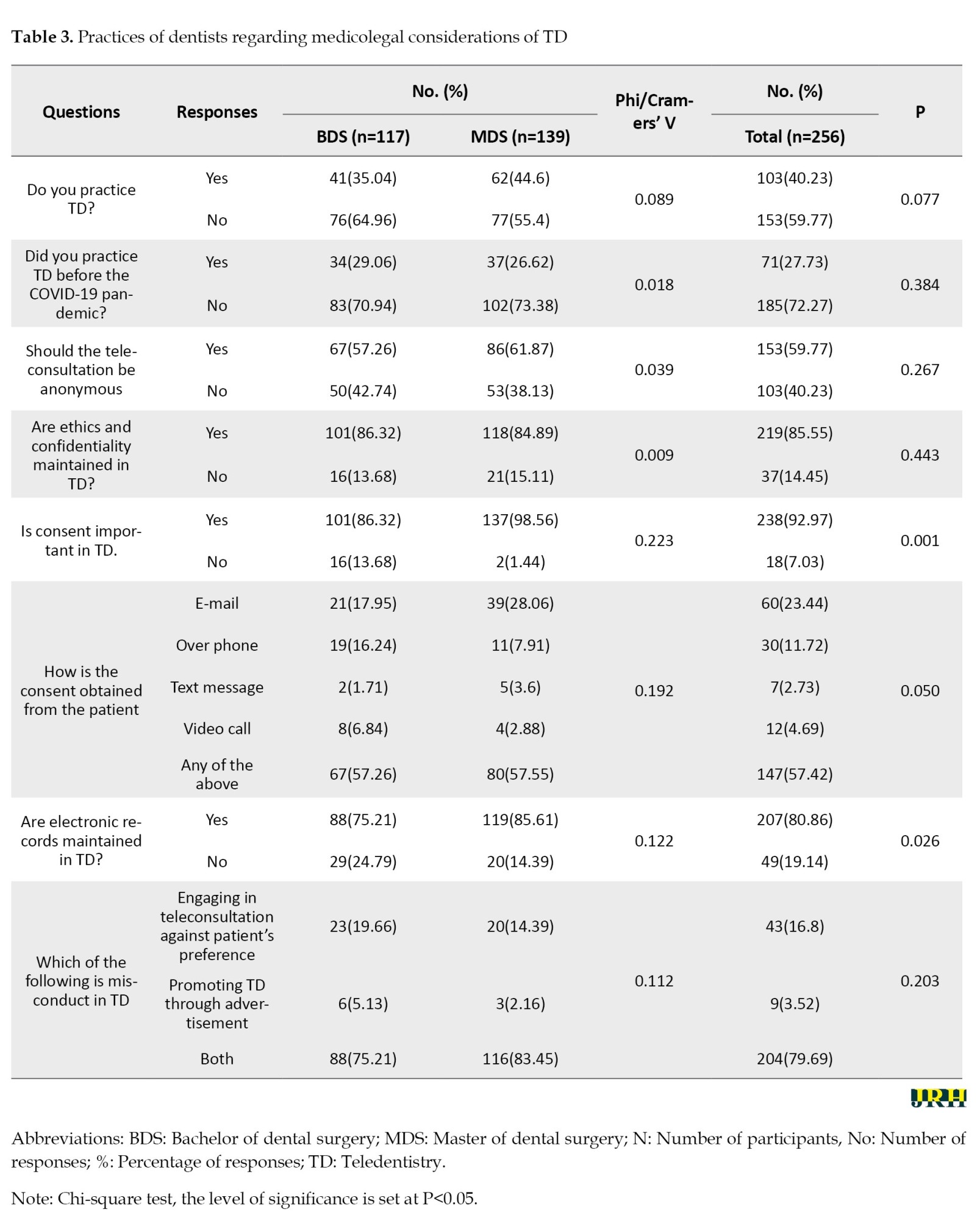
However, no significant difference was found between BDS and MDS groups in terms of usage.
Most dentists (85.6%) confirmed maintaining electronic records, with MDS participants showing higher compliance (P=0.026). Consent was considered important by 93% of all respondents, with MDS showing stronger agreement (P=0.001), which was also reflected in the effect size (Cramer’s V=0.223). Email was the most preferred method of obtaining consent. Approximtely 80% correctly identified both unauthorized consultations and the advertisement of TD services as misconduct, indicating a sound understanding of ethical boundaries. Participants demonstrated good understanding of patient confidentiality and misconduct, but showed uncertainty about anonymity in teleconsultation.
Responses regarding future prospects (Table 4) underscored broad support among participants for training and strict regulatory frameworks in TD, with notable agreement on the need for clear guidelines from the dental council of India (DCI).
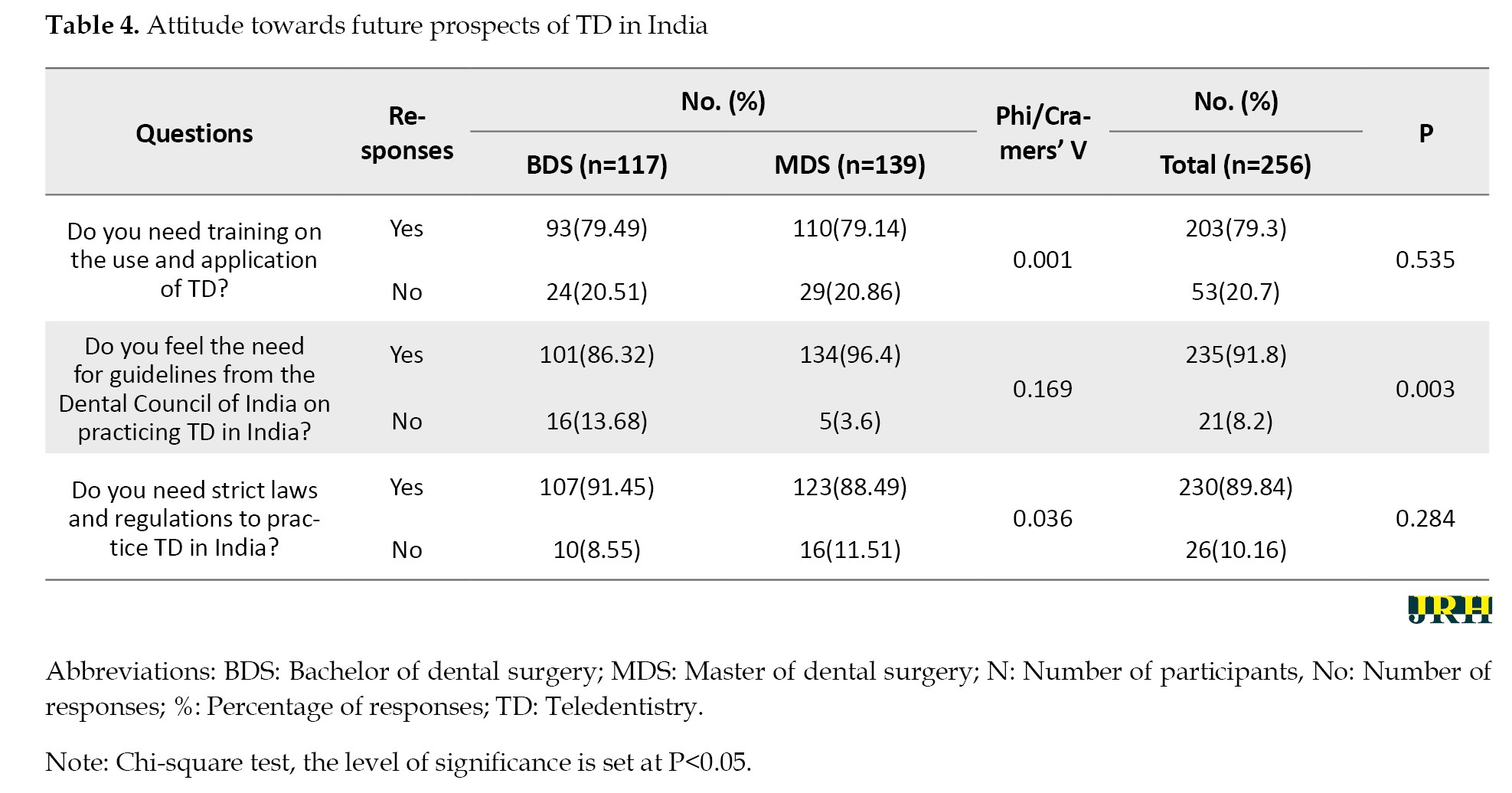
This association was stronger with MDS professionals.
Spearman’s correlation analysis
The average knowledge score among 256 respondents was 80.55%, reflecting a high level of awareness about TD. The average practice score was 57.51%, indicating moderate adoption. Spearman’s correlation analysis showed a moderate, statistically significant positive relationship (r=0.683, P<0.001) between knowledge and practice scores, suggesting that higher knowledge is associated with better practice behaviors.
Discussion
This cross-sectional study explored knowledge and practice gaps in the medico-legal aspects of TD among dentists in the Delhi-NCR region of India. Participants varied in qualification, years of experience, and type of experience, with a higher proportion of females than males. A generally high awareness (88.6%) of TD was observed, with significant deficiencies in understanding its legal status, consent requirements, and electronic record-keeping. When comparing the BDS and the MDS groups, the latter demonstrated higher awareness of TD and its legal status in India. These findings were consistent with other studies [16-18] where postgraduates showed better knowledge regarding TD as compared to undergraduates. The higher knowledge and practice scores among MDS professionals in the current study could be attributed to having both private and institutional job experience exposing them to ethical protocols, documentation, administrative procedures, and regulatory compliance frameworks. Internationally, similar uncertainties were documented by Nassani et al. [19] in Saudi Arabia and Kasuma et al. [20] in Indonesia, underscoring this knowledge gap as a global challenge, especially in low- and middle-income countries.
Overall, 92.97% of participants believed in the importance of patient’s consent similar to 93.4% of participants who agreed in a study by Sujatha et al. [21]. Although no statistical difference was observed in the various methods of obtaining patient’s consent, an inconsistent documentation process was observed among both BDS and MDS participants. A notable finding was a low percentage of participants knowing the specific contexts in which consent must be obtained. Morey et al. [5] similarly noted that dentists often failed to obtain explicit consent before teleconsultation. However, better understanding of the importance of consent and the timing of its acquisition was shown by MDS professionals in comparison to BDS professionals.
Despite the rising trend of using TD in the post-pandemic phase, only 40.2% of respondents showed engagement with TD, reflecting a low adoption rate. Fahim et al. [13] reported similarly limited uptake. Nearly 80% of respondents maintained electronic records, which is higher than 65% compliance rate reported by Morey et al. [5]. Maintaining patient anonymity has been a challenging issue as there ought to be a balance between knowing patient’s identity and at the same time responsibly maintaining the patient’s information confidential as bound by the legal and ethical principles. Fewer individuals supported the idea of anonymity but understood the importance of confidentiality. This highlighted a misconception regarding patient identification and confidentiality principles among dental professionals. A study conducted by BV et al. [22] in Chennai showed that 30-37% of dentists had concerns regarding patients’ consent, digital forgery, confidentiality, and hardware reliability in TD.
Approximately 92% of the respondents expressed the need for training and strict laws and regulations for practicing TD in India to bridge the knowledge and practice gaps and desired the DCI to take up a critical role in establishing specific guidelines to streamline the TD practices. Similar findings were observed in a questionnaire-based study done by Nassani et al. [19] in Saudi Arabia and Fahim et al. [13] in Pakistan where dental professionals felt the need for integration of TD in dental curriculum and establishment of a legal framework to protect patients’ privacy and confidentiality. The consistency of these demands across countries suggests that this is not an isolated issue but a broader global concern regarding the safe and ethical integration of TD.
This study contributes novel insights by evaluating medico-legal preparedness for TD, a domain often overlooked by research focusing on feasibility, attitudes or patient satisfaction. A self-designed questionnaire was particularly important in this study as it focused on targeted areas of medico-legal dimensions of TD. The inclusion of effect size measures (Phi/Cramer’s V) allowed interpretation beyond significance testing by quantifying the strength of observed associations. Most significant associations between qualification and medico-legal awareness/practices demonstrated small to moderate effect sizes, suggesting that while differences between BDS and MDS professionals exist, they are not overwhelmingly large. Notably, the moderate effect size for overall awareness of TD highlights that postgraduate training may confer a substantial advantage in this area. However, smaller effect sizes for aspects, such as legal status, consent, and record-keeping imply that knowledge gaps persist across both groups, albeit more pronounced among undergraduates.
Spearman’s correlation analysis uncovered a significant gap between knowledge and practice among participants. Although the average knowledge score was 80.55%, showing strong awareness of TD concepts, the average practice score was only 57.51%, indicating a lag in practical application. The substantial difference between the two mean scores highlights that many respondents have sufficient knowledge but have yet to consistently apply it in practice. These findings underline the need for structured curricular reforms, practical guidelines to reduce disparities and eliminate the practical lag among all dental professionals.
Limitations
This study has several limitations, including the use of a convenience sampling technique which may not be fully representative of all dentists in India but could indicate similar challenges in other regions. Future studies should therefore consider much larger and more diverse samples to enhance generalizability. Since the data were self-reported, there is a possibility of response bias. Inclusion of only closed-ended questions limited the capturing of qualitative perspectives of the participants by overlooking the underlying reasons or contextual factors contributing to them. Multivariate analysis was not performed in this study as the primary objective was exploratory—to assess group-wise differences in knowledge and practices related to TD. However, future studies could also benefit from regression models to adjust for potential confounders to examine predictive relationships more robustly. Longitudinal studies are needed to establish how TD can effectively be integrated into dental curricula, and the impact should be measured on knowledge and practice outcomes.
Conclusion
This survey helped identify key areas where dentists need education on pertinent ethical and legal principles while practicing TD. Most of the professionals knew about TD but showed limited awareness of the existing legal framework to practice TD in India. This lack of understanding poses risks not only to patient safety but also to the legal accountability of dentists. However, MDS professionals showed greater knowledge than BDS professionals, which could be observed in their practices as well. The findings of the study suggest the need for targeted interventions, such as integration of TD, medico-legal principles, and data privacy laws into the undergraduate and post graduate dental curriculum, along with mandatory continuing education programs. The DCI should issue formal practice guidelines for TD, covering informed consent protocols, documentation standards, and digital prescription norms. Such structured efforts will ensure safe, ethical, and legally compliant adoption of TD across the country.
Ethical Considerations
Compliance with ethical guidelines
The study protocol was approved by the Institutional Ethical Committee of the School of Dental Sciences, Manav Rachna International Institute of Research and Studies (Ref No. MRDC/IEC/2024/107) and was conducted in accordance with the principles in the Declaration of Helsinki. Written informed consent was obtained from each participant, and participant confidentiality and privacy were maintained by anonymizing all identifying information.
Funding
This research did not receive any grants from public, commercial, or non-profit funding agencies.
Authors' contributions
All authors contributed equally to the preparation of this manuscript.
Conflict of interest
The authors declared no conflict of interest.
Acknowledgments
The authors acknowledge the participants for generously contributing their time to this study.
Teledentistry (TD) is defined as the use of telehealth systems and methods in the field of dentistry. Telehealth refers to a broad variety of technologies and tactics to deliver virtual healthcare and educational services mainly through audio-visual telecommunications or electronic communications technologies [1]. It has significantly reduced geographical barriers and aided in providing nearly the same quality of services as in-person delivery [2]. There has been a surge in the use of TD during the COVID-19 pandemic phase, as it helped in serving patients without the fear of transferring infection [3, 4]. This development has been facilitated by digitization in dentistry, enabling simultaneous execution of multiple procedures without direct physical interaction with patients [5, 6]. TD may be practiced for real-time consultation or remote counselling which may occur through video conferencing in the presence of the patient or using stored patient records in the absence of the patient [7].
While in countries, such as the United States and the United Kingdom TD operates under well-established telehealth laws and practice guidelines, there are no specific legal frameworks governing TD practice in India. In the U.S., the Health Insurance Portability and Accountability Act ensures patient data security, while the UK follows general data protection regulation for the practice of TD [8, 9]. In contrast, India primarily relies on the information technology act of 2000 regulations, the personal data protection bill (2019) and recently the digital personal data protection act 2023 which are not specific to healthcare [10]. There are “telemedicine practice guidelines” issued by the Government of India in 2020 which outline the delivery of medical services within the purview of legal and ethical standards [11]. However, such guidelines do not specifically address dentistry [10, 11].
This regulatory gap creates ambiguity among dental professionals. Despite the growing popularity of TD, this has led to limited awareness of its medico-legal aspects [6, 12-14]. A bibliometric analysis by Valeri et al. [15] published in 2023 on scientific publications on TD also highlighted the demand for more research efforts especially particularly in protocol development and risk assessment. The prime objective of this survey was to identify the knowledge and practice gaps related to medico-legal considerations in TD among dentists in the Delhi-NCR region of India. This area remains globally underexplored as most existing studies focus on feasibility and attitudes rather than ethical and legal preparedness, especially in low or middle-income countries. This study identifies the nature, distribution and extent of gaps within the dentists’ medico-legal knowledge and practices. The findings were investigated based on the difference in educational qualification among dental professionals, viz., bachelor of dental surgery (BDS) or master of dental surgery (MDS) to highlight knowledge-practice gaps and the need for curriculum reforms, continuing education and the development of clear regulatory guidelines.
Methods
Study design
The cross-sectional study was conducted among dental professionals in the Delhi-NCR region of India between May and July 2024 to evaluate their knowledge and practices regarding the medicolegal aspects of TD. The Delhi-NCR region was selected due to its high concentration of dental professionals, diversity in practice-settings and early adoption of digital health tools.
Sample size determination
The sample size was determined using nMaster2.0 (CMC, Vellore) and findings from a pilot study. The minimum required sample size was 236, based on 80% power and 5% precision. A total of 256 dentists participated in this survey.
Eligibility criteria
Participants were included in the study using convenience sampling and included all the dentists located in the Delhi-NCR region who were willing to participate. All participants were informed about the purpose of the study, and written informed consent was obtained.
Dentists who were not currently practicing or who did not provide informed consent were excluded from the study.
Data collection tool and validation
A self-designed questionnaire consisting of 19 items was used for this study. To ensure content validity, the questionnaire was evaluated by a panel of five experts (prosthodontist, public health dentist, endodontist, orthodontist and general dentist) with at least 15 years of experience. The content validity ratio (CVR) and content validity index (CVI) were calculated. The CVR ranged from 0.78 to 1.00, and the average CVI was 0.92, indicating strong agreement on item relevance and overall good content validity. The questionnaire was validated by pilot-testing with 25 dentists in the Delhi-NCR region. Internal consistency among the survey items was evaluated using Cronbach’s α, which was 0.8 and fell within the acceptable range. The questionnaire was divided into four sections: Demographic distribution of the participants (3 questions), knowledge regarding medicolegal considerations of TD (5 questions), practices regarding medicolegal considerations of TD (8 questions) and attitude of dentists towards future prospects of TD (3 questions). Each section contained fixed response items (yes/no/multiple-choice).
Data collection procedure
The closed-ended questionnaire was distributed through a fourpage Google Form while maintaining participant anonymity. The survey was announced through WhatsApp groups and shared via email to the willing participants. Each participant was required to answer all questions. Reminder emails were sent to the participants every fortnight to complete the questionnaire. Participants were able to review their answers using the back button in case they wanted to change them before final submission after which the responses were recorded permanently. There were no dropouts. The Google Form settings limited responses to one per participant to avoid duplicate entries. The survey was closed after achieving the desired number of responses.
Statistical analysis
Data were analyzed using the SPSS software, version 27 (IBM Corp., Armonk, NY). Descriptive data were reported for each variable. Summarized data were presented using tables and graphs. The chi-square test was used to analyse categorical variables. The level of statistical significance was set at P<0.05. Additionally, Phi and Cramer’s V values were reported as effect size measures to quantify the association between response and educational qualification.
Knowledge and practice correlation analysis
The questionnaire’s knowledge section included 12 items measuring participants’ understanding of TD, including its definition, usage modes, legality, regulations, ethical considerations, consent requirements, prescription capabilities, and potential applications in research and clinical practice. Correct answers (coded as 1) were summed to generate a knowledge score, while incorrect answers (coded as 0) received no points. The practice section consisted of five items assessing how participants applied TD, such as its use in practice, maintenance of electronic records, consentobtaining practices, prior experience before COVID19, and perceived need for training. Responses were coded similarly (yes=1, no=0). The relationship between these scores was examined using Spearman’s rank correlation coefficient because the data were not normally distribution.
Results
A total of 256 dentists aged 24-48 years participated in this survey, including 159 were females and 97 were males. Participants were grouped according to their qualification as MDS or BDS professionals (Table 1).
A statistically significant difference in the years of professional experience was observed between the two groups (P=0.004), with a greater proportion of MDS participants having more experience. A greater proportion of MDS participants reported experience in both private practice and institutional employment compared with BDS participants. However, the distribution of work experience did not differ significantly between groups (P=0.135).
The study assessed awareness of TD, and most participants demonstrate familiarity with the concept (Table 2).
A significant difference in the basic knowledge of TD was observed between BDS and MDS professionals (P=0.001), with higher knowledge among MDS professionals.
Overall, 88.67% of respondents were aware of TD, with significantly higher awareness among MDS professionals (P=0.001), showing a moderate association with qualification (Cramer’s V=0.303). However, nearly 30% were unaware of the legal status of TD. Knowledge of the legal status of TD showed small association with higher qualification (Cramer’s V=0.168). A significant difference (P=0.042) was found in awareness about when patient consent is required, with MDS professionals showing slightly better understanding (Cramer’s V=0.108).
In terms of practising TD, overall 27.73% reported practicing it before the COVID-19 pandemic with numbers not increasing much (40.23%) in post-pandemic phase (Table 3).
However, no significant difference was found between BDS and MDS groups in terms of usage.
Most dentists (85.6%) confirmed maintaining electronic records, with MDS participants showing higher compliance (P=0.026). Consent was considered important by 93% of all respondents, with MDS showing stronger agreement (P=0.001), which was also reflected in the effect size (Cramer’s V=0.223). Email was the most preferred method of obtaining consent. Approximtely 80% correctly identified both unauthorized consultations and the advertisement of TD services as misconduct, indicating a sound understanding of ethical boundaries. Participants demonstrated good understanding of patient confidentiality and misconduct, but showed uncertainty about anonymity in teleconsultation.
Responses regarding future prospects (Table 4) underscored broad support among participants for training and strict regulatory frameworks in TD, with notable agreement on the need for clear guidelines from the dental council of India (DCI).
This association was stronger with MDS professionals.
Spearman’s correlation analysis
The average knowledge score among 256 respondents was 80.55%, reflecting a high level of awareness about TD. The average practice score was 57.51%, indicating moderate adoption. Spearman’s correlation analysis showed a moderate, statistically significant positive relationship (r=0.683, P<0.001) between knowledge and practice scores, suggesting that higher knowledge is associated with better practice behaviors.
Discussion
This cross-sectional study explored knowledge and practice gaps in the medico-legal aspects of TD among dentists in the Delhi-NCR region of India. Participants varied in qualification, years of experience, and type of experience, with a higher proportion of females than males. A generally high awareness (88.6%) of TD was observed, with significant deficiencies in understanding its legal status, consent requirements, and electronic record-keeping. When comparing the BDS and the MDS groups, the latter demonstrated higher awareness of TD and its legal status in India. These findings were consistent with other studies [16-18] where postgraduates showed better knowledge regarding TD as compared to undergraduates. The higher knowledge and practice scores among MDS professionals in the current study could be attributed to having both private and institutional job experience exposing them to ethical protocols, documentation, administrative procedures, and regulatory compliance frameworks. Internationally, similar uncertainties were documented by Nassani et al. [19] in Saudi Arabia and Kasuma et al. [20] in Indonesia, underscoring this knowledge gap as a global challenge, especially in low- and middle-income countries.
Overall, 92.97% of participants believed in the importance of patient’s consent similar to 93.4% of participants who agreed in a study by Sujatha et al. [21]. Although no statistical difference was observed in the various methods of obtaining patient’s consent, an inconsistent documentation process was observed among both BDS and MDS participants. A notable finding was a low percentage of participants knowing the specific contexts in which consent must be obtained. Morey et al. [5] similarly noted that dentists often failed to obtain explicit consent before teleconsultation. However, better understanding of the importance of consent and the timing of its acquisition was shown by MDS professionals in comparison to BDS professionals.
Despite the rising trend of using TD in the post-pandemic phase, only 40.2% of respondents showed engagement with TD, reflecting a low adoption rate. Fahim et al. [13] reported similarly limited uptake. Nearly 80% of respondents maintained electronic records, which is higher than 65% compliance rate reported by Morey et al. [5]. Maintaining patient anonymity has been a challenging issue as there ought to be a balance between knowing patient’s identity and at the same time responsibly maintaining the patient’s information confidential as bound by the legal and ethical principles. Fewer individuals supported the idea of anonymity but understood the importance of confidentiality. This highlighted a misconception regarding patient identification and confidentiality principles among dental professionals. A study conducted by BV et al. [22] in Chennai showed that 30-37% of dentists had concerns regarding patients’ consent, digital forgery, confidentiality, and hardware reliability in TD.
Approximately 92% of the respondents expressed the need for training and strict laws and regulations for practicing TD in India to bridge the knowledge and practice gaps and desired the DCI to take up a critical role in establishing specific guidelines to streamline the TD practices. Similar findings were observed in a questionnaire-based study done by Nassani et al. [19] in Saudi Arabia and Fahim et al. [13] in Pakistan where dental professionals felt the need for integration of TD in dental curriculum and establishment of a legal framework to protect patients’ privacy and confidentiality. The consistency of these demands across countries suggests that this is not an isolated issue but a broader global concern regarding the safe and ethical integration of TD.
This study contributes novel insights by evaluating medico-legal preparedness for TD, a domain often overlooked by research focusing on feasibility, attitudes or patient satisfaction. A self-designed questionnaire was particularly important in this study as it focused on targeted areas of medico-legal dimensions of TD. The inclusion of effect size measures (Phi/Cramer’s V) allowed interpretation beyond significance testing by quantifying the strength of observed associations. Most significant associations between qualification and medico-legal awareness/practices demonstrated small to moderate effect sizes, suggesting that while differences between BDS and MDS professionals exist, they are not overwhelmingly large. Notably, the moderate effect size for overall awareness of TD highlights that postgraduate training may confer a substantial advantage in this area. However, smaller effect sizes for aspects, such as legal status, consent, and record-keeping imply that knowledge gaps persist across both groups, albeit more pronounced among undergraduates.
Spearman’s correlation analysis uncovered a significant gap between knowledge and practice among participants. Although the average knowledge score was 80.55%, showing strong awareness of TD concepts, the average practice score was only 57.51%, indicating a lag in practical application. The substantial difference between the two mean scores highlights that many respondents have sufficient knowledge but have yet to consistently apply it in practice. These findings underline the need for structured curricular reforms, practical guidelines to reduce disparities and eliminate the practical lag among all dental professionals.
Limitations
This study has several limitations, including the use of a convenience sampling technique which may not be fully representative of all dentists in India but could indicate similar challenges in other regions. Future studies should therefore consider much larger and more diverse samples to enhance generalizability. Since the data were self-reported, there is a possibility of response bias. Inclusion of only closed-ended questions limited the capturing of qualitative perspectives of the participants by overlooking the underlying reasons or contextual factors contributing to them. Multivariate analysis was not performed in this study as the primary objective was exploratory—to assess group-wise differences in knowledge and practices related to TD. However, future studies could also benefit from regression models to adjust for potential confounders to examine predictive relationships more robustly. Longitudinal studies are needed to establish how TD can effectively be integrated into dental curricula, and the impact should be measured on knowledge and practice outcomes.
Conclusion
This survey helped identify key areas where dentists need education on pertinent ethical and legal principles while practicing TD. Most of the professionals knew about TD but showed limited awareness of the existing legal framework to practice TD in India. This lack of understanding poses risks not only to patient safety but also to the legal accountability of dentists. However, MDS professionals showed greater knowledge than BDS professionals, which could be observed in their practices as well. The findings of the study suggest the need for targeted interventions, such as integration of TD, medico-legal principles, and data privacy laws into the undergraduate and post graduate dental curriculum, along with mandatory continuing education programs. The DCI should issue formal practice guidelines for TD, covering informed consent protocols, documentation standards, and digital prescription norms. Such structured efforts will ensure safe, ethical, and legally compliant adoption of TD across the country.
Ethical Considerations
Compliance with ethical guidelines
The study protocol was approved by the Institutional Ethical Committee of the School of Dental Sciences, Manav Rachna International Institute of Research and Studies (Ref No. MRDC/IEC/2024/107) and was conducted in accordance with the principles in the Declaration of Helsinki. Written informed consent was obtained from each participant, and participant confidentiality and privacy were maintained by anonymizing all identifying information.
Funding
This research did not receive any grants from public, commercial, or non-profit funding agencies.
Authors' contributions
All authors contributed equally to the preparation of this manuscript.
Conflict of interest
The authors declared no conflict of interest.
Acknowledgments
The authors acknowledge the participants for generously contributing their time to this study.
References
- Estai M, Kanagasingam Y, Tennant M, Bunt S. A systematic review of the research evidence for the benefits of teledentistry. Journal of Telemedicine and Telecare. 2018; 24(3):147-56. [DOI:10.1177/1357633x16689433] [PMID]
- Verma N, Buch B, Taralekar R, Acharya S. Diagnostic concordance of telemedicine as compared with face-to-face care in primary health care clinics in rural India: Randomized crossover Trial. JMIR Formative Research. 2023; 7:e42775. [DOI:10.2196/42775] [PMID]
- Wilson R. Ethical issues in teledentistry: Following the American dental association principles of ethics and code of professional conduct. Journal of The American Dental Association (1939). 2021; 152(2):176-7. [DOI:10.1016/j.adaj.2020.12.001] [PMID]
- Ansari SH, Albusair D, Alangari L, Alsudairy N, Alsuhaibani L, Alqurashi R, et al. Impact of teledentistry during the covid-19 pandemic on Saudi patients’ satisfaction and treatment outcomes. Annals of Dental Specialty. 2023; 11(2):129-35. [DOI:10.51847/X7LSvA0AV2]
- Morey A, Boradkar V, Chhabra KG, Reche A, Madhu PP, Date A, et al. Medicolegal issues on teledntistry in India. Journal of Pharmaceutical Research International. 2021; 33(50A):106-12. [DOI:10.9734/jpri/2021/v33i50A33386]
- Irving M, Stewart R, Spallek H, Blinkhorn A. Using teledentistry in clinical practice as an enabler to improve access to clinical care: A qualitative systematic review. Journal of Telemedicine and Telecare. 2018; 24(3):129-46. [DOI:10.1177/1357633x16686776] [PMID]
- Islam MRR, Islam R, Ferdous S, Watanabe C, Yamauti M, Alam MK, et al. Teledentistry as an effective tool for the communication improvement between dentists and patients: An overview. Healthcare (Basel) 2022; 10(8):1586. [DOI:10.3390/healthcare10081586] [PMID]
- Edemekong PF, Annamaraju P, Afzal M, Haydel MJ. Health insurance portability and accountability act (HIPAA) compliance. [Updated 2024 Nov 24]. In: StatPearls [Internet]. Treasure Island (FL): StatPearls Publishing; 2025. [Link]
- Knott N. The general data protection regulation. Faculty Dental Journal. 2018; 9(2):54-7. [DOI:10.1308/rcsfdj.2018.54]
- Jain D. Regulation of digital healthcare in India: Ethical and legal challenges. Healthcare (Basel). 2023; 11(6):911. [DOI:10.3390/healthcare11060911] [PMID]
- Pai SN, Jeyaraman M, Jeyaraman N, Yadav S. Understanding the Medico-Legal Aspects of Telemedicine in India. Cureus. 2023; 15(7):e42431. [DOI:10.7759/cureus.42431] [PMID]
- Ateriya N, Saraf A, Meshram VP, Setia P. Telemedicine and virtual consultation: The Indian perspective. The National Medical Journal of India. 2018; 31(4):215-8. [DOI:10.4103/0970-258x.258220] [PMID]
- Fahim A, Saleem Z, Malik KA, Atta K, Mahmood R, Alam MK, et al. Exploring challenges and mitigation strategies towards practicing Teledentistry. BMC Oral Health. 2022; 22:658-67. [DOI:10.1186/s12903-022-02685-2] [PMID]
- Morey A, Boradkar V, Rohankar D, Date A, Chhabra GK, Paul P, et al. A Cross-sectional survey on knowledge and awareness of dental professionals towards medicolegal issues in teledentistry in Sharad Pawar dental college. Journal of Pharmaceutical Research International. 2021; 33(63A):149-53. [DOI:10.9734/jpri/2021/v33i63A35227]
- Valeri C, Quinzi V, Di Giandomenico D, Fani E, Leonardi R, Marzo G. Teledentistry: A bibliometric analysis of the scientific publication’s trend. Digital Health. 2023; 9:20552076231204747. [DOI:10.1177/20552076231204747] [PMID]
- Abdul NS, Almohareb LA, Algahtani EF, Alnasrallah SZ. Teledentistry: Knowledge, awareness, and attitude among undergraduate, graduate and postgraduate dental students. Annals of Dental Specialty. 2020; 8(4):10-17. [Link]
- Priyanka BS, Reddy LV, Parlapalli V, Pydi S. Teledentistry: Knowledge, attitude, and perception among undergraduate and postgraduate dental students. Journal of Indian Association of Public Health Dentistry. 2022; 20(4):393‐7. [DOI:10.4103/jiaphd.jiaphd_133_21]
- Mathivanan A, Gopalakrishnan JR, Dhayanithi A, Narmatha M, Bharathan K, Saranya K. Teledentistry: Is it the future of rural dental practice? A cross-sectional study. Journal of Pharmacy and Bioallied Sciences. 2020; 12(Suppl 1):S304-7. [DOI:10.4103/jpbs.jpbs_91_20] [PMID]
- Nassani MZ, Al-Maweri SA, AlSheddi A, Alomran A, Aldawsari MN, Aljubarah A, et al. Teledentistry—knowledge, practice, and attitudes of dental practitioners in Saudi Arabia: A nationwide web-based survey. Healthcare. 2021; 9(12):1682. [DOI:10.3390/healthcare9121682] [PMID]
- Kasuma N, Nurwidyastuti P, Daulay Z, Sumantri D, Nismal H, Ernesto G. Knowledge of legal aspects in teledentistry among dental practitioners in Padang, West Sumatera, Indonesia. The Open Dentistry Journal. 2023; 17:e187421062302140. [DOI:10.2174/18742106-v17-230302-2022-76]
- Sujatha P, Kanitkar AA, Ranjeri S, Annu A, Patil A, Biradar J. Assessment of knowledge and attitude regarding teledentistry among dental professionals: A cross-sectional study. Cureus. 2024; 16(3):e55954. [DOI:10.7759/cureus.55954] [PMID]
- Vishveshwar B, Ghosh D, Sathya Kumar M, Magesh K T, Indumathi K P, Aravindhan R, et al. Telemedicine awareness among Chennai-based dentists: A web-based questionnaire survey. Cureus. 2024; 16(7):e65349. [DOI:10.7759/cureus.65349] [PMID]
Type of Study: Orginal Article |
Subject:
● Health Systems
Received: 2025/01/11 | Accepted: 2025/12/13 | Published: 2026/03/14
Received: 2025/01/11 | Accepted: 2025/12/13 | Published: 2026/03/14
| Rights and permissions | |
 |
This work is licensed under a Creative Commons Attribution-NonCommercial 4.0 International License. |


This is an open access article distributed under the terms of the Creative Commons Attribution License (CC-By-NC), which permits use, distribution, and reproduction in any medium, provided the original work is properly cited and is not used for commercial purposes.
Contact Information
