

Volume 16, Issue 5 (Sep & Oct 2026)
J Research Health 2026, 16(5): 443-452 |
Back to browse issues page



Ethics code: N/A


Download citation:
BibTeX | RIS | EndNote | Medlars | ProCite | Reference Manager | RefWorks
Send citation to:


BibTeX | RIS | EndNote | Medlars | ProCite | Reference Manager | RefWorks
Send citation to:
Jang J W, Kwon K H. The Mediating Role of Self-perception Between Appearance-related Factors and Psychological Health and Self-esteem. J Research Health 2026; 16 (5) :443-452
URL: http://jrh.gmu.ac.ir/article-1-3008-en.html
URL: http://jrh.gmu.ac.ir/article-1-3008-en.html


1- Division of Beauty Arts Care, Department of Practical Arts, Graduate School of Culture and Arts, Dongguk University, Seoul, Republic of Korea.
2- College of General Education, Kookmin University, Seoul, Republic of Korea. ,kihan.kwon@kookmin.ac.kr
2- College of General Education, Kookmin University, Seoul, Republic of Korea. ,
Full-Text [PDF 633 kb]
(22 Downloads)
| Abstract (HTML) (728 Views)
Full-Text: (32 Views)
Introduction
Perceptions of physical appearance extend beyond aesthetic preference and are increasingly recognized as determinants of self-esteem and psychosocial health [1–3]. In contemporary society, beauty-related practices, such as makeup application, personal color analysis, and body shape diagnosis, have diversified, functioning not only as forms of self-presentation but also as behaviors that influence psychological well-being and identity development [4–6]. As these practices become integrated into health-related behavioral frameworks, scholars have paid greater attention to their roles in enhancing confidence, emotional stability, and mental well-being [7–9].
Makeup behavior is one of the most common and accessible forms of appearance management. Prior research shows that makeup use enhances confidence, social attractiveness, and perceived competence [4]. Individuals with higher self-esteem tend to view makeup as a psychological resource rather than superficial enhancement [7, 10], and mental health professionals have noted its potential benefits for mood regulation and emotional coping [8, 11, 12]. These findings suggest that appearance-modifying behaviors may function as self-care practices that support emotional regulation and psychosocial health.
Personal color diagnosis has similarly received growing interest as a tool for improving self-perception and identity expression. Studies among Korean adults show that identifying one’s optimal color palette strengthens self-image and increases interpersonal confidence [5, 6, 13]. The four-season color framework—originating from Itten and later refined by Birren and Caygill [14–16]—offers a structured method for linking biological characteristics with psychological perception. Recent evidence further demonstrates that alignment with one’s personal color enhances authenticity, emotional balance, and subjective well-being [17].
Body shape diagnosis and body image perceptions represent another key dimension of appearance-related psychology. Body image is a multidimensional construct incorporating cognitive, emotional, and behavioral elements [2, 18, 19]. Positive body image has been linked to higher self-esteem and improved health-related well-being [19, 20], whereas dissatisfaction is associated with anxiety, depressive symptoms, and disordered eating [21–24]. Life transitions, sociocultural pressures, and biological changes also shape body perception and may contribute to psychological distress and reduced well-being [25–27]. Theoretical perspectives—including cognitive-behavioral models, the tripartite influence model, and social comparison theory—underscore how internal beliefs and external influences jointly shape appearance attitudes and behaviors [17, 28, 29]. Evolutionary viewpoints further frame physical preferences as potential indicators of health or social adaptability [30, 31], while media exposure has intensified unrealistic beauty norms, increasing appearance dissatisfaction across populations [32, 33].
Collectively, prior findings suggest that makeup behavior, personal color recognition, and body shape awareness are interconnected components that influence self-esteem and psychosocial health outcomes [19, 29, 34, 35]. However, most studies have examined these variables independently, and limited research has investigated the mechanisms through which appearance-related awareness may influence psychological health. In particular, the mediating role of self-perception and behavior-based interpretation remains insufficiently explored. In addition, many previous studies relied on cross-sectional designs and focused on individual appearance factors, limiting the ability to explain integrated mechanisms underlying psychological outcomes.
Therefore, this study aimed to examine the relationships among body shape diagnosis, personal color recognition, makeup behavior, and self-esteem, while assessing whether self-perception mediates these associations. It was hypothesized that appearance-related awareness would be positively associated with psychological health and self-esteem, and that self-perception and makeup behavior would mediate these relationships.
Methods
Study design
This study employed a quantitative cross-sectional design to examine the relationships among body shape diagnosis perception, personal color recognition, perception factors, makeup behavior, psychological health, and self-esteem. The research model proposed that appearance-related awareness influences psychological outcomes indirectly through perceptual and behavioral mechanisms. Because the design is cross-sectional, causal relationships cannot be inferred.
Participants
A total of 528 adults aged 18–50 years voluntarily participated in the study.
Participants were recruited using convenience sampling through online distribution and public consumer settings, including department stores, supermarkets, and beauty shops. The sample consisted of 414 women (78.4%) and 114 men (21.6%). Inclusion criteria required that participants be Korean residents within the target age range and able to provide informed consent. Before the survey, all participants received information about the study purpose, anonymity, and voluntary participation. Only individuals who agreed to digital informed consent proceeded. The higher proportion of female participants reflects greater engagement in appearance-related activities and should be considered when interpreting the findings’ generalizability.
Data collection
Data were collected between December 17 and 31, 2024, using an online self-administered questionnaire distributed via Google Forms. Recruitment occurred in public consumer settings—including department stores, supermarkets, and beauty shops—to target individuals with experience or interest in appearance-related activities.
The questionnaire consisted of four components:
1) demographic characteristics, 2) body shape diagnosis perception, 3) personal color recognition, 4) perception subdomains, makeup behavior, and self-esteem.
All variables were measured using structured Likert-type scales, with higher scores indicating stronger levels of perception, behavior, or psychological outcomes. To prevent duplicate submissions, responses were restricted to one per IP address.
Measurement instruments
The questionnaire consisted of five sections: body shape diagnosis perception, personal color recognition, perception factors, makeup behavior, and self-esteem. All items were measured using a five-point Likert scale ranging from 1 (strongly disagree) to 5 (strongly agree), with higher scores indicating higher levels of the corresponding construct.
Body shape diagnosis perception and personal color recognition were assessed using items developed from previous appearance-related perception studies and adapted to this research context.
Perception factors included five subdomains: self-awareness, social perception, situational awareness, behavioral awareness, and emotional perception. These items were designed to assess individuals’ cognitive and emotional awareness of their appearance in personal and social contexts.
Makeup behavior was measured by the frequency, intention, and functional use of makeup as an appearance-management strategy.
Self-esteem was assessed using items adapted from established self-esteem measures to evaluate participants’ overall sense of self-worth and self-acceptance.
Data analysis
Statistical analyses were conducted using IBM SPSS software, version 27.0 (IBM Corp., Armonk, NY, USA).
The analysis procedures were as follows:
1) Descriptive statistics were used to summarize demographic characteristics and appearance-related variables. 2) Exploratory factor analysis (principal component analysis method) was conducted to assess construct validity, and Cronbach’s α coefficients were calculated to evaluate internal consistency of each scale. Factors were extracted based on eigenvalues >1.0 and rotated using varimax rotation to achieve a simpler and more interpretable factor structure. 3) Group differences by demographic characteristics were examined using independent-samples t tests and one-way analysis of variance, with Duncan’s post-hoc test applied where appropriate. 4) Pearson correlation analysis assessed the bivariate associations among all major variables. 5) Hierarchical multiple regression analysis was conducted to examine the predictive effects of body shape diagnosis and personal color recognition on perception factors, makeup behavior, psychological health, and self-esteem. 6) Mediation analysis was performed using a three-step regression approach, and Sobel’s test was used to confirm the significance of indirect effects. Prior to regression analyses, assumptions of normality, multicollinearity, and homoscedasticity were examined and found to be acceptable.
Statistical significance was determined at P<0.05, P<0.01, and P<0.001.
The study adhered to the ethical principles of the Declaration of Helsinki. Because the survey involved minimal risk and collected no identifiable information, formal IRB approval was not required.
Results
Sample characteristics
Table 1 presents the general characteristics of the participants.
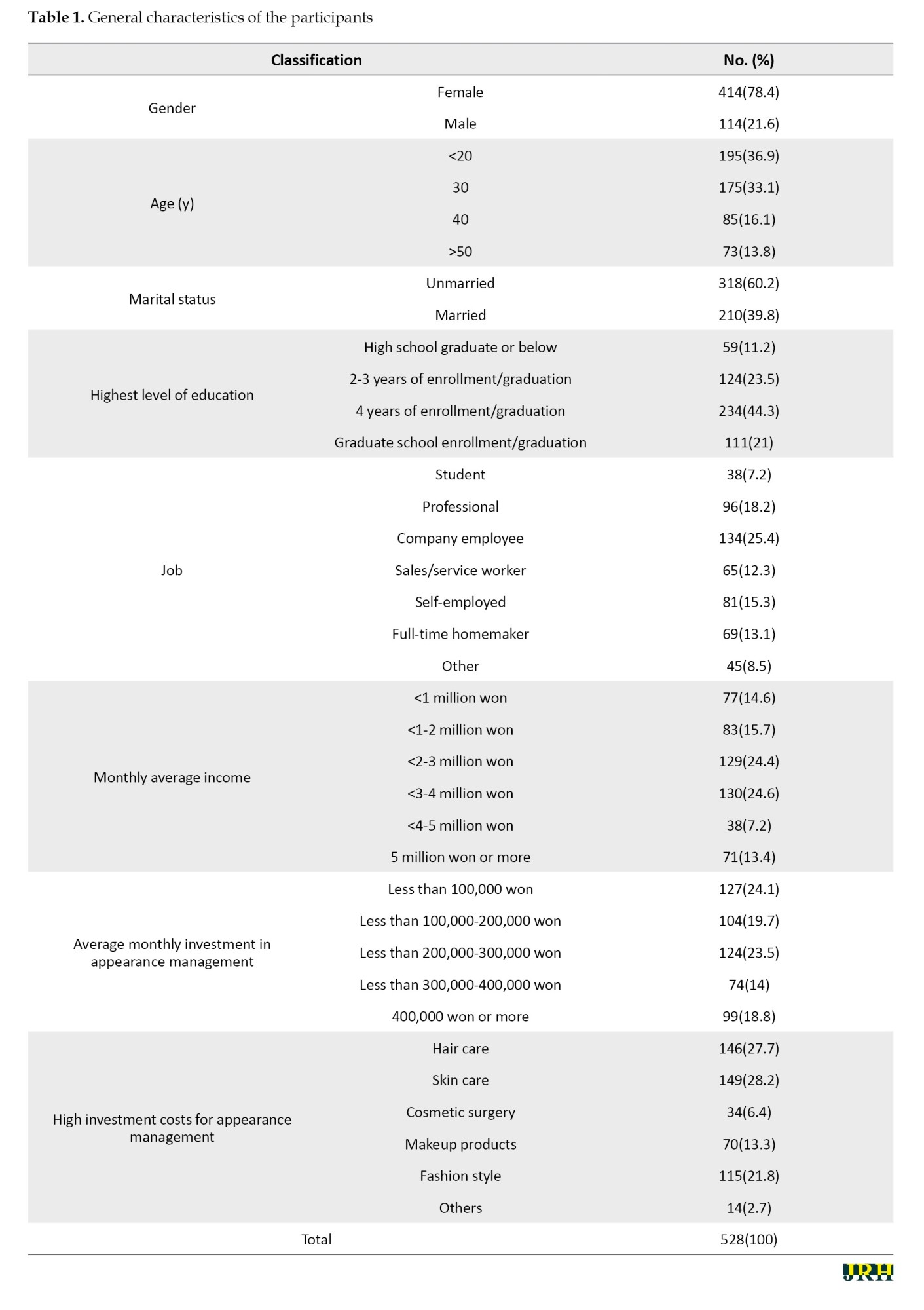
A total of 528 Korean adults aged 18–50 years were included in the analysis, comprising 414 women (78.4%) and 114 men (21.6%). Most participants were in their 20s and 30s, and 60.2% were unmarried. Educational attainment ranged from high school graduation to graduate-level education, with company employees and professionals representing the largest occupational groups. Monthly income was most commonly distributed between 2 and 4 million KRW, and appearance-related expenditures were primarily allocated to skin care, hair care, and fashion styling.
Reliability and validity of measurement instruments
All measurement scales demonstrated acceptable internal consistency, with Cronbach’s α coefficients exceeding the recommended threshold of 0.70. Exploratory factor analysis confirmed construct validity, supporting the appropriateness of the measurement tools for subsequent analyses.
Correlations among major variables
Pearson correlation analysis revealed significant positive associations among all major study variables (Table 2).
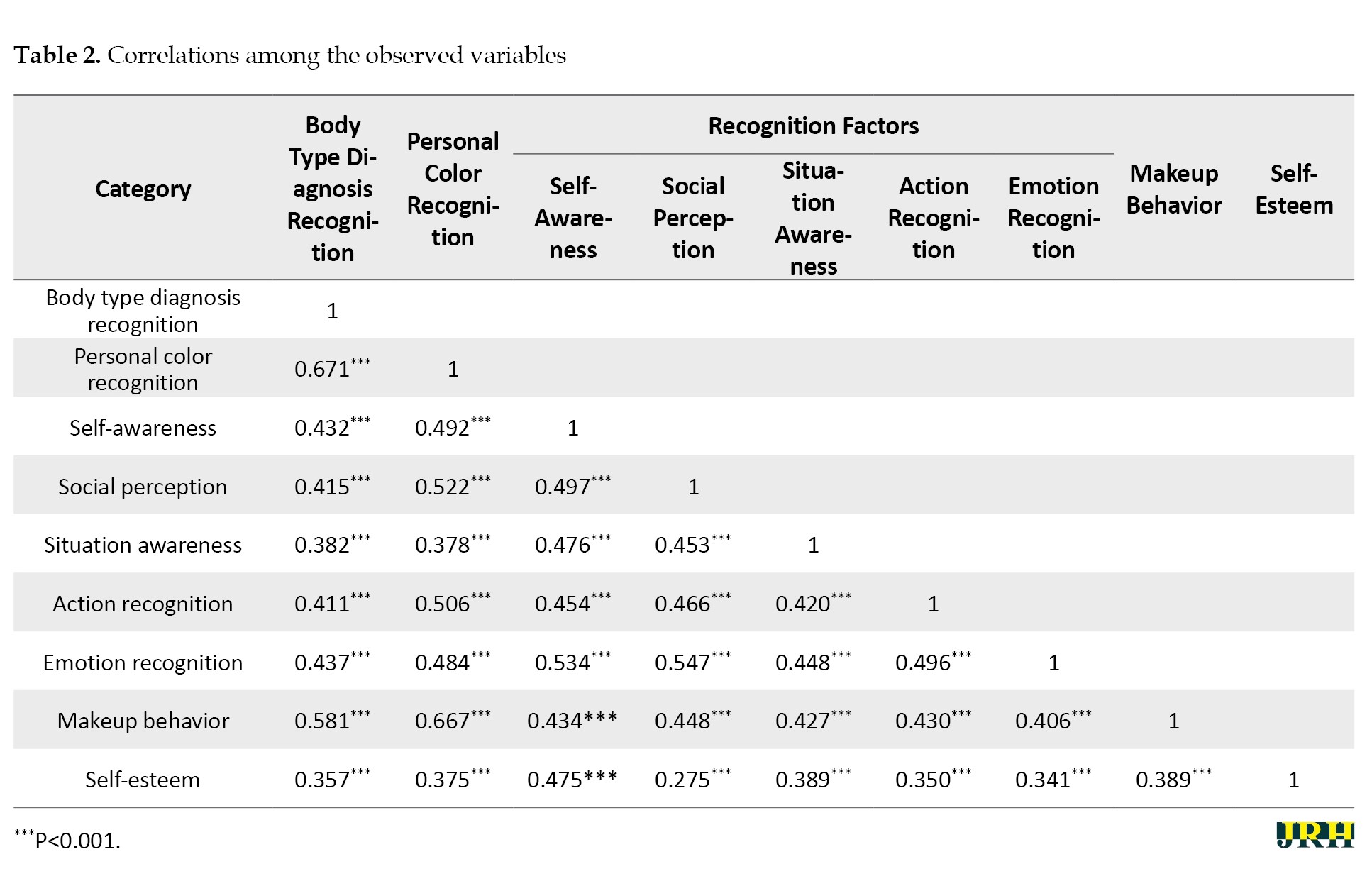
Body shape diagnosis perception and personal color recognition were positively correlated with all perception subdomains, makeup behavior, and self-esteem (P<0.001). In addition, perception subdomains—including self-awareness, social perception, situational awareness, behavioral awareness, and emotional perception—were significantly associated with makeup behavior and self-esteem (P<0.001), indicating coherent relationships among appearance-related awareness, perception, and psychological outcomes. These findings suggest that higher levels of appearance-related awareness are linked to more adaptive perceptual and behavioral responses. However, these relationships should be interpreted as associative rather than causal due to the cross-sectional design.
Effects of body shape diagnosis perception on perception subdomains
Linear regression analysis indicated that body shape diagnosis perception was significantly associated with all perception subdomains (Table 3).
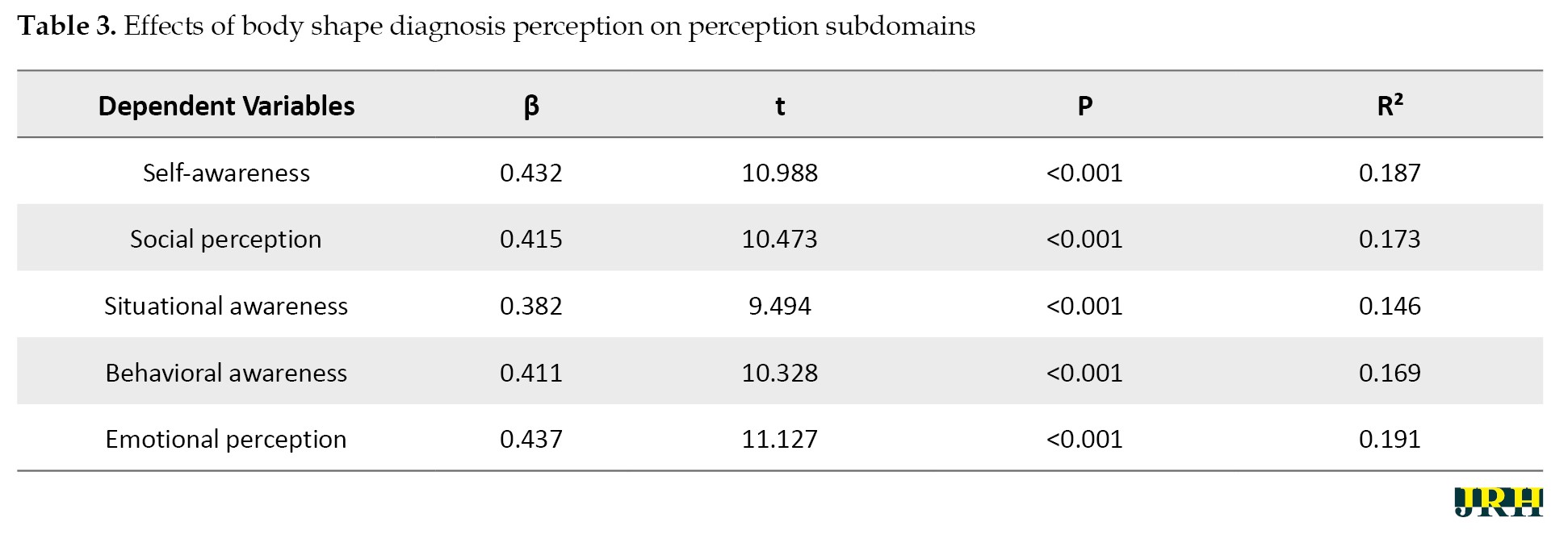
Specifically, body shape diagnosis showed significant positive effects with self-awareness (β=0.432, P<0.001), social perception (β=0.415, P<0.001), situational awareness (β=0.382, P<0.001), behavioral awareness (β=0.411, P<0.001), and emotional perception (β=0.437, P<0.001). Among these, emotional perception exhibited the strongest association, explaining the largest proportion of variance.
All coefficients are standardized (β). All models were significant at P<0.001.
Mediation effects of perception and makeup behavior
Mediation analysis indicated that body shape diagnosis perception and personal color recognition were not directly associated with self-esteem. Instead, their associations with self-esteem were mediated through perception subdomains and makeup behavior (Table 4).
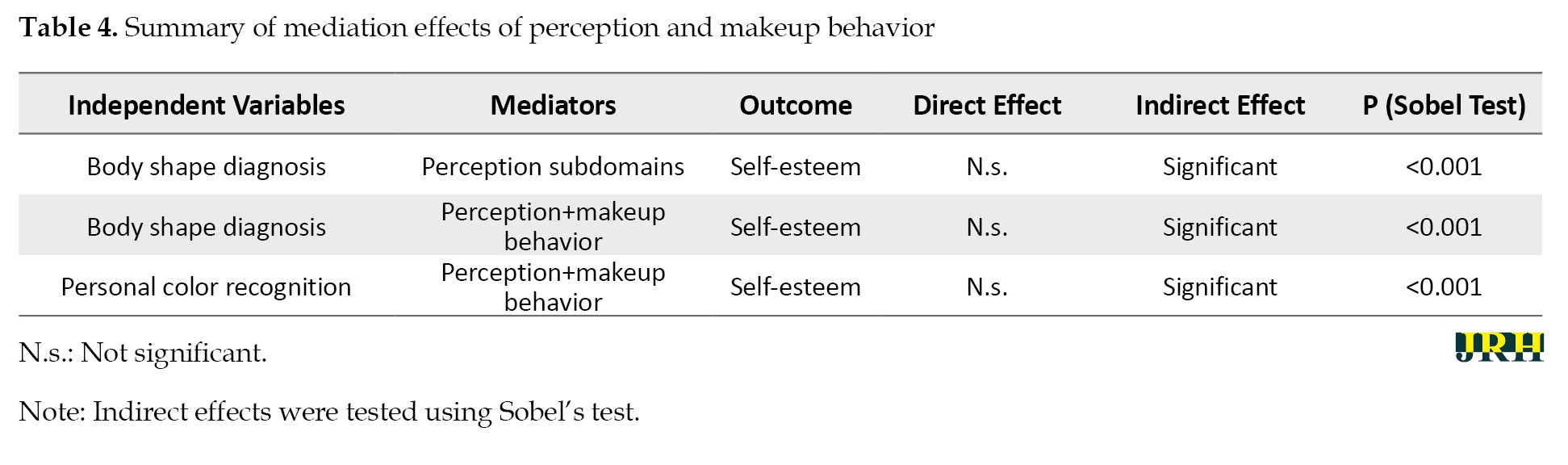
Sobel’s test confirmed that the indirect effects were statistically significant (P<0.001), supporting the mediating role of cognitive perception and appearance-management behavior in the relationship between appearance-related awareness and psychological outcomes. Although the indirect effects were statistically significant, the magnitude of these effects should be interpreted with caution.
Discussion
The findings of this study suggest that body-shape diagnosis and personal-color are indirectly associated with self-esteem through perceptual factors and makeup behavior. Individuals with clearer awareness of their physical characteristics tended to report higher levels of self-perception, social recognition, and behavioral awareness.
These outcomes are consistent with previous research suggesting that accurate and realistic body perception contributes to psychological stability and adaptive functioning [36]. The results further align with sociocultural perspectives showing that appearance-related perceptions are shaped by gender norms, body mass index (BMI), and broader cultural expectations, indicating that body awareness operates within interconnected psychosocial environments [37].
The mediating effects observed for perceptual factors support theoretical explanations grounded in mindfulness-based and cognitive-behavioral frameworks. Prior evidence suggests that strengthening internal awareness enhances emotional regulation, resilience, and self-acceptance [38, 39]. Similarly, structural models have demonstrated that positive body image increases self-efficacy, which reinforces self-esteem [40, 41]. These findings collectively suggest that appearance-related recognition can be understood as a psychosocial health construct in which cognitive interpretation and emotional processing contribute to overall psychological well-being [2, 25, 38].
Makeup behavior also emerged as an important mechanism linking appearance awareness to psychological outcomes. Consistent with earlier research, makeup use was associated with increased confidence, perceived authenticity, and improved social adaptation [10, 39]. Prior studies have additionally noted that makeup serves as a form of identity expression, emotional communication, and social belonging, particularly among younger adults [42, 43]. These outcomes reinforce the notion that appearance-management behaviors may contribute positively to well-being when practiced as intentional self-expression rather than as an external obligation or a basis for comparison [7, 11, 42].
In this context, structured appearance diagnosis and personal color analysis may be adaptive coping strategies that help individuals manage appearance-related pressures and support self-perception.
From a sociocultural health perspective, these findings may be interpreted in light of the Korean appearance environment, which has been described in prior studies as emphasizing both high beauty standards and personal presentation [37, 41]. This interpretation aligns with health-behavior frameworks proposing that reframing appearance practices as self-care may enhance emotional well-being, motivation, and sustainable confidence [10, 38, 43].
Practically, the results suggest that integrating psychological principles into beauty consulting, personal color education, and body-shape coaching may support self-awareness and emotional well-being. Programs that emphasize reflection, competence-building, and autonomy—rather than comparison or perfectionism—may foster healthier psychological adjustment and hold relevance for community health promotion. These insights have potential applications in public health education, school-based self-esteem programs, and adult wellness interventions oriented toward preventive mental health [29, 34, 43].
Several limitations of this study should be considered when interpreting the findings.
First, the cross-sectional design prevents causal inferences regarding the temporal relationships among appearance recognition, perception, behavior, and psychological outcomes.
Second, the sample was restricted to adults aged 18–50 in South Korea, which limits the generalizability of the results to adolescents, older adults, or individuals from different cultural contexts.
Third, the study relied on self-reported measures, which may be influenced by social desirability bias or subjective interpretation of appearance traits.
Finally, the study did not examine additional psychological variables—such as self-compassion, social comparison tendencies, or media exposure—that may interact with appearance awareness.
Conclusion
This study examined how body shape diagnosis and personal color recognition are associated with self-esteem and psychological health through the mediating roles of perceptual factors and makeup behavior. The findings suggest that appearance awareness was not directly associated with psychological outcomes but was indirectly related through cognitive interpretation and behavioral expression. These results suggest that the psychological meaning individuals assign to their physical characteristics may play a more central role in well-being than the characteristics themselves. Appearance-related practices grounded in accurate self-perception may have potential value for supporting confidence, emotional regulation, and identity expression. However, these findings should be interpreted with caution due to the cross-sectional design and the Korean adult sample.
Recommendations
Future research should benefit from longitudinal or experimental designs to clarify causal pathways and examine how perception develops over time. Cross-cultural studies are also recommended to determine whether the mediating roles of perception and makeup behavior operate similarly across diverse sociocultural environments. Incorporating qualitative approaches may provide deeper insight into how individuals internalize and interpret appearance diagnosis. Additionally, integrating variables, such as digital media exposure, body satisfaction trajectories, or emotion-regulation strategies, may broaden the understanding of appearance-based psychological mechanisms. Practically, beauty education and consulting programs should emphasize cognitive clarity, emotional comfort, and autonomy to help individuals use appearance awareness as a constructive tool for psychological well-being rather than a source of pressure.
Ethical Considerations
Compliance with ethical guidelines
All participants signed an informed consent form and could withdraw any time during the study, in accordance with the Declaration of Helsinki. All procedures in studies involving human participants followed the Ethical Standards of Dongguk University and/or the National Research Committee and the 1964 Helsinki Declaration and its later amendments or comparable ethical standards.
Funding
This research did not receive any grant from funding agencies in the public, commercial, or non-profit sectors.
Authors' contributions
Intervention adaptation, data collection, data analysis, and manuscript drafting: Ji Won Jang; Supervision, data interpretation, review and editing: Ki Han Kwon; Conceptualization and study design: All authors.
Conflict of interest
The authors declared no conflict of interest.
Perceptions of physical appearance extend beyond aesthetic preference and are increasingly recognized as determinants of self-esteem and psychosocial health [1–3]. In contemporary society, beauty-related practices, such as makeup application, personal color analysis, and body shape diagnosis, have diversified, functioning not only as forms of self-presentation but also as behaviors that influence psychological well-being and identity development [4–6]. As these practices become integrated into health-related behavioral frameworks, scholars have paid greater attention to their roles in enhancing confidence, emotional stability, and mental well-being [7–9].
Makeup behavior is one of the most common and accessible forms of appearance management. Prior research shows that makeup use enhances confidence, social attractiveness, and perceived competence [4]. Individuals with higher self-esteem tend to view makeup as a psychological resource rather than superficial enhancement [7, 10], and mental health professionals have noted its potential benefits for mood regulation and emotional coping [8, 11, 12]. These findings suggest that appearance-modifying behaviors may function as self-care practices that support emotional regulation and psychosocial health.
Personal color diagnosis has similarly received growing interest as a tool for improving self-perception and identity expression. Studies among Korean adults show that identifying one’s optimal color palette strengthens self-image and increases interpersonal confidence [5, 6, 13]. The four-season color framework—originating from Itten and later refined by Birren and Caygill [14–16]—offers a structured method for linking biological characteristics with psychological perception. Recent evidence further demonstrates that alignment with one’s personal color enhances authenticity, emotional balance, and subjective well-being [17].
Body shape diagnosis and body image perceptions represent another key dimension of appearance-related psychology. Body image is a multidimensional construct incorporating cognitive, emotional, and behavioral elements [2, 18, 19]. Positive body image has been linked to higher self-esteem and improved health-related well-being [19, 20], whereas dissatisfaction is associated with anxiety, depressive symptoms, and disordered eating [21–24]. Life transitions, sociocultural pressures, and biological changes also shape body perception and may contribute to psychological distress and reduced well-being [25–27]. Theoretical perspectives—including cognitive-behavioral models, the tripartite influence model, and social comparison theory—underscore how internal beliefs and external influences jointly shape appearance attitudes and behaviors [17, 28, 29]. Evolutionary viewpoints further frame physical preferences as potential indicators of health or social adaptability [30, 31], while media exposure has intensified unrealistic beauty norms, increasing appearance dissatisfaction across populations [32, 33].
Collectively, prior findings suggest that makeup behavior, personal color recognition, and body shape awareness are interconnected components that influence self-esteem and psychosocial health outcomes [19, 29, 34, 35]. However, most studies have examined these variables independently, and limited research has investigated the mechanisms through which appearance-related awareness may influence psychological health. In particular, the mediating role of self-perception and behavior-based interpretation remains insufficiently explored. In addition, many previous studies relied on cross-sectional designs and focused on individual appearance factors, limiting the ability to explain integrated mechanisms underlying psychological outcomes.
Therefore, this study aimed to examine the relationships among body shape diagnosis, personal color recognition, makeup behavior, and self-esteem, while assessing whether self-perception mediates these associations. It was hypothesized that appearance-related awareness would be positively associated with psychological health and self-esteem, and that self-perception and makeup behavior would mediate these relationships.
Methods
Study design
This study employed a quantitative cross-sectional design to examine the relationships among body shape diagnosis perception, personal color recognition, perception factors, makeup behavior, psychological health, and self-esteem. The research model proposed that appearance-related awareness influences psychological outcomes indirectly through perceptual and behavioral mechanisms. Because the design is cross-sectional, causal relationships cannot be inferred.
Participants
A total of 528 adults aged 18–50 years voluntarily participated in the study.
Participants were recruited using convenience sampling through online distribution and public consumer settings, including department stores, supermarkets, and beauty shops. The sample consisted of 414 women (78.4%) and 114 men (21.6%). Inclusion criteria required that participants be Korean residents within the target age range and able to provide informed consent. Before the survey, all participants received information about the study purpose, anonymity, and voluntary participation. Only individuals who agreed to digital informed consent proceeded. The higher proportion of female participants reflects greater engagement in appearance-related activities and should be considered when interpreting the findings’ generalizability.
Data collection
Data were collected between December 17 and 31, 2024, using an online self-administered questionnaire distributed via Google Forms. Recruitment occurred in public consumer settings—including department stores, supermarkets, and beauty shops—to target individuals with experience or interest in appearance-related activities.
The questionnaire consisted of four components:
1) demographic characteristics, 2) body shape diagnosis perception, 3) personal color recognition, 4) perception subdomains, makeup behavior, and self-esteem.
All variables were measured using structured Likert-type scales, with higher scores indicating stronger levels of perception, behavior, or psychological outcomes. To prevent duplicate submissions, responses were restricted to one per IP address.
Measurement instruments
The questionnaire consisted of five sections: body shape diagnosis perception, personal color recognition, perception factors, makeup behavior, and self-esteem. All items were measured using a five-point Likert scale ranging from 1 (strongly disagree) to 5 (strongly agree), with higher scores indicating higher levels of the corresponding construct.
Body shape diagnosis perception and personal color recognition were assessed using items developed from previous appearance-related perception studies and adapted to this research context.
Perception factors included five subdomains: self-awareness, social perception, situational awareness, behavioral awareness, and emotional perception. These items were designed to assess individuals’ cognitive and emotional awareness of their appearance in personal and social contexts.
Makeup behavior was measured by the frequency, intention, and functional use of makeup as an appearance-management strategy.
Self-esteem was assessed using items adapted from established self-esteem measures to evaluate participants’ overall sense of self-worth and self-acceptance.
Data analysis
Statistical analyses were conducted using IBM SPSS software, version 27.0 (IBM Corp., Armonk, NY, USA).
The analysis procedures were as follows:
1) Descriptive statistics were used to summarize demographic characteristics and appearance-related variables. 2) Exploratory factor analysis (principal component analysis method) was conducted to assess construct validity, and Cronbach’s α coefficients were calculated to evaluate internal consistency of each scale. Factors were extracted based on eigenvalues >1.0 and rotated using varimax rotation to achieve a simpler and more interpretable factor structure. 3) Group differences by demographic characteristics were examined using independent-samples t tests and one-way analysis of variance, with Duncan’s post-hoc test applied where appropriate. 4) Pearson correlation analysis assessed the bivariate associations among all major variables. 5) Hierarchical multiple regression analysis was conducted to examine the predictive effects of body shape diagnosis and personal color recognition on perception factors, makeup behavior, psychological health, and self-esteem. 6) Mediation analysis was performed using a three-step regression approach, and Sobel’s test was used to confirm the significance of indirect effects. Prior to regression analyses, assumptions of normality, multicollinearity, and homoscedasticity were examined and found to be acceptable.
Statistical significance was determined at P<0.05, P<0.01, and P<0.001.
The study adhered to the ethical principles of the Declaration of Helsinki. Because the survey involved minimal risk and collected no identifiable information, formal IRB approval was not required.
Results
Sample characteristics
Table 1 presents the general characteristics of the participants.
A total of 528 Korean adults aged 18–50 years were included in the analysis, comprising 414 women (78.4%) and 114 men (21.6%). Most participants were in their 20s and 30s, and 60.2% were unmarried. Educational attainment ranged from high school graduation to graduate-level education, with company employees and professionals representing the largest occupational groups. Monthly income was most commonly distributed between 2 and 4 million KRW, and appearance-related expenditures were primarily allocated to skin care, hair care, and fashion styling.
Reliability and validity of measurement instruments
All measurement scales demonstrated acceptable internal consistency, with Cronbach’s α coefficients exceeding the recommended threshold of 0.70. Exploratory factor analysis confirmed construct validity, supporting the appropriateness of the measurement tools for subsequent analyses.
Correlations among major variables
Pearson correlation analysis revealed significant positive associations among all major study variables (Table 2).
Body shape diagnosis perception and personal color recognition were positively correlated with all perception subdomains, makeup behavior, and self-esteem (P<0.001). In addition, perception subdomains—including self-awareness, social perception, situational awareness, behavioral awareness, and emotional perception—were significantly associated with makeup behavior and self-esteem (P<0.001), indicating coherent relationships among appearance-related awareness, perception, and psychological outcomes. These findings suggest that higher levels of appearance-related awareness are linked to more adaptive perceptual and behavioral responses. However, these relationships should be interpreted as associative rather than causal due to the cross-sectional design.
Effects of body shape diagnosis perception on perception subdomains
Linear regression analysis indicated that body shape diagnosis perception was significantly associated with all perception subdomains (Table 3).
Specifically, body shape diagnosis showed significant positive effects with self-awareness (β=0.432, P<0.001), social perception (β=0.415, P<0.001), situational awareness (β=0.382, P<0.001), behavioral awareness (β=0.411, P<0.001), and emotional perception (β=0.437, P<0.001). Among these, emotional perception exhibited the strongest association, explaining the largest proportion of variance.
All coefficients are standardized (β). All models were significant at P<0.001.
Mediation effects of perception and makeup behavior
Mediation analysis indicated that body shape diagnosis perception and personal color recognition were not directly associated with self-esteem. Instead, their associations with self-esteem were mediated through perception subdomains and makeup behavior (Table 4).
Sobel’s test confirmed that the indirect effects were statistically significant (P<0.001), supporting the mediating role of cognitive perception and appearance-management behavior in the relationship between appearance-related awareness and psychological outcomes. Although the indirect effects were statistically significant, the magnitude of these effects should be interpreted with caution.
Discussion
The findings of this study suggest that body-shape diagnosis and personal-color are indirectly associated with self-esteem through perceptual factors and makeup behavior. Individuals with clearer awareness of their physical characteristics tended to report higher levels of self-perception, social recognition, and behavioral awareness.
These outcomes are consistent with previous research suggesting that accurate and realistic body perception contributes to psychological stability and adaptive functioning [36]. The results further align with sociocultural perspectives showing that appearance-related perceptions are shaped by gender norms, body mass index (BMI), and broader cultural expectations, indicating that body awareness operates within interconnected psychosocial environments [37].
The mediating effects observed for perceptual factors support theoretical explanations grounded in mindfulness-based and cognitive-behavioral frameworks. Prior evidence suggests that strengthening internal awareness enhances emotional regulation, resilience, and self-acceptance [38, 39]. Similarly, structural models have demonstrated that positive body image increases self-efficacy, which reinforces self-esteem [40, 41]. These findings collectively suggest that appearance-related recognition can be understood as a psychosocial health construct in which cognitive interpretation and emotional processing contribute to overall psychological well-being [2, 25, 38].
Makeup behavior also emerged as an important mechanism linking appearance awareness to psychological outcomes. Consistent with earlier research, makeup use was associated with increased confidence, perceived authenticity, and improved social adaptation [10, 39]. Prior studies have additionally noted that makeup serves as a form of identity expression, emotional communication, and social belonging, particularly among younger adults [42, 43]. These outcomes reinforce the notion that appearance-management behaviors may contribute positively to well-being when practiced as intentional self-expression rather than as an external obligation or a basis for comparison [7, 11, 42].
In this context, structured appearance diagnosis and personal color analysis may be adaptive coping strategies that help individuals manage appearance-related pressures and support self-perception.
From a sociocultural health perspective, these findings may be interpreted in light of the Korean appearance environment, which has been described in prior studies as emphasizing both high beauty standards and personal presentation [37, 41]. This interpretation aligns with health-behavior frameworks proposing that reframing appearance practices as self-care may enhance emotional well-being, motivation, and sustainable confidence [10, 38, 43].
Practically, the results suggest that integrating psychological principles into beauty consulting, personal color education, and body-shape coaching may support self-awareness and emotional well-being. Programs that emphasize reflection, competence-building, and autonomy—rather than comparison or perfectionism—may foster healthier psychological adjustment and hold relevance for community health promotion. These insights have potential applications in public health education, school-based self-esteem programs, and adult wellness interventions oriented toward preventive mental health [29, 34, 43].
Several limitations of this study should be considered when interpreting the findings.
First, the cross-sectional design prevents causal inferences regarding the temporal relationships among appearance recognition, perception, behavior, and psychological outcomes.
Second, the sample was restricted to adults aged 18–50 in South Korea, which limits the generalizability of the results to adolescents, older adults, or individuals from different cultural contexts.
Third, the study relied on self-reported measures, which may be influenced by social desirability bias or subjective interpretation of appearance traits.
Finally, the study did not examine additional psychological variables—such as self-compassion, social comparison tendencies, or media exposure—that may interact with appearance awareness.
Conclusion
This study examined how body shape diagnosis and personal color recognition are associated with self-esteem and psychological health through the mediating roles of perceptual factors and makeup behavior. The findings suggest that appearance awareness was not directly associated with psychological outcomes but was indirectly related through cognitive interpretation and behavioral expression. These results suggest that the psychological meaning individuals assign to their physical characteristics may play a more central role in well-being than the characteristics themselves. Appearance-related practices grounded in accurate self-perception may have potential value for supporting confidence, emotional regulation, and identity expression. However, these findings should be interpreted with caution due to the cross-sectional design and the Korean adult sample.
Recommendations
Future research should benefit from longitudinal or experimental designs to clarify causal pathways and examine how perception develops over time. Cross-cultural studies are also recommended to determine whether the mediating roles of perception and makeup behavior operate similarly across diverse sociocultural environments. Incorporating qualitative approaches may provide deeper insight into how individuals internalize and interpret appearance diagnosis. Additionally, integrating variables, such as digital media exposure, body satisfaction trajectories, or emotion-regulation strategies, may broaden the understanding of appearance-based psychological mechanisms. Practically, beauty education and consulting programs should emphasize cognitive clarity, emotional comfort, and autonomy to help individuals use appearance awareness as a constructive tool for psychological well-being rather than a source of pressure.
Ethical Considerations
Compliance with ethical guidelines
All participants signed an informed consent form and could withdraw any time during the study, in accordance with the Declaration of Helsinki. All procedures in studies involving human participants followed the Ethical Standards of Dongguk University and/or the National Research Committee and the 1964 Helsinki Declaration and its later amendments or comparable ethical standards.
Funding
This research did not receive any grant from funding agencies in the public, commercial, or non-profit sectors.
Authors' contributions
Intervention adaptation, data collection, data analysis, and manuscript drafting: Ji Won Jang; Supervision, data interpretation, review and editing: Ki Han Kwon; Conceptualization and study design: All authors.
Conflict of interest
The authors declared no conflict of interest.
References
- Aggarwal R, Ranjan R, Chandola R. Effect of body image on self-esteem: A systematic literature review and future implication. European Chemical Bulletin. 2023; 12(Special Issue 4):6087-95. [Link]
- Freud S. The ego and the id. In: Strachey J, editor. The standard edition of the complete psychological works of Sigmund Freud. London: Hogarth Press; 1923. [Link]
- Slade PD. What is body image? Behaviour Research and Therapy. 1994; 32(5):497-502. [DOI:10.1016/0005-7967(94)90136-8] [PMID]
- Ma Y. The influence of makeup on individual self-identity: An exploratory study. Paper presented at: Proceedings of The Kyoto Conference on Arts, Media & Culture. 2024. December 27; Kyoto, Japan. [Link]
- Seo HK. The effect of personal color diagnosis on the self-esteem of women in their 20s. Journal of the Korean Society of Cosmetology. 2024; 30(2):279-92. [DOI:10.52660/JKSC.2024.30.2.279]
- Jackson C. Color me beautiful. New York: Simon & Schuster; 1980. [Link]
- Mafra AL, Silva CSA, Varella MAC, Valentova JV. The contrasting effects of body image and self-esteem in makeup usage. Plos One. 2022; 17(3):e0265197. [DOI:10.1371/journal.pone.0265197] [PMID] [PMCID]
- Nazish N. 7 ways your makeup routine is actually helpful for depression [Internet]. 2025 [Updated 2026 June 15]. Available from: [Link]
- Merino M. Body perceptions and psychological well-being: A review of current evidence. Healthcare. 2024; 12(4):493. [DOI:10.3390/healthcare12040493] [PMID] [PMCID]
- Silverio CJ. Makeup’s effects on self-perception [master thesis]. Norfolk: Old Dominion University. 20100. [Link]
- Virakul S. Makeup: A genderless form of artistic expression explored by content creators and their followers. Journal of Student Research. 2022; 11(3):1-6. [DOI:10.47611/jsr.v11i3.1707]
- Thompson CJ, Hirschman EC. Understanding the socialized body: A poststructuralist analysis of consumers' self-conceptions, body images, and self-care practices. Journal of Consumer Research. 1995; 22(2):139-53. [DOI:10.1086/209441]
- Wang L, Lee JH. The impact of K-beauty social media influencers, sponsorship, and product exposure on consumer acceptance of new products. Fashion and Textiles. 2021; 8(1):15. [DOI:10.1186/s40691-020-00239-0]
- Birren F. Color psychology and color therapy: A factual study of the influence of color on human life. New York: McGraw-Hill; 1961. [Link]
- Caygill S. Color: The essence of you. Covelo: Celestial Arts; 1980. [Link]
- Pooser D. Always in style with color me beautiful: Your shape, your style. Washington: Acropolis Books; 1985. [Link]
- Cash TF. Cognitive-behavioral perspectives on body image. In: Cash TF, Pruzinsky T, editors. Body image: A handbook of theory, research, and clinical practice. New York: Guilford Press; 2002. [Link]
- Grogan S. Body Image. 3rd ed. London: Routledge; 2016. [DOI:10.4324/9781315681528]
- Grogan S. Body Image. 4th ed. London: Routledge; 2021. [DOI:10.4324/9781003100041]
- Mallaram GK, Sharma P, Kattula D, Singh S, Pavuluru P. Body image perception, eating disorder behavior, self-esteem and quality of life: A cross-sectional study among female medical students. Journal of Eating Disorders. 2023; 11(1):225. [DOI:10.1186/s40337-023-00945-2] [PMID] [PMCID]
- Cash TF, Pruzinsky T. Body images: Development, deviance, and change. New York: Guilford Press; 2002. [Link]
- Tiggemann M. Body image across the adult life span: Stability and change. Body Image. 2004; 1(1):29-41. [DOI:10.1016/S1740-1445(03)00002-0] [PMID]
- Schilder P. The Image and Appearance of the Human Body. Reprint ed. London: Routledge; 1999. [Link]
- Hockey A, Milojev P, Sibley CG, Donovan CL, Barlow FK. Body image across the adult lifespan: A longitudinal investigation of developmental and cohort effects. Body Image. 2021; 39:114-24. [DOI:10.1016/j.bodyim.2021.06.007] [PMID]
- McDonald S, Fardouly J, Herring J, Patterson J. The role of body image on psychosocial outcomes in individuals with physical health conditions. Frontiers in Psychology. 2021; 11:614369. [DOI:10.3389/fpsyg.2020.614369] [PMID] [PMCID]
- Rifkin WJ, Kantar RS, Ali-Khan S, Darcy CM, Diaz-Siso JR, Rohde CH. Facial disfigurement and identity: A review. AMA Journal of Ethics. 2018; 20(4):350-60. [DOI:10.1001/journalofethics.2018.20.4.peer1-1804] [PMID]
- Merino M. Body perceptions and psychological well-being: A review. Healthcare. 2024; 12(14):1396. [DOI:10.3390/healthcare12141396] [PMID] [PMCID]
- Festinger L. A theory of social comparison processes. Human Relations. 1954; 7(2):117-40. [DOI:10.1177/001872675400700202]
- Lee Rodgers J, Nicewander WA. Thirteen ways to look at the correlation coefficient. The American Statistician. 1988; 42(1):59-66. [DOI:10.1080/00031305.1988.10475524]
- Buss DM. Sex differences in human mate preferences: Evolutionary hypotheses tested in 37 cultures. Behavioral and Brain Sciences. 1989; 12(1):1-4. [DOI:10.1017/S0140525X00023992]
- Swami V, Taylor M, Jonas K, Olson JA, Furnham A. Willingness to undergo cosmetic surgery: A cross-cultural investigation. Body Image. 2008; 5(3):189-98. [DOI:10.1016/j.bodyim.2008.05.002]
- Jung J, Forbes GB. Body dissatisfaction and disordered eating among college women in China, South Korea, and the United States: Contrasting predictions from sociocultural and feminist theories. Psychology of Women Quarterly. 2007; 31(4):381-93. [DOI:10.1111/j.1471-6402.2007.00387.x]
- Graham JA, Jouhar AJ. The importance of cosmetics in the psychology of appearance. International Journal of Dermatology. 1983; 22(3):153–156. [DOI:10.1111/j.1365-4362.1983.tb03353.x] [PMID]
- Tiggemann M, Slater A. NetGirls: The Internet, Facebook, and body image concern in adolescent girls. International Journal of Eating Disorders. 2014; 47(6):630-43. [DOI:10.1002/eat.22141] [PMID]
- Cash TF. Body image: Past, present, and future. Body Image. 2004; 1(1):1-5. [DOI:10.1016/S1740-1445(03)00011-1] [PMID]
- Hamurcu P. Impact of perceived body weight on depression, anxiety and stress levels among young adults in Turkey. Iranian Journal of Public Health. 2023; 52(5):233-240. [DOI:10.18502/ijph.v52i3.12143] [PMID] [PMCID]
- Zakaria N, Elghazouani F, Chakor K, Elmouden A. Body dissatisfaction and associated factors: A study of Moroccan adolescents. Iranian Journal of Public Health. 2021; 50(6):1278-87. [DOI:10.18502/ijph.v50i2.5367] [PMID] [PMCID]
- Lim M, Son C. [Effects of mindfulness-based cognitive therapy (MBCT) on body image satisfaction, anxiety, and self-esteem in university students with negative body image (Korean)]. Korean Journal of Health Psychology. 2012; 17(4):823-40. [LINK]
- Ali N, Ramnani V, Desai OP. To study the correlation between body image and self-esteem in adolescents and young adults. Indian Journal of Physiotherapy and Occupational Therapy. 2022; 16(3):54-60. [DOI:10.37506/ijpot.v16i3.18397]
- Aggarwal R, Ranjan D, Chandola R. Effect of body image on self esteem: A systematic literature review and future implication. European Chemical Bulletin. 2023; 12(4):6087-95.[Link]
- Yiyi O, Xue X, Jiong L, Yanhui Z. Research on the influence of body image on college students’ weight-loss intention: Chained intermediary analysis of self-efficacy and self-esteem. Frontiers in Psychology. 2024; 15:1458259.[DOI:10.3389/fpsyg.2024.1458259] [PMID] [PMCID]
- Smith RK, Van Dellen MR, Ton LAN. Makeup as self-expression: Framing beauty work as creative expression enhances perceived authenticity. Journal of Consumer Psychology. 2020; 30(4):676-94. [DOI:10.1093/jcr/ucaa066]
- Branden N. The six pillars of self-esteem. New York: Bantam Books; 1994. [Link]
Type of Study: Orginal Article |
Subject:
● Psychosocial Health
Received: 2025/12/13 | Accepted: 2026/02/25 | Published: 2026/08/23
Received: 2025/12/13 | Accepted: 2026/02/25 | Published: 2026/08/23
| Rights and permissions | |
 |
This work is licensed under a Creative Commons Attribution-NonCommercial 4.0 International License. |


This is an open access article distributed under the terms of the Creative Commons Attribution License (CC-By-NC), which permits use, distribution, and reproduction in any medium, provided the original work is properly cited and is not used for commercial purposes.
Contact Information
